
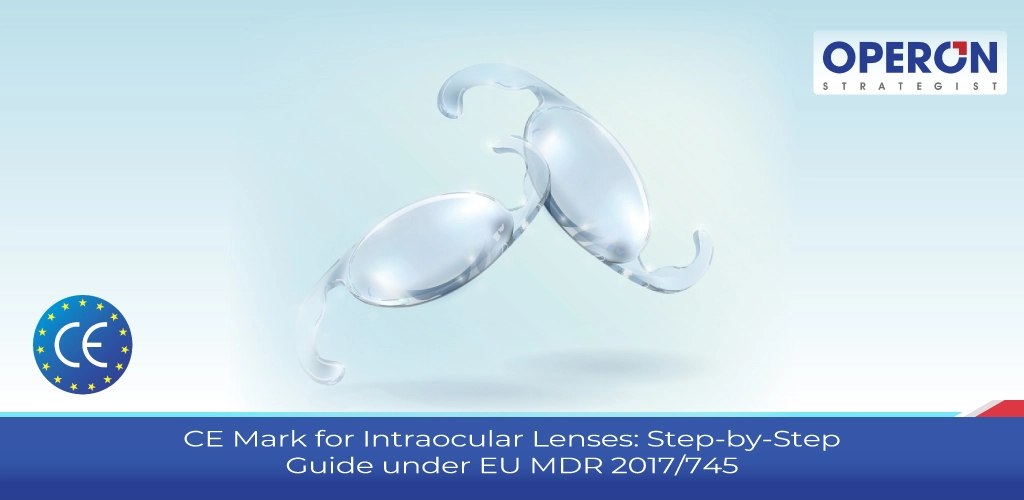
CE Mark for Intraocular Lenses: Step-by-Step Guide under EU MDR 2017/745
Intraocular Lenses (IOLs) are one of the most widely used implantable ophthalmic devices designed to replace the natural lens of the eye, typically after cataract surgery. To market these devices in the European Union — including Germany, a major hub for ophthalmic innovations — manufacturers must obtain the CE Mark for Intraocular Lenses in compliance with EU MDR 2017/745.
The CE Mark demonstrates that the IOL meets stringent safety, performance, and quality requirements as per the European Medical Device Regulation (MDR). This guide explains the step-by-step CE marking process for IOLs, documentation needs, regulatory pathways, and how expert consultants like Operon Strategist can help streamline compliance for German and EU manufacturers.
Let's Grow Your Business Together
What Is a CE Mark for Intraocular Lenses (IOL)?
A CE Mark (Conformité Européenne) for an Intraocular Lens (IOL) is a mandatory regulatory certification showing that the lens complies with the safety, performance, and quality standards of the European Union Medical Device Regulation (EU MDR 2017/745).
Because IOLs are surgically implanted inside the eye to replace the natural lens (usually during cataract surgery or for vision correction), they are subject to highly rigorous regulatory pathways. Without a CE Mark, an IOL cannot be legally sold or distributed anywhere in the European Union (EU) or European Economic Area (EEA).
Step-by-Step Process to Obtain CE Mark for Intraocular Lenses
1. Determine Device Classification
Under MDR 2017/745, Intraocular Lenses are classified as Class III implantable devices, requiring a comprehensive conformity assessment. This step determines the applicable route for CE marking and sets the foundation for all subsequent processes.
2. Implement a Quality Management System (QMS)
Manufacturers must establish a QMS compliant with ISO 13485. This system ensures consistent product design, manufacturing, and control processes. In Germany, regulatory bodies and notified bodies prioritize robust QMS implementation before any technical review begins.
3. Conduct Clinical Evaluation and Performance Studies
Clinical evaluation for IOLs must comply with Annex XIV of MDR 2017/745. Manufacturers need to provide data on biocompatibility, optical performance, mechanical stability, and postoperative outcomes. When existing data is insufficient, clinical investigations must be conducted in line with ISO 14155 standards.
4. Prepare Technical Documentation
The technical documentation (as per Annex II and III of MDR) must include:
- Device description and specifications
- Design and manufacturing information
- Risk management file (as per ISO 14971)
- Verification and validation data
- Clinical evaluation report (CER)
- Post-market surveillance (PMS) plan
Comprehensive and well-structured documentation is key for notified body assessment and CE certification approval.
5. Engage a Notified Body
For Class III IOLs, manufacturers must work with a designated Notified Body authorized under MDR 2017/745. The Notified Body will audit the manufacturer’s QMS and evaluate the technical documentation, clinical data, and product safety performance before issuing the CE certificate.
6. Compile the EU Declaration of Conformity
Once compliance is verified, the manufacturer prepares the EU Declaration of Conformity (DoC). This legal document declares that the product meets all applicable requirements of MDR 2017/745.
7. Affix the CE Marking
After receiving the CE certificate and completing the DoC, the manufacturer may affix the CE Mark to the device and packaging. This step officially authorizes the IOL for sale in Germany and other EU countries.
Regulatory Considerations for IOL Manufacturers in Germany
Germany’s Federal Institute for Drugs and Medical Devices (BfArM) oversees the market surveillance of medical devices. Manufacturers and authorized representatives in Germany must ensure:
- Compliance with German Medical Device Implementation Act (MPDG)
- Timely registration in EUDAMED database
- Proper vigilance reporting for incidents and field safety corrective actions
Having a German Authorized Representative (EC REP) is essential for non-EU manufacturers to maintain compliance within Germany.
Key MDR Requirements for IOLs
- Material Biocompatibility: IOL materials (e.g., hydrophobic acrylic, silicone, PMMA) must pass cytotoxicity and sensitization tests.
- Optical Performance: Verification of power accuracy, resolution, and stability over time.
- Sterilization Validation: Compliance with ISO 11135 or ISO 17665 for ethylene oxide or steam sterilization.
- Labeling and UDI: MDR-compliant labeling with Unique Device Identification (UDI) for traceability.
- Post-Market Surveillance: Continuous monitoring and reporting of adverse events through PMS and PMCF (Post-Market Clinical Follow-up).
Role of Operon Strategist in CE Marking for IOLs
At Operon Strategist, we provide comprehensive consulting services to help manufacturers and innovators in Germany achieve CE Mark for Intraocular Lenses efficiently. Our experts support you through:
- Device classification and MDR gap analysis
- Technical documentation and CER preparation
- QMS implementation (ISO 13485)
- Clinical investigation guidance
- Notified Body coordination and submission support
- Post-market compliance and vigilance setup
With over a decade of experience in medical device regulatory consulting, we ensure a seamless and compliant pathway to market approval for ophthalmic and implantable devices.
FAQ
What is the device classification for Intraocular Lenses (IOLs) under EU MDR 2017/745?
Under the EU MDR, Intraocular Lenses are classified as Class III implantable devices due to the high-risk nature of permanent ocular implantation. This classification requires the highest level of regulatory scrutiny, including a full Quality Management System (QMS) audit and a detailed review of technical and clinical documentation by a Notified Body.
Can IOL manufacturers use equivalent clinical data to bypass clinical investigations?
Under EU MDR, rules for demonstrating clinical equivalence are much stricter than under the old MDD. If a manufacturer cannot prove absolute technical, biological, and clinical equivalence to a legally marketed predicate device, they must conduct dedicated clinical investigations in accordance with ISO 14155 standards to generate raw clinical data.
What specific material and optical tests are required for an IOL CE Mark?
Manufacturers must provide rigorous verification and validation data covering material biocompatibility (such as cytotoxicity and sensitization tests under ISO 10993), optical power accuracy, light resolution, mechanical stability, and validated sterilization processes (like ethylene oxide or steam).
What extra steps must non-EU IOL manufacturers take to sell in Germany?
Non-EU manufacturers must appoint a European Authorized Representative (EC REP), often based in Germany, to act as the primary liaison with local authorities like the Federal Institute for Drugs and Medical Devices (BfArM). They must also ensure proper registration in the EUDAMED database and adhere to the German Medical Device Implementation Act (MPDG).