
IV Cannula Manufacturing: Step-by-Step Process, Validation & Regulatory Requirements
Introduction
IV cannulas are critical single-use medical devices used for vascular access in hospitals, emergency care, and infusion therapies. Despite being high-volume consumables, their manufacturing requires tight control over dimensions, needle performance, material behavior, and sterilization outcomes.
With rising global healthcare demand and increasing focus on patient safety, IV cannula manufacturing offers a scalable and high-growth opportunity. However, success depends on process capability, validation strategy, and regulatory compliance from the outset.
What is IV Cannula Manufacturing?
IV cannula manufacturing involves the design, production, assembly, sterilization, and testing of devices used to deliver fluids and medications directly into the bloodstream.
It integrates precision metal components (needle), polymer extrusion (catheter), molded parts, and sterile packaging, ensuring consistent clinical performance and patient safety.
Why is IV Cannula Manufacturing a High-Growth Opportunity?
The demand for IV cannulas is driven by:
- Increasing hospital admissions and surgical procedures
- Growth in emergency and critical care treatments
- Expansion of healthcare infrastructure globally
- Rising adoption of safety-engineered devices
Industry Insight:
The market is rapidly shifting toward safety IV cannulas and closed systems, driven by infection control protocols and needlestick injury prevention regulations.
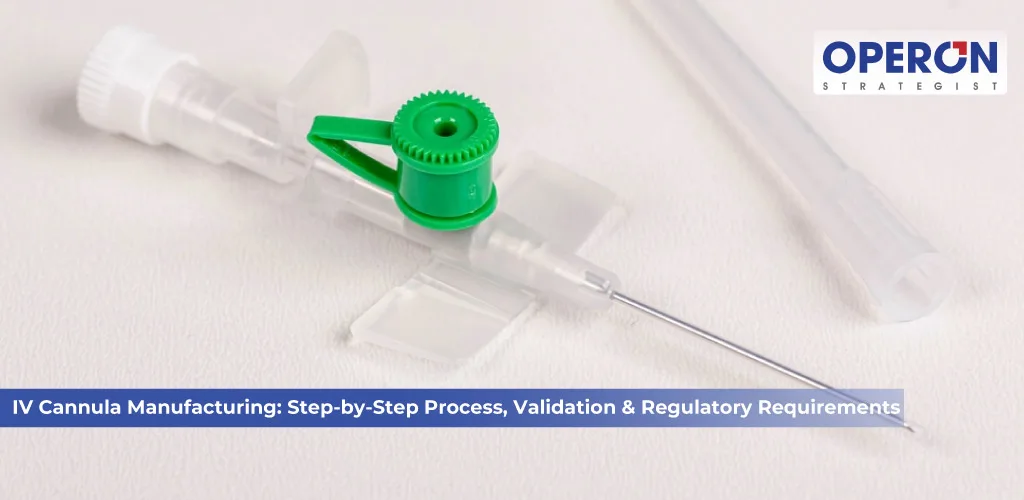
What are the Key Components of an IV Cannula?
- Introducer Needle (Stylet): Stainless steel with multi-facet bevel geometry
- Catheter Tube: Flexible polymer (FEP, PTFE, or polyurethane)
- Hub: Transparent chamber for blood flashback visualization
- Wings: Provide stability during insertion
- Injection Port (Optional): Enables intermittent drug delivery
Insight:
Device performance depends on the interaction between needle sharpness, catheter flexibility, and bonding strength.
What are the Different Types of IV Cannulas?
- Standard IV Cannulas – Basic open systems
- Safety IV Cannulas – Integrated needle shielding mechanisms
- Closed IV Catheter Systems – Reduce blood exposure and contamination
Gauge Sizes and Applications
- 14G–16G: Trauma care and rapid transfusion
- 18G–20G: General infusion and surgery
- 22G–24G: Pediatric and geriatric use
What is the Step-by-Step IV Cannula Manufacturing Process?
- Raw Material Qualification
- Medical-grade polymers compliant with ISO 10993 and USP Class VI
- Stainless steel with controlled mechanical and corrosion properties
- Incoming quality checks for consistency and purity
- Needle Manufacturing
- Tube cutting and multi-angle bevel grinding
- Electropolishing for ultra-smooth surface
- Controlled siliconization coating to reduce friction
Critical Insight:
Non-uniform siliconization increases penetration force and impacts patient comfort.
- Catheter Extrusion
- High-precision extrusion with real-time laser monitoring
- Tight dimensional tolerance (±0.02–0.05 mm)
Process Sensitivity:
Temperature variation and line speed directly affect wall thickness, flexibility, and consistency.
- InjectionMoldingof Components
- Manufacturing of hubs, caps, and ports
- Control of transparency, shrinkage, and dimensional stability
- Assembly Process
- Needle insertion into catheter
- Hub bonding (adhesive or solvent bonding)
- Integration of wings and safety features
Critical Control:
Misalignment or weak bonding can result in leakage or device failure.
- Cleaning and Sterilization
Sterilization Methods:
- Ethylene Oxide (EtO)
- Gamma Radiation
Validation Requirements:
- ISO 11135 compliance
- Sterility Assurance Level (SAL) of 10⁻⁶
- Residual limits as per ISO 10993-7
- Packaging andLabeling
- Sterile barrier packaging (blister or form-fill-seal)
- Seal strength and integrity validation
- UDI labeling and batch traceability
What are the Critical Quality Attributes (CQAs) in IV Cannula Manufacturing?
- Needle sharpness and penetration force
- Catheter dimensional accuracy
- Hub-catheter bond strength
- Flow rate consistency
- Sterility assurance
Insight:
CQAs must be defined early and directly linked to process validation and regulatory submissions.
What Testing and Validation are Required?
Mechanical and Functional Testing
- Leak and pressure testing
- Flow rate verification
- Tensile strength and bond integrity
Needle Performance
- Penetration force testing
- Tip geometry inspection
Biocompatibility
- ISO 10993 testing (cytotoxicity, irritation, sensitization)
Sterilization Validation
- Biological indicators
- Residual gas analysis
Stability Studies
- Shelf-life validation
- Packaging integrity testing
How Does Manufacturing Impact Clinical Performance?
- Sharp needle tip → Reduced insertion pain and tissue trauma
- Flexible catheter → Better vein compatibility and longer dwell time
- Consistent flow rate → Accurate and effective therapy delivery
- Validated sterility → Lower infection risk
Insight:
Clinical outcomes are a direct reflection of manufacturing precision and process control.
How is Risk Managed in IV Cannula Manufacturing?
Risk | Control Measure |
Needlestick injury | Safety cannula design |
Leakage | Bond strength validation |
Infection | Sterilization and packaging |
Catheter failure | Material and extrusion control |
What are the Regulatory Requirements for IV Cannula Manufacturing?
Device Classification
Typically classified as Class II medical devices
Key Regulatory Pathways
- India (CDSCO): MD-5 / MD-9 license under MDR 2017
- USA (FDA): 510(k) clearance, 21 CFR Part 820
- Europe (EU MDR): CE Marking with clinical evaluation
Applicable Standards
- ISO 14971 – Risk Management
- ISO 10993 – Biocompatibility
- ISO 11135 – EtO Sterilization
- ISO 8536 – Infusion devices
What Infrastructure is Required for IV Cannula Manufacturing?
- ISO Class 7 or 8 cleanroom environments
- HVAC systems with HEPA filtration
- Segregated production zones
- Qualified equipment (IQ, OQ, PQ)
What are the Common Challenges in IV Cannula Manufacturing?
- Maintaining extrusion consistency
- Needle coating and quality variability
- Sterilization validation delays
- Regulatory documentation gaps
- Scaling from pilot to mass production
Expert Insight:
Most project delays occur during sterilization validation and incomplete regulatory documentation, not basic manufacturing setup.
What are the Key Cost Drivers and Timeline?
Typical Timeline
- Facility setup: 4–8 months
- Validation and approvals: 6–12 months
Key Cost Drivers
- Automation level in assembly
- Sterilization validation
- Testing and regulatory submissions
How Can Operon Strategist Support IV Cannula Manufacturing?
Operon Strategist provides end-to-end execution support:
Value Proposition:
An integrated approach enables faster approvals, reduced risk, and optimized investment outcomes.
Planning to Start IV Cannula Manufacturing?
A successful IV cannula manufacturing project requires a well-integrated strategy covering design, process engineering, validation, and compliance.
Operon Strategist supports manufacturers from concept to commercialization, ensuring efficient execution and global regulatory alignment.
Contact Operon Strategist to start your IV cannula manufacturing project with confidence.
Frequently Asked Questions (FAQs)
Do IV cannulas require regulatory approval?
Yes, approvals such as CDSCO licensing, FDA 510(k), and CE Marking are required along with ISO 13485 compliance.
How long does it take to start manufacturing?
Typically 6–18 months depending on infrastructure and regulatory readiness.
What is the biggest challenge in IV cannula manufacturing?
Maintaining consistent product quality while meeting sterilization and regulatory requirements.