Overview of SFDA VS EU MDR
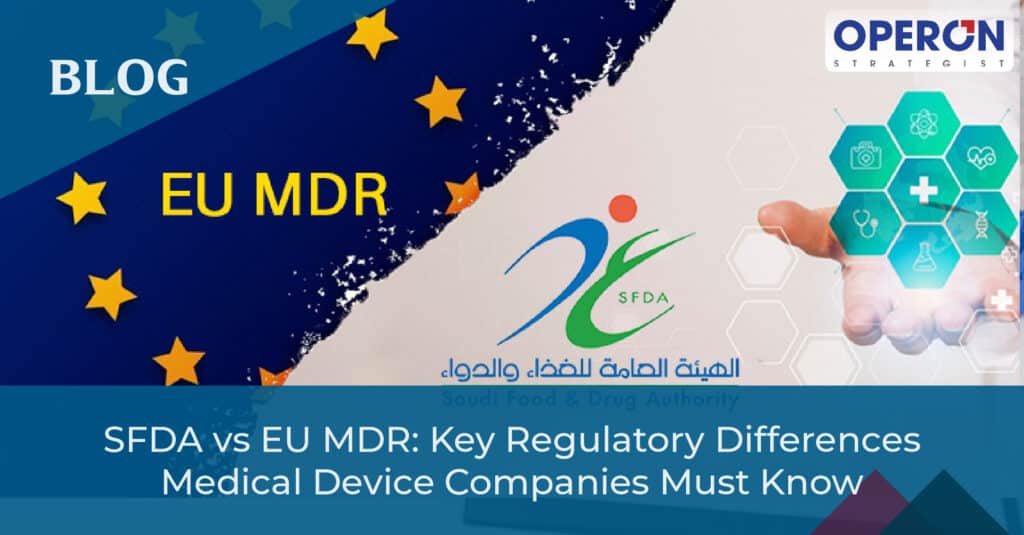
Expanding into global markets requires a clear understanding of regional regulatory frameworks. For medical device manufacturers targeting both Europe and Saudi Arabia, understanding the differences between the Saudi Food and Drug Authority (SFDA) and the European Union Medical Device Regulation (EU MDR) is essential.
This blog highlights the SFDA vs EU MDR regulatory differences that companies must know to ensure compliance and avoid delays in market entry.
- SFDA (Saudi Arabia): Governs medical device regulation in Saudi Arabia, focusing on registration, licensing, and post-market compliance.
- EU MDR (Europe): A comprehensive regulatory framework that replaced the Medical Device Directive (MDD), with stricter clinical and post-market requirements across EU member states.
Looking For a Medical Device Regulatory Consultant?
SFDA vs EU MDR: Key Regulatory Differences Medical Device Companies Must Know
1. Regulatory Framework Approach
- SFDA: Relies on a recognition-based approach, often considering prior approvals (e.g., CE marking, FDA approval).
- EU MDR: Operates under a standalone, stringent framework requiring full conformity assessment within the EU system.
2. Device Classification System
- SFDA: Classification is broadly aligned with international frameworks but may vary based on local interpretation.
- EU MDR: Has a detailed and strict classification system with specific rules for software, implants, and reusable devices.
3. Clinical Evaluation Requirements
- SFDA: May accept clinical data supported by prior approvals or international references.
- EU MDR: Requires extensive clinical evaluation, clinical investigations, and continuous updates.
4. Approval Pathway
- SFDA: Medical Device Marketing Authorization (MDMA) process with centralized submission.
- EU MDR: Requires involvement of Notified Bodies for conformity assessment before CE marking.
5. Quality Management System (QMS)
- SFDA: Requires compliance with ISO 13485, often supported by existing certifications.
- EU MDR: Enforces stricter QMS integration with lifecycle management, traceability, and PMS systems.
6. Labeling and Language Requirements
- SFDA: Requires Arabic labeling elements along with English.
- EU MDR: Requires labeling in official languages of each EU member state where the device is marketed.
7. Post-Market Surveillance (PMS)
- SFDA: Focuses on vigilance reporting and compliance monitoring.
- EU MDR: Introduces enhanced PMS requirements, including PSUR, trend reporting, and periodic updates.
8. Authorized Representative Requirement
- SFDA: Mandatory appointment of a Saudi Authorized Representative for foreign manufacturers.
- EU MDR: Requires an EU Authorized Representative for non-EU manufacturers.
9. Timeline and Complexity
- SFDA: Typically faster if prior approvals exist.
- EU MDR: More time-consuming due to rigorous clinical and conformity assessment requirements.
Why Understanding SFDA vs EU MDR Differences Matters
For manufacturers planning dual-market entry, misunderstanding these frameworks can lead to:
- Delayed approvals
- Increased regulatory costs
- Product launch setbacks
- Compliance risks
A strategic regulatory approach ensures smoother approvals across both regions.
Planning to enter both Saudi Arabia and European markets?
Role of Operon Strategist in Global Regulatory Compliance
Operon Strategist supports medical device companies in navigating both SFDA and EU MDR regulatory frameworks with a structured and compliance-driven approach.
Our expertise includes:
- Regulatory pathway comparison and strategy development
- Device classification and gap analysis
- Technical documentation alignment for multiple markets
- ISO 13485 and QMS readiness support
- SFDA and EU MDR submission coordination
- Labeling and IFU compliance review
- Post-market surveillance and lifecycle support
With Operon Strategist, manufacturers can ensure regulatory consistency, reduced risks, and faster market access across Saudi Arabia and Europe.
FAQs
What is the main difference between SFDA and EU MDR?
SFDA often follows a recognition-based approach, while EU MDR requires a more stringent, independent conformity assessment process.
Does CE marking guarantee SFDA approval?
No. CE marking may support the application, but SFDA registration is still mandatory.
Which regulation is more stringent: SFDA or EU MDR?
EU MDR is generally considered more stringent due to its detailed clinical and post-market requirements.
Is ISO 13485 required for both SFDA and EU MDR?
Yes. Both frameworks expect a compliant Quality Management System aligned with ISO 13485.