
Senior Sales Executive | 3 Years of Experience
Vyankatesh Dhavale holds a Bachelor of Pharmacy (B.Pharm) and an MBA specializing in Operations and Supply Chain Management
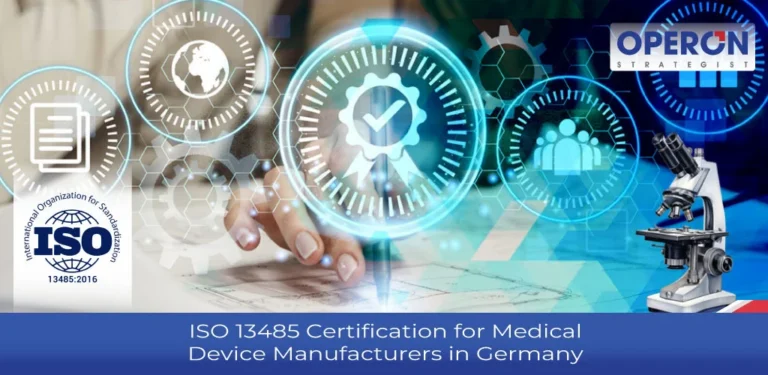
Overview of ISO 13485 Certification in Germany
In Germany, customers, distributors and Notified Bodies will be requesting your ISO 13485 Certification. As the biggest Medical Technology market in Europe, it is expected that stringent evidence will be requested by purchasing bodies and competent authorities to confirm that your production processes and quality management systems are well controlled.
Although ISO 13485 is a voluntary international standard, in order to obtain CE Marking under Regulation (EU) 2017/745 (EU MDR) it is impossible to do so without having an auditable Quality Management System (QMS) in place. Below we outline how the certification process works in Germany, what auditors will be looking for in production and how best to get prepared without creating excessive paperwork.
What is ISO 13485 Certification?
The certificate of ISO 13485 is an internationally acknowledged quality management standard. Specifically for medical devices, requirements concerning the establishment, application, operation and continual improvement of quality management systems in order to ensure safe and effective products have been established for manufacturers within Europe.
EN ISO 13485 covers all aspects of product life cycle management of medical devices. These include product design, production in clean rooms, installation, servicing and monitoring. Within Germany, EN ISO 13485 is a key regulatory requirement. The EN ISO 13485 is also well suited to align with the EU Medical Device Regulation (EU MDR 2017/745). In addition, it is acknowledged along with other international medical device standards.
Why ISO 13485 Certification Matters in Germany
Germany’s healthcare and medtech sector thrives on engineering precision and strict adherence to statutory standards. Both local German producers and international exporters must comply with medical devices ISO 13485 requirements to:
- Meet EU MDR Requirements: In order to meet the requirements set by EU MDR regulation, Medical Devices in Germany must be manufactured under a quality management system to ISO 13485. Without evidence that you have a quality management system in place according to ISO 13485 it will not be possible to perform Conformity Assessment and obtain CE marking.
- Gain Smooth Market Access: Once certified, medical device manufacturers in Germany can be confident they are compliant with relevant Notified Bodies and national Competent Authorities, for example BfArM (Federal Institute for Drugs and Medical Devices)
- Enhance Commercial Credibility: Medical device manufacturers in Germany that hold ISO 13485 certification gain credibility from Hospitals, Healthcare Providers, Distributors and International Buyers.
- Reduce Operational and Compliance Risks: Implementing a structured Quality Management System within manufacturing reduces the risk of mistakes/defects in manufacturing. This leads to fewer product recalls and major non-conformances in audits.
ISO 13485 Certification is essential for Start-ups, SMEs and Manufacturing businesses based in Germany in order to sustainably grow their business within the European Market.
Key Requirements of ISO 13485 for German Medical Device Manufacturers
German medical device manufacturers should structure their quality management system to address the following requirements to be ISO 13485 compliant:
1. Quality Management System
Include documentation in the quality system. Within the quality system, include a Quality Manual, Medical Device Files, SOPs, work instructions and traceable quality records to show continuous compliance.
2. Responsibility of Management
Management must demonstrate commitment by setting a Quality Policy, planning for quality within the business, including sufficient resources and carrying out regular management reviews.
3. Risk Management
Ensure that ISO 14971 risk management is implemented within all aspects of the quality management system. Risks should be identified, assessed and controlled and monitored throughout the product life cycle.
4. Design Controls
Within design, risk management and design controls should be incorporated to enable full traceability of design input, output, verification, validation (clinical and biological testing, including biocompatibility testing of medical devices in accordance with ISO 10993 medical device biocompatibility ) and design change to production.
5. Control of Suppliers and Processes
Control of suppliers and vendors should be rigorously defined. Vendor performance should be regularly monitored. Critical processes in manufacturing and sterilisation (in accordance with ISO 13485) should be validated to ensure consistent quality of product.
6. Corrective Action and Preventative Action (CAPA)
Implement a CAPA system to investigate deviations, define root causes, make corrective actions and confirm effectiveness, to ensure deviation does not occur again.
7. Post Market Surveillance
Proactive post-market surveillance for medical devices to gather field data, including complaints and vigilance. This information should be analysed to ensure continuous patient safety.
Integration of ISO 13485 with EU MDR Compliance
Link between ISO 13485 and EU MDR requirements.
EN ISO 13485 provides a general Quality Management System structure. The EU MDR defines specific requirements relating to medical device safety, clinical performance, medical device labeling and medical device labeling standards , and eIFU in medical devices within medical devices.
Notified Bodies within Germany (TÜV SÜD, TÜV Rheinland & DEKRA) require confirmation that a Quality Management System is in place and certified to ISO 13485 standard prior to conducting MDR conformity assessments. The certified Quality Management System will provide a solid basis for building your technical documentation (Annex II & III), Clinical Evaluation Report (CER) and risk management documents. Having a Quality Management System which adheres to ISO 13485 also allows for easier routes to regulation in other regions. These include the United States ( US FDA 510(k) and QMSR registration ) and CDSCO India licensing in India.
Local Certification Bodies and Auditing Organizations in Germany
In Germany, the following certification bodies are recognized in international scope. They perform audits on ISO 13485 certification and issue certified certificates:
- TÜV SÜD Product Service GmbH
- TÜV Rheinland LGA Products GmbH
- DEKRA Certification GmbH
- BSI Group Deutschland GmbH
- DNV GL Business Assurance Germany GmbH
All of these certification bodies are accredited by the DAkkS (national accreditation body within the Federal Republic of Germany). Therefore, certificates on ISO 13485, issued in Germany, have worldwide recognition.
6 Steps to Obtain ISO 13485 Certification in Germany
1. Gap Analysis: Identify any gaps in the quality system to meet requirements of ISO 13485:2016.
2. QMS Setup: Ensure correct quality manuals, SOPs, risk documentation and records are in place to meet requirements of ISO 13485 and EU MDR .
3. Internal Audit: Conduct a full internal audit of the Quality Management System to ensure it is effective. Correct any non-conformances before external audit.
4. Management Review: Ensure that management has conducted reviews of information from internal audit, CAPA, risk and resource requirements.
5. External Audit (Certification): Conduct stage 1 document audit and stage 2 on site audit with an accredited body (DAkkS). These bodies can be (but are not limited to) TUV SUD and DEKRA.
6. Certification + Maintenance: Achieve ISO 13485 certification. To maintain compliance with ISO 13485, annual surveillance audits must be performed and re-certification performed every 3 years.
Streamlining ISO 13485 Certification in Germany with Operon Strategist
Operon Strategist can help you achieve ISO 13485 Certification and compliance with EU MDR:
- Gap Analysis and Remediation Plan: We can help you achieve full compliance with ISO 13485 by identifying any gaps in processes and documentation.
- Quality Management Documentation: We can provide fully auditable quality management documentation as required by EN ISO 13485:2016. This includes a Quality Manual, Standard Operating Procedures, Risk Management and Corrective Action & Preventative Action documents.
- EU MDR Compliance: Ensure that your Quality Management System meets the requirements of EU MDR 2017/745 in order to achieve CE marking.
- Internal Audits & Management Reviews: We can support Internal Audits, as part of your pre-assessment. We can also help management teams undertake structured Management Reviews.
- Audit Support: We can help prepare your team for audit at Stage 1 & 2 by DAkkS accredited certification bodies (TÜV SÜD, TÜV Rheinland, DEKRA).
- New Facilities or Improvements: We can support new medical device manufacturing sites, or improvements to current quality systems.
Connect with Operon Strategist for tailored QMS consulting
FAQ's
What is ISO 13485 Certification for medical device manufacturers in Germany?
It is an internationally recognized Quality Management System (QMS) certification (EN ISO 13485:2016) verifying that a manufacturer designs, produces, and distributes safe, compliant medical devices.
Why is ISO 13485 Certification important for medical device manufacturers in Germany?
It is essential for meeting EU MDR 2017/745 QMS requirements, obtaining CE Marking, passing BfArM inspections, and building trust with European healthcare buyers.
Which certification bodies are recognized for ISO 13485 audits in Germany?
Prominent DAkkS-accredited certification bodies in Germany include TÜV SÜD, TÜV Rheinland, DEKRA Certification GmbH, BSI Group Deutschland, and DNV GL.
How does ISO 13485 support EU MDR compliance in Germany?
ISO 13485 provides the mandatory QMS framework required by German Notified Bodies before they evaluate EU MDR technical documentation, risk files, and clinical data.
How long is an ISO 13485 certificate valid in Germany?
An ISO 13485 certificate is valid for three years, subject to successful annual surveillance audits and a full recertification audit at the end of the third year.
Senior Sales Executive | 3 Years of Experience
Vyankatesh Dhavale holds a Bachelor of Pharmacy (B.Pharm) and an MBA specializing in Operations and Supply Chain Management, with a minor in Marketing. He brings experience in domestic and international business development, strategic client relationship management, and sales of medical device regulatory consulting and turnkey project services. His expertise includes supporting market entry and regulatory service requirements related to CDSCO registration, EU MDR CE marking, US FDA regulations, and ISO 13485 quality management systems.