
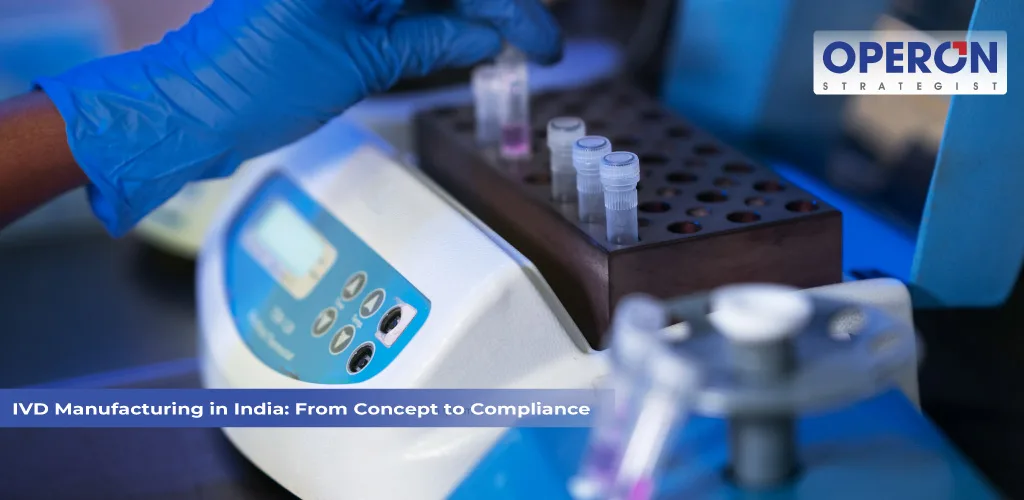
IVD Manufacturing in India: From Concept to Compliance — Plant Setup, Process & Licensing Explained
India’s diagnostics sector is undergoing rapid transformation, with IVD (In-Vitro Diagnostic) devices playing a central role in early detection, disease management, and preventive healthcare. From routine blood tests to advanced molecular diagnostics, IVD products are now integral to clinical decision-making across hospitals, laboratories, and home-care settings.
This growth has created a strong opportunity for manufacturers to enter the IVD space. However, success in IVD manufacturing is not driven by demand alone. It requires a clear understanding of regulatory pathways, compliance-driven facility design, and validated manufacturing processes aligned with the Medical Devices Rules, 2017.
Regulatory Excellence for Global Medical Device Markets
This guide provides a practical overview of IVD manufacturing in India—covering classification, licensing, plant setup, process requirements, and key challenges—enabling manufacturers to approach the sector with clarity and execution readiness.
Why Do IVD Projects Fail at Execution Despite Strong Market Demand?
IVD manufacturing is one of the fastest-growing segments in healthcare—yet many new facilities face delays not due to lack of demand, but due to regulatory and compliance gaps.
While the market opportunity is clear, execution often fails because:
- Regulatory planning starts after facility setup
- Plant design does not align with inspection expectations
- Validation and documentation are treated as secondary activities
Execution reality:
In IVD manufacturing, compliance is not a phase—it is the foundation. Projects that do not integrate regulatory requirements from day one face delays, redesigns, and approval setbacks.
What Defines IVD Manufacturing in Today’s Healthcare Ecosystem?
In-vitro diagnostics (IVD) manufacturing involves producing devices that analyze biological samples outside the human body to support medical decisions.
These include testing of:
- Blood and plasma
- Urine and body fluids
- Tissue samples
Applications span:
- Clinical diagnostics and screening
- Infectious disease detection
- Chronic disease monitoring
- Molecular and genetic analysis
IVD devices are increasingly moving beyond centralized labs into point-of-care and home-testing environments, making reliability and consistency even more critical.
What is Driving the Growth of IVD Manufacturing in India?
India presents a strong opportunity for IVD manufacturing due to both domestic demand and export potential.
Key drivers include:
- Increasing disease burden requiring frequent diagnostics
- Shift toward early detection and preventive care
- Growth in molecular diagnostics and rapid testing technologies
- Expansion of private laboratories and diagnostic chains
- Government focus on healthcare infrastructure
Strategic perspective:
The opportunity is significant—but so is the regulatory rigor. Success depends on aligning product, process, and compliance from the outset.
How Does CDSCO Classify IVD Devices and Why Does it Matter?
IVD devices in India are regulated under the Medical Devices Rules, 2017 and classified based on risk. This classification determines both the approval pathway and the level of scrutiny.
Class | Risk Level | Approval Authority | Compliance Requirement |
A | Low | State Authority | Basic compliance, limited oversight |
B | Low–Moderate | State Authority | Review with possible inspection |
C | Moderate–High | CDSCO | Detailed evaluation and inspection |
D | High | CDSCO | Stringent review with performance evidence |
Key implication:
As device risk increases, so does the expectation for validation, documentation, and facility compliance. Misclassification at the beginning can significantly delay approvals.
What Does It Take to Obtain a Manufacturing License for IVD Devices?
Manufacturing of IVD devices in India requires regulatory approval under the Medical Devices Rules.
Licensing pathway:
- Class A & B → State Licensing Authority
- Class C & D → Central Licensing Authority (CDSCO)
Core requirements:
- ISO 13485-compliant Quality Management System
- GMP-aligned facility and operations
- Device Master File (DMF) and Plant Master File (PMF)
- Defined manufacturing and validation processes
- Inspection readiness and compliance
Practical insight:
Regulatory approvals are often delayed due to inconsistencies between submitted documentation and actual facility conditions observed during inspection.
What are the Critical Stages in IVD Manufacturing?
IVD manufacturing is a controlled and validation-intensive process.
- Product Planning and Definition
- Intended use and target users
- Analytical and clinical performance expectations
- Regulatory classification and pathway
- Design and Engineering
- Product architecture and material selection
- Prototype development
- Risk management aligned with ISO 14971
- Validation and Verification
- Analytical performance validation
- Stability and shelf-life studies
- Clinical or performance evaluation (if required)
- Controlled Manufacturing
- Component fabrication
- Reagent formulation under controlled conditions
- Assembly and packaging
- Quality Assurance and Release
- In-process quality checks
- Final product testing
- Batch traceability and release documentation
Technical insight:
Traceability and reproducibility are critical in IVD manufacturing, especially for reagent-based and assay-driven products.
What are the Infrastructure Requirements for an IVD Facility?
A compliant IVD facility is not just about space—it is about controlled environments and process flow.
Key infrastructure elements:
- Cleanroom systems designed based on product requirements
- HVAC systems for environmental control
- Segregated zones for material and personnel flow
- Controlled areas for reagent preparation
- Quality control laboratories
Utilities:
- Compressed air systems
- Purified water systems (PW/WFI as applicable)
- Temperature-controlled storage systems
Important note:
Cleanroom classification and environmental control must be aligned with the specific IVD product type, not over- or under-designed.
What Machinery is Typically Used in IVD Manufacturing?
Machinery selection depends on the product category but generally includes:
- Injection molding machines for plastic components
- Automated assembly systems
- Liquid handling and dispensing systems
- Sealing and packaging machines
- Inspection and testing equipment
Sterilization systems are used only where required, depending on product design and intended use.
Execution insight:
Automation improves consistency and reduces contamination risk, but must be validated and integrated with quality systems.
Where Do Most Manufacturers Face Challenges?
Despite planning, several issues arise during execution:
- Inadequate understanding of regulatory pathways
- Facility layouts not aligned with GMP requirements
- Weak documentation structure
- Delayed validation planning
- Inspection observations leading to rework
Ground-level reality:
Many facilities are technically capable but fail during inspection due to gaps in compliance, documentation, or process control.
What is the Right Approach to Setting Up an IVD Manufacturing Facility?
A successful setup requires alignment between product, process, and compliance.
Recommended approach:
- Define product scope and classification early
- Build regulatory strategy before infrastructure decisions
- Design facility based on process and compliance needs
- Select machinery aligned with scalability
- Plan and execute validation (IQ/OQ/PQ)
- Prepare complete and consistent regulatory documentation
Outcome:
This reduces approval risk, avoids redesign, and accelerates commercialization.
How Long Does It Take to Get Regulatory Approval?
Approval timelines depend on device classification and preparedness.
Typical timelines:
- Class A: Few weeks
- Class B: 2–4 months
- Class C & D: 4–9+ months
Delay factors:
- Facility not ready for inspection
- Documentation gaps in DMF/PMF
- Regulatory queries and resubmissions
Timelines are directly influenced by the quality of preparation.
How Can Operon Strategist Support IVD Manufacturing Projects?
Setting up an IVD manufacturing unit requires integration of engineering, regulatory, and operational expertise.
Operon Strategist provides:
- Regulatory strategy and CDSCO licensing support
- GMP-compliant facility layout design
- Machinery selection and vendor coordination
- ISO 13485 implementation
- Documentation (DMF, PMF) and submission support
- Validation and inspection readiness
Value impact:
- Reduced approval timelines
- Lower risk of rework
- Compliance-ready facility from day one
- Scalable manufacturing operations
Conclusion: What Separates Successful IVD Manufacturers?
The difference between delayed projects and successful ones lies in execution discipline.
Successful manufacturers:
- Integrate regulatory requirements early
- Design facilities for compliance, not just production
- Prioritize validation and documentation
- Align engineering with regulatory expectations
Final takeaway:
In IVD manufacturing, speed to market is not achieved by faster construction—but by smarter, compliance-driven planning.
FAQ
What is IVD manufacturing?
It is the production of diagnostic devices used to test biological samples outside the human body.
Is regulatory approval mandatory in India?
Yes, a manufacturing license is required under the Medical Devices Rules, 2017.
Who grants the license?
State authorities for Class A & B, and CDSCO for Class C & D devices.
What standards must be followed?
ISO 13485 and GMP compliance are essential.
Do all IVD products require sterilization?
No, sterilization depends on the product type and intended use.
Can Indian manufacturers export IVD devices?
Yes, provided they meet regulatory requirements of the target markets.