
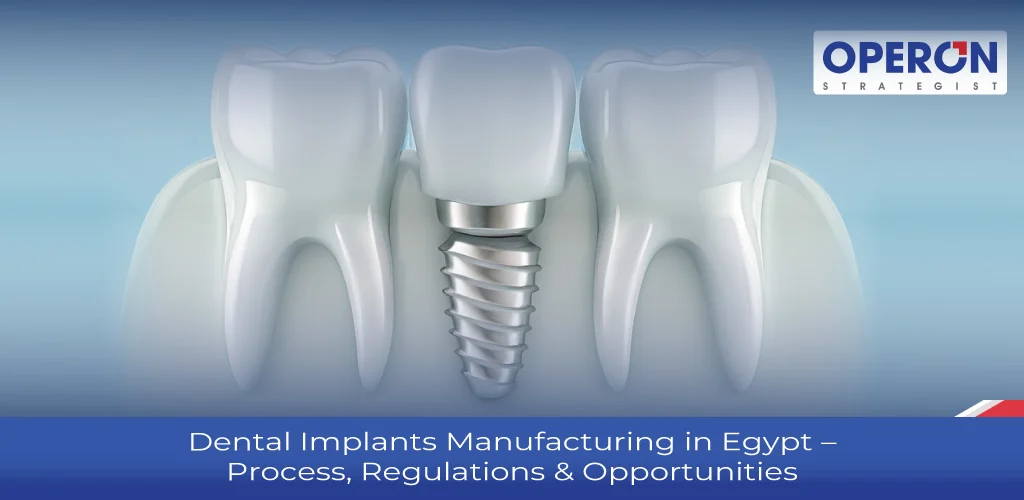
Dental Implants Manufacturing in Egypt – Process, Regulations & Opportunities
Introduction to Dental Implants Manufacturing in Egypt
Egypt’s dental industry is experiencing rapid growth, driven by increasing awareness of oral health, rising patient expectations, and advancements in dental technology. At the center of this progress is Dental Implants Manufacturing, a field that combines precision engineering, advanced biomaterials, and strict regulatory compliance to produce high-quality tooth replacement solutions.
With rising demand both locally and across regional markets, Egypt offers significant opportunities for manufacturers committed to quality, innovation, and compliance.
Let's Grow Your Business Together
What Are Dental Implants?
Dental implants are medical devices surgically placed into the jawbone to act as artificial roots, supporting crowns, bridges, or dentures. They restore chewing function and aesthetics, closely mimicking natural teeth.
Most implants are made from titanium or zirconia because they offer:
- Biocompatibility – Encourages natural bone integration.
- Corrosion Resistance – Maintains performance over time.
- Strength & Durability – Withstands daily chewing forces.
As demand grows in Egypt, local Dental Implants Manufacturing is becoming an increasingly important sector.
Technology and Machinery Used in Dental Implants Manufacturing
Producing reliable dental implants requires precision and advanced technology. Common equipment used in Dental Implants Manufacturing includes:
- CNC Turning & Milling Machines – For shaping implant bodies with micron accuracy.
- Laser Welding Machines – To assemble small components without compromising strength.
- Ultrasonic Cleaning Systems – For thorough decontamination before packaging.
- Passivation Units – To improve titanium corrosion resistance.
- Surface Treatment Equipment – For sandblasting, acid etching, and anodizing to enhance osseointegration.
- 3D Coordinate Measuring Machines (CMM) – For accurate dimensional inspections.
Dental Implants Manufacturing Process in Egypt
While each manufacturer may adapt methods to their capabilities, the standard Dental Implants Manufacturing process includes:
- Material Selection – Sourcing medical-grade titanium or zirconia.
- CNC Machining – Shaping and threading the implant for surgical placement.
- Surface Treatment – Sandblasting, acid etching, or anodizing to improve bone bonding.
- Cleaning & Sterilization – Ultrasonic cleaning followed by validated sterilization.
- Quality Inspection – Mechanical testing, dimensional checks, and surface analysis.
Packaging – Using sterile, medical-grade materials to maintain integrity.
Regulatory Framework for Dental Implants in Egypt
In Egypt, Dental Implants Manufacturing is regulated by the Egyptian Drug Authority (EDA), which ensures all medical devices meet safety and performance requirements.
Key EDA requirements include:
- Establishment Licensing – For all manufacturers, importers, and distributors.
- Device Registration – Dental implants usually fall into Class IIb or Class III.
- ISO 13485 Certification – Mandatory quality management system.
- ISO 14801 Compliance – Fatigue testing for durability.
- Technical Documentation – Safety, performance, and risk assessment data.
.
Ready to build an EDA-compliant dental implant facility in Egypt?
Schedule Your Expert Consultation
Market Opportunities for Dental Implants Manufacturing in Egypt
Egypt’s strategic location, skilled workforce, and growing healthcare sector make it an ideal hub for Dental Implants Manufacturing. Manufacturers who meet international standards can serve both domestic patients and export markets across the Middle East and Africa.
With rising dental care demand, investment in this sector offers high growth potential and export competitiveness.
How Operon Strategist Supports Dental Implants Manufacturing in Egypt
Operon Strategist, we provide end-to-end manufacturing and regulatory consulting services to help you set up or optimize your Dental Implants Manufacturing operations in Egypt. Our expertise covers:
- EDA Establishment License Applications
- Design & Setup of GMP-Compliant Manufacturing Facilities (Facility Design Services)
- Implementation of ISO 13485-Certified QMS Systems
- Preparation of Complete Technical Documentation for regulatory approval
- Equipment Sourcing, Installation, and Validation (Equipment & Validation Services)
We help manufacturers reduce time-to-market, ensure full regulatory compliance, and maintain world-class product quality—positioning them for long-term success in Egypt’s expanding dental market.
Accelerate your dental implant plant setup and EDA approvals
Contact Operon Strategist Today
FAQ's
What materials are commonly used in dental implant manufacturing in Egypt?
Dental implants are primarily manufactured from medical-grade titanium and zirconia due to their excellent biocompatibility, strength, corrosion resistance, and ability to integrate with bone (osseointegration). The choice of material depends on the implant design and clinical application.
What regulatory requirements apply to dental implant manufacturing in Egypt?
Manufacturers should comply with the Egyptian Drug Authority (EDA) regulations and implement an ISO 13485-compliant Quality Management System (QMS). Companies intending to export dental implants should also meet the regulatory requirements of their target markets, such as US FDA, EU MDR, or other applicable international standards.
What are the key steps in the dental implant manufacturing process?
The manufacturing process typically includes raw material selection, precision machining or CNC milling, surface treatment, cleaning, sterilization, quality inspection, packaging, and final product testing. Each stage must be validated to ensure product safety, quality, and regulatory compliance.
Is dental implant manufacturing a growing business opportunity in Egypt?
Yes. Increasing demand for restorative dentistry, rising oral healthcare awareness, and expanding medical tourism are creating significant opportunities for dental implant manufacturers in Egypt. Companies that invest in advanced manufacturing technologies, quality management systems, and regulatory compliance can compete effectively in both domestic and international markets.