
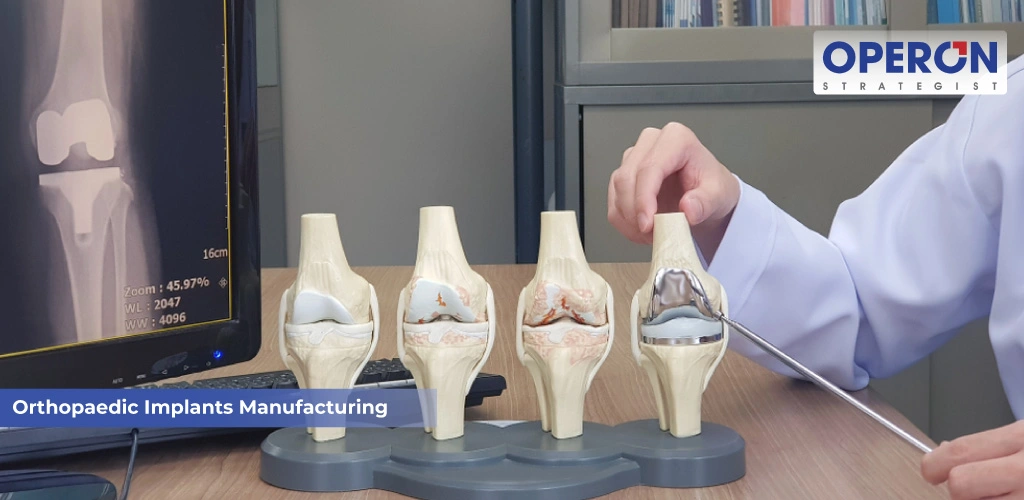
Orthopaedic Implants Manufacturing Process, Materials, Plant Setup & Global Regulatory Requirements
Orthopaedic implants are critical medical devices designed to restore mobility, stability, and structural integrity of bones and joints. With the increasing prevalence of trauma cases, degenerative disorders, and joint replacement surgeries, the demand for high-quality orthopaedic implants continues to grow globally.
Manufacturing these implants is significantly more complex than standard device production.
Talk to our experts
It requires advanced materials, precision engineering, controlled surface treatment, and strict regulatory compliance. Clinical success depends not only on design but also on consistent manufacturing quality, validated processes, and long-term performance.
This guide provides a technically robust and practical overview of orthopaedic implant manufacturing, covering process steps, materials, facility requirements, validation, regulatory pathways, and key challenges.
However, success in this highly regulated industry depends on one critical foundation a well-prepared Detailed Project Report (DPR).
What Are Orthopaedic Implants and Why is Precision Critical?
Orthopaedic implants are devices used to support, stabilize, or replace damaged bones and joints.
Major categories:
- Joint Implants (Hip, Knee): Require high wear resistance and ultra-smooth articulation surfaces
- Trauma Implants (Plates, Screws): Focus on strength and fixation stability
- Spinal Implants: Often use radiolucent materials like PEEK for imaging compatibility
Why precision matters:
- Accurate anatomical fit is essential
- Load-bearing components must withstand cyclic fatigue
- Surface properties influence bone integration and wear behavior
Technical insight:
Typical dimensional tolerances range from ±5–20 µm, and deviations can lead to implant loosening, wear, or revision surgery.
What Materials Are Used in Orthopaedic Implant Manufacturing?
Material selection directly impacts mechanical strength, wear resistance, and biocompatibility.
Common materials:
Titanium Alloys (Ti-6Al-4V – ASTM F136)
- High strength-to-weight ratio
- Excellent biocompatibility
- Strong corrosion resistance
Stainless Steel (316L – ASTM F138)
- Cost-effective
- Common in trauma implants
Cobalt-Chromium Alloys
- Superior wear resistance
- Widely used in joint implants
PEEK (Polyether Ether Ketone)
- Radiolucent
- Common in spinal implants
UHMWPE (Ultra-High Molecular Weight Polyethylene)
- Used as articulating surface in joint implants
Standards:
- ISO 10993 (biocompatibility)
- ASTM material standards
- ISO 13485 (quality management system)
What is the Step-by-Step Orthopaedic Implant Manufacturing Process?
- Design and Engineering Development
- CAD-based design
- Finite Element Analysis (FEA) for load simulation
- Design verification and risk analysis
- Raw Material Processing
- Certified medical-grade materials
- Forging, casting, or bar stock preparation
- Full material traceability
- CNC Machining and Precision Manufacturing
- Multi-axis CNC machining (3/4/5-axis)
- Turning, milling, drilling operations
- Tolerances typically within ±5–20 µm
- Surface Treatment and Finishing
- Polishing: For articulating surfaces (Ra < 0.05 µm in joint implants)
- Sandblasting: Improves bone integration
- Plasma spraying: Hydroxyapatite coatings
Advanced approaches:
- Porous coatings
- Additive-manufactured surfaces
- Heat Treatment
- Enhances fatigue strength
- Relieves internal stresses
- Improves material properties
- Cleaning and Passivation
- Multi-stage ultrasonic cleaning
- Removal of contaminants and residues
- Chemical passivation for corrosion resistance
- Sterilization
- Gamma radiation or Ethylene Oxide (EtO)
- Sterility Assurance Level (SAL): 10⁻⁶
- Packaging andLabeling
- Sterile barrier systems (ISO 11607 compliant)
- Seal strength validation
- Accelerated aging for shelf-life
- Transit testing
- UDI labeling for traceability
What Facility and Cleanroom Requirements Are Needed?
- ISO Class 7 or 8 cleanrooms (for final processing and packaging)
- Segregated zones for machining, cleaning, and sterile handling
- Controlled material and personnel flow
Key systems:
- HVAC with HEPA filtration
- Environmental monitoring systems
- Temperature and humidity control
What Machinery is Required for Orthopaedic Implant Manufacturing?
Core machinery:
- CNC turning and milling machines
- 5-axis machining centers
- Grinding and polishing equipment
Specialized systems:
- Surface treatment and coating systems
- Heat treatment furnaces
- Ultrasonic cleaning systems
Inspection systems:
- Coordinate Measuring Machines (CMM)
- Surface roughness testers
- Mechanical testing systems (fatigue, tensile, wear)
What are the Regulatory Requirements for Orthopaedic Implants?
Orthopaedic implants are classified as high-risk medical devices.
India (CDSCO):
- Typically Class C or D
- Manufacturing license required
Global pathways:
- USA: FDA 510(k) or PMA
- Europe: CE marking under EU MDR
Key standards:
- ISO 13485 (QMS)
- ISO 14971 (risk management)
- ISO 10993 (biocompatibility)
- ISO 11607 (packaging validation)
Additional requirements:
- UDI implementation
- Technical file / design dossier
- Post-market surveillance (PMS)
What Validation is Required in Orthopaedic Implant Manufacturing?
Validation ensures consistency, safety, and regulatory compliance.
- IQ (Installation Qualification)
- OQ (Operational Qualification)
- PQ (Performance Qualification)
Critical validations:
- Machining process validation
- Surface coating validation
- Cleaning validation
- Sterilization validation
What are the Critical Quality Control Parameters?
- Dimensional accuracy (micron-level)
- Surface roughness
- Mechanical strength (fatigue, tensile)
- Corrosion resistance
- Sterility assurance
What Role Does Wear Testing and Tribology Play?
Wear performance is critical, especially in joint implants.
- Evaluation of friction and wear between implant surfaces
- Testing using joint simulators (hip/knee simulators)
- Assessment of wear debris and long-term behavior
Technical importance:
Poor wear performance can lead to particle generation, inflammation, and implant failure.
What are the Common Failure Modes in Orthopaedic Implants?
- Implant loosening due to poor osseointegration
- Wear debris leading to inflammation
- Corrosion or material degradation
- Fatigue failure under cyclic loading
Insight:
Most failures are linked to surface quality, material performance, or inadequate validation.
What are the Common Manufacturing Challenges?
- Complex geometry machining
- Maintaining consistency in surface coatings
- Material defects or variability
- Multi-market regulatory compliance
- High capital investment
What are the Latest Trends in Orthopaedic Implant Manufacturing?
- Additive manufacturing for patient-specific implants
- Porous and lattice structures for better integration
- Smart implants with embedded sensors
- Robotic-assisted manufacturing
- Increased use of advanced polymers like PEEK
How Can Operon Strategist Support Orthopaedic Implant Manufacturing?
Operon Strategist provides:
- Manufacturing strategy and feasibility
- GMP-compliant plant layout and cleanroom design
- Technical documentation and risk management
- Process validation and inspection readiness
Value delivered:
- Faster approvals
- Reduced compliance risk
- Scalable and audit-ready manufacturing
Conclusion
What Defines Success in Orthopaedic Implant Manufacturing?
Orthopaedic implant manufacturing is a precision-driven and compliance-intensive domain.
Success depends on:
- Advanced material selection
- Tight machining tolerances
- Controlled surface engineering
- Robust validation and quality systems
- Strong regulatory alignment
Final insight:
Long-term success is achieved through process control, validation depth, and consistent quality, not just production capability.
FAQs
What is the most commonly used material?
Titanium alloys due to their strength, corrosion resistance, and biocompatibility.
Why is surface treatment important?
It directly impacts bone integration and implant longevity.
Are orthopaedic implants highly regulated?
Yes, they require strict compliance with global regulatory standards.
What is the biggest manufacturing challenge?
Maintaining precision and consistency at scale.
Is 3D printing used in implant manufacturing?
Yes, especially for customized and complex implants.