
ISO 13485 Certification in Costa Rica
What is ISO 13485 Certification for Medical Devices?
ISO 13485:2016 is the internationally recognized standard for Quality Management Systems (QMS) specifically designed for the medical device industry. Because safety and quality are non-negotiable in healthcare, this certification provides formal proof that a manufacturer can consistently produce devices that meet both customer and stringent regulatory requirements throughout the product lifecycle.
- Global Lifecycle Standard: It forms the basis for certifying companies involved in any stage of a device’s life—including design, manufacturing, distribution, and maintenance.
- Focus on Safety & Quality: The standard ensures that devices are safe for their intended use and that quality is maintained through strictly controlled processes.
- Facilitates International Trade: For organizations in regions like Costa Rica, obtaining ISO 13485 is essential for exporting medical devices to global markets, as it aligns the management system with international expectations.
- Regulatory Compliance: It is not merely a preference but a necessity for organizations to demonstrate they can manage medical equipment under a robust, audited framework.
As an ISO 13485 guidance consultant, Operon Strategist provides services like implementation, documentation, gap analysis, training, and registration process for the ISO 13485 certification. We make sure that you get the benefits of ISO 13485 certification for your organization.

How to Get ISO 13485 Certification?
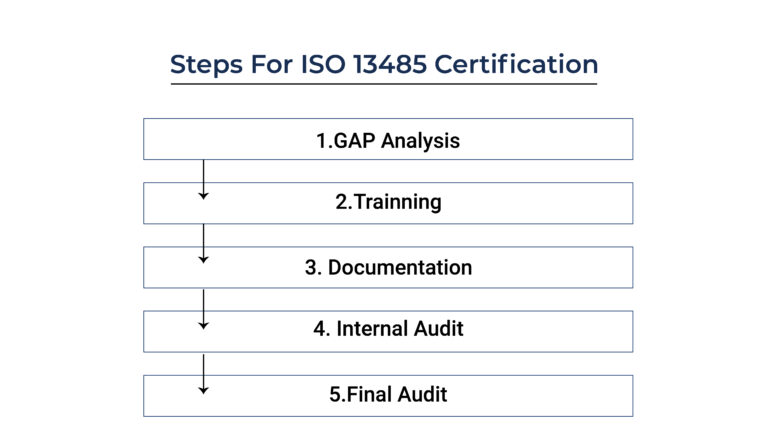
Establishing an effective quality management system is the first step to obtaining successful ISO 13485 certification in Costa Rica. Post-implementing QMS in your organization, your certification journey begins. You need to follow the process which starts by filling out the application form.
What Is the Difference Between ISO 13485 and EN ISO 13485?
ISO 13485 is the internationally recognized basic version of the standard, it has been harmonized/recognized for its consideration in the implementation of the regional regulatory approval procedures like EN ISO 13485, ANSI ISO 13485, and IS/ISO 13485 for India.
By complying with a harmonized standard, a manufacturer can prove that its products or services comply with the technical requirements of the regional legislation.
Also read the difference between 21 CFR 820 and ISO 13485:2016
Benefits of ISO 13485:2016 Certification
- Improves company’s credibility and identity
- Evidence-based decision making
- Continual improvement in product process and quality
- Increased employee involvement.
- Enhanced customer satisfaction.
Learn more about How to Use ISO 13485 Standard For CE Marking Approval of Medical Devices?

How Operon Strategist Helps You Achieve ISO 13485 Certification
As a specialized medical device regulatory consultant, Operon Strategist simplifies the certification process in India by providing end-to-end support. Their services ensure your company meets global quality standards through the following steps:
- Notified Body Selection: Helping you choose the right approved organization to conduct your official audit.
- Custom Documentation: Preparing all necessary manuals and records specifically tailored to your product’s requirements.
- Staff Training: Educating your team on ISO standards to ensure everyone understands their role in the quality system.
- QMS Implementation Review: Evaluating your current processes to ensure they are functioning correctly before the final audit.
- Audit Assistance: Providing hands-on support during the formal ISO 13485 audit to address any technical queries.
- Certification Management: Managing the administrative side to ensure you receive and maintain your official certificate.
To improve the energy efficiency of your business you can show compliance with ISO 13485 Certification with the aid of an Operon Strategist.
Let's Grow Your Business Together
Process vs. Product Standardization
It is a common misconception that ISO 13485 defines the physical quality or technical specifications of a medical device. In reality, it is a process-based standard. It provides a framework for managing operations so that the resulting product consistently meets regulatory and customer requirements. It governs how you work, rather than what the specific dimensions or materials of your device should be.
Organizational vs. Individual Certification
ISO 13485 is an organizational standard. This means:
- Companies, not people: Certification is granted to a legal entity or manufacturing site, not an individual person.
- Lead Auditor Exception: While a person cannot be “ISO 13485 Certified” in the same way a company is, they can become a Certified Lead Auditor. This requires completing a specialized 5-day training course, allowing them to conduct formal audits for other organizations.
The Path to Certification
To achieve and maintain ISO 13485 status, an organization must follow a specific lifecycle:
- Implementation: Develop and deploy a Quality Management System (QMS) that meets the current ISO 13485 requirements.
- External Audit: A third-party Registrar (Certification Body) conducts a formal audit of the organization’s processes and documentation.
- Registration: If the audit is successful, the Registrar issues a certificate valid for three years.
- Maintenance: The organization must undergo a re-certification audit every three years to prove continued compliance and maintain their registered status.
Eligibility Criteria for ISO 13485 Certification in India
Before applying for ISO 13485 Certification, you must adhere to the points specified in ISO 13485 standards. For that purpose, you need to train your organization as per this standard.
ISO 13485 Certification Requirements
- Identify and adopt a risk management approach to product development and product realization.
- Creation of QMS Manual, Processes, Procedures, Formats/Records.
- Creation of Medical Device Master File.
- Analysis of the validation of processes and procedures.
What Are the Stages of the ISO 13485 Process?

The journey to ISO 13485 certification is a structured process designed to move a company from initial planning to a fully audited quality system. Here are the core stages:
- Quality System Planning
Every QMS begins with a strategic plan based on the PDCA (Plan-Do-Check-Act) Cycle. You must document exactly how you intend to build and modify your quality system to meet the standard. - Regulatory Alignment
Define your target markets and map your quality plan to their specific laws. For example, if you are targeting the U.S., your ISO 13485 framework must also satisfy FDA 21 CFR Part 820 requirements. - Documentation & Training
Establish your Quality Manual and define how different processes interact. This stage involves creating the necessary records and training your team to ensure that quality control is consistently measured and documented. - Internal Audit
Before the official inspectors arrive, conduct a risk-based Internal Audit. The goal is to identify nonconformities and “Opportunities for Improvement” (OFI) so you can fix them while the stakes are still low. - Management Review
Once the internal audit is complete and corrective actions have started, leadership must conduct a Management Review. This ensures the system meets all 12 requirements of the ISO 13485:2016 standard and has the necessary inputs for a final evaluation. - Certification Audit (Stages 1 & 2)
A third-party registrar performs a formal assessment. They will interview process owners and review record samples to verify that your system is not just on paper, but effectively implemented and compliant with all relevant legal and technical requirements.
ISO 13485 and MDSAP: The Global Connection
ISO 13485 and MDSAP (Medical Device Single Audit Program) work together to streamline global market access. While ISO 13485 provides the foundational framework for a Quality Management System (QMS), MDSAP is a harmonized audit program. It allows a single audit to satisfy the regulatory requirements of five major markets: the USA, Canada, Australia, Brazil, and Japan.
ISO 13485 under EU MDR
Under the European Medical Device Regulation (EU MDR), compliance with EN ISO 13485 is the primary way manufacturers demonstrate they have a robust QMS in place. However, the EU MDR adds several specific requirements that go beyond the standard ISO framework.
Key “Extra” QMS Requirements for EU Compliance
To meet the stricter EU MDR standards, your QMS must now include:
- Documented Regulatory Strategy: A clear roadmap for how the device will maintain compliance throughout its lifecycle.
- Enhanced Risk Management: Expanded risk evaluation procedures that align with the specific cases listed in Annex I.
- Clinical Evaluation & PMS: More detailed procedures for continuous clinical data collection and Post-Market Surveillance (PMS).
- UDI Implementation: Systems to support Unique Device Identification (UDI) and “Basic-UDI” for tracking devices in the EUDAMED database.
- Economic Operator Oversight: Stricter controls and legal agreements for importers and distributors within the supply chain.
- Updated Terminology: Alignment of all QMS definitions with the specific language used in the MDR.
FAQ
What is ISO 13485?
ISO 13485 is an internationally recognized standard for Quality Management Systems (QMS) specifically designed for medical device manufacturers. It ensures compliance with regulatory and customer requirements for medical device safety and performance.
Who needs ISO 13485 certification?
ISO 13485 certification is required for medical device manufacturers, suppliers, and service providers involved in the design, production, and distribution of medical devices to meet global regulatory standards.
How does ISO 13485 help with regulatory compliance?
ISO 13485 helps medical device companies comply with regulatory requirements such as FDA 21 CFR Part 820, MDR (EU Medical Device Regulation), and other country-specific medical device regulations.
What are the key requirements of ISO 13485?
Key requirements of ISO 13485 include risk management, process validation, CAPA (Corrective and Preventive Actions), supplier management, complaint handling, and continuous improvement of the QMS.