
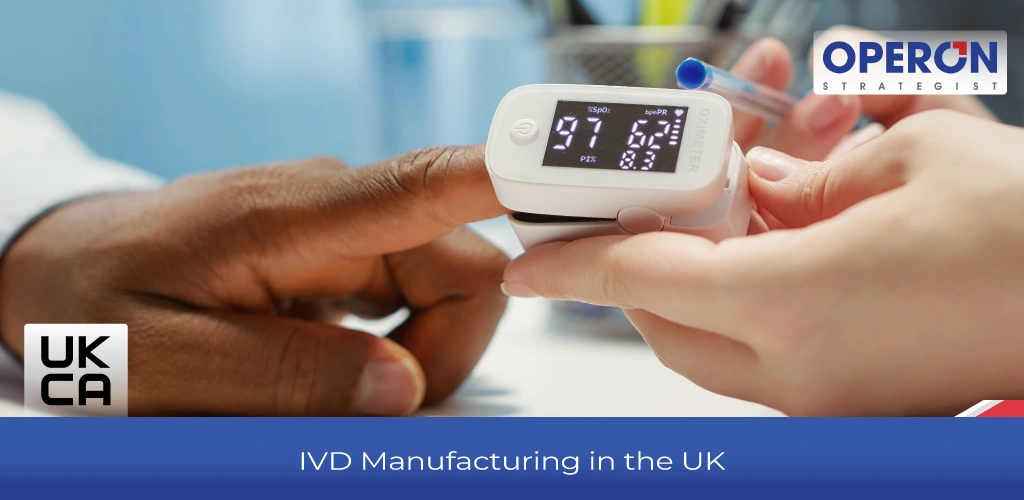
IVD Manufacturing in the UK: A Complete Guide for Startups and Manufacturers
Introduction
To manufacture and sell in vitro diagnostic (IVD) devices in the UK, a company must register with the MHRA, implement an ISO 13485-certified Quality Management System, compile a full technical file, classify the device by risk, and affix UKCA marking before placing it on the market. Non-compliance can result in market delays, penalties, or recalls.
What is IVD Manufacturing?
In vitro diagnostic (IVD) devices are tools used to test human samples — blood, urine, tissue, or saliva — outside the body to detect disease, monitor health conditions, or guide clinical decisions. Common examples include glucose meters, pregnancy tests, PCR kits, COVID-19 test kits, and laboratory diagnostic reagents.
Talk to Our Experts
Because IVD results directly influence patient care, IVD manufacturing in the UK is tightly regulated. Every stage — design, production, labeling, and quality control — must meet UK regulatory law and recognized quality standards.
IVD Manufacturing in the UK is growing fast as hospitals, diagnostic labs, and healthcare providers depend on faster, more accurate diagnostic testing for disease screening, early diagnosis, and ongoing patient monitoring.
Regulatory Requirements for IVD Manufacturing in the UK
1. UKCA Marking
Most IVD devices sold in Great Britain must carry UKCA (UK Conformity Assessed) marking, confirming the device meets essential safety and performance requirements before it reaches the market.
2. Quality Management System (QMS)
Manufacturers must implement a robust QMS, typically aligned with ISO 13485, covering:
- Traceability
- Risk control
- Documentation accuracy
- Process consistency
- Product safety
3. Technical Documentation
A complete Device Technical File is required to demonstrate the device is safe and performs as intended. It should include:
- Device description
- Manufacturing process details
- Risk management files
- Validation reports
- Clinical or performance evaluation data
- Labeling and Instructions for Use (IFU)
- Post-market surveillance plan
4. Device Classification
IVDs are classified by risk level — the higher the risk to patients, the stricter the regulatory pathway and evidence required.
5. MHRA Registration
Every IVD device must be registered with the MHRA before it can be marketed or sold in the UK.
Failure to meet these five requirements can result in market delays, financial penalties, or product recalls — which is why most manufacturers partner with experienced IVD regulatory consultants.
Key Stages in the IVD Manufacturing Process
| Stage | What Happens |
|---|---|
| 1. Concept & Feasibility | Market analysis, user needs, target patient group, and intended purpose are defined |
| 2. Design & Development | Design planning, verification, validation, usability, and clinical performance testing |
| 3. Raw Material Selection | Only approved, fully traceable materials are used |
| 4. Process Validation | Manufacturing processes are validated to ensure consistent, repeatable results |
| 5. Quality Control & Testing | Every batch undergoes strict inspection and testing |
| 6. Packaging & Labeling | Labels must comply with UK and international standards |
| 7. Distribution & Post-Market Surveillance | Continuous safety monitoring after launch |
Facility and Clean Room Requirements
A compliant IVD manufacturing facility in the UK typically needs:
- Controlled clean rooms
- Environmental monitoring systems
- Trained, qualified staff
- Validated equipment
- Robust documentation systems
- Separate material flow areas
- Controlled storage conditions
The required clean room classification depends on the device type and associated process risk — higher-risk devices generally demand stricter environmental controls.
Why Manufacture IVDs in the UK?
The UK remains a strong base for IVD manufacturing because of:
- Strong, consistent healthcare demand
- Advanced hospital and laboratory infrastructure
- Government focus on diagnostics investment
- Rising chronic disease prevalence
- A fast-growing point-of-care testing market
These factors make the UK an attractive hub for both domestic supply and export-focused IVD manufacturing.
How Operon Strategist Supports IVD Manufacturing
Operon Strategist is a Medical Device and IVD Regulatory and Quality Consulting company with deep, hands-on experience helping manufacturers set up, scale, and stay compliant in the UK market. We support startups, established manufacturers, importers, and exporters entering or expanding in the UK.
Our end-to-end IVD manufacturing consulting services include:
- IVD Regulatory Consulting Services
- UKCA Marking Support for Medical Devices and IVDs
- ISO 13485 QMS Implementation
- Technical File and Documentation Support
- Design and Development Consulting
- Clean Room Design and Validation
- MDSAP and Global Market Regulatory Consulting
- Turnkey Project Consulting for IVD and Medical Device Manufacturing
- CDSCO and International Regulatory Approvals
- Gap Assessment and Compliance Audits
- Product Registration and Licensing Support
We guide you from concept to market — helping you stay compliant, avoid costly rework, and achieve faster approvals.
Need Help With IVD Manufacturing in the UK?
If you need expert guidance on UKCA marking, MHRA registration, ISO 13485 QMS, clean room setup, or turnkey IVD manufacturing consulting, Operon Strategist is here to help.
Share your requirements today and our team will build a clear, compliant, growth-focused plan for your business.
Schedule a Compliance Consultation
Ensure FDA QSR Compliance for German Manufacturers with Expert Guidance
FAQ
What are the regulatory requirements for IVD manufacturing in the UK?
IVD manufacturers must comply with the UK Medical Devices Regulations 2002 (as amended), implement an ISO 13485-compliant Quality Management System (QMS), prepare technical documentation, perform risk management in accordance with ISO 14971, complete the appropriate UKCA conformity assessment where required, and register eligible IVD devices with the MHRA before placing them on the Great Britain market.
Which standards apply to IVD manufacturing in the UK?
IVD manufacturers commonly implement ISO 13485 for quality management systems and ISO 14971 for risk management. Depending on the product, additional standards related to performance evaluation, software lifecycle processes, electrical safety, biocompatibility, labeling, and packaging may also apply to demonstrate product safety and performance.
What documents are required for UK IVD registration?
Manufacturers typically prepare technical documentation, ISO 13485 certification, risk management files, performance evaluation reports, analytical and clinical performance data where applicable, labeling, Instructions for Use (IFU), post-market surveillance documentation, and a Declaration of Conformity. Eligible devices must also be registered with the MHRA before being placed on the Great Britain market.
Is UKCA marking required for IVD medical devices?
For devices placed on the Great Britain market, manufacturers should comply with the applicable UK regulatory framework. Depending on the device type and the applicable transitional arrangements, UKCA marking may be required, while certain CE-marked devices may continue to be accepted for a defined transition period. Manufacturers should verify the latest MHRA guidance applicable to their device.