
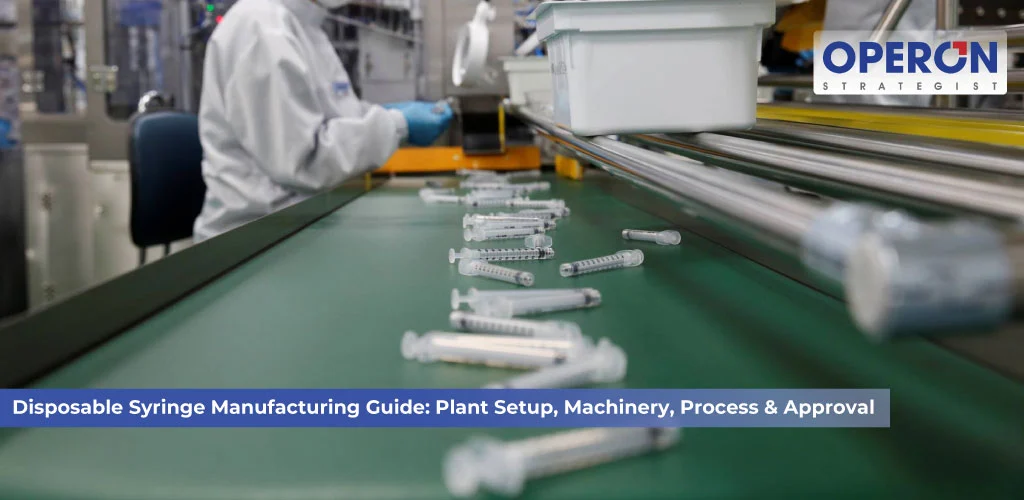
Disposable Syringe Manufacturing Guide: Plant Setup, Machinery, Process & Approval
Disposable syringe manufacturing is the process of producing sterile single-use syringes using medical-grade plastic through molding, assembly, sterilization, packaging, and quality-controlled systems.
As hospitals and healthcare systems move toward sterile single-use devices, the demand for high-quality disposable syringes continues to grow globally.
However, success in syringe manufacturing depends on more than machines. It requires proper plant design, cleanroom systems, validated sterilization, documentation, and regulatory compliance.
Operon Strategist supports companies in setting up compliant disposable syringe manufacturing plants through end-to-end consulting for facility setup, regulatory approvals, process validation, and manufacturing readiness.
Disposable syringe manufacturing is the process of producing sterile single-use syringes using medical-grade plastic through molding, assembly, sterilization, packaging, and quality-controlled systems.
Regulatory Excellence for Global Medical Device Markets
What is Disposable Syringe Manufacturing?
Disposable syringe manufacturing is the process of producing single-use sterile syringes used for medical injections, fluid transfer, drug delivery, and laboratory applications.
These syringes are typically manufactured using medical-grade polypropylene through controlled processes such as injection molding, automated assembly, printing, sterilization, and packaging.
Why is Disposable Syringe Manufacturing in High Demand?
Disposable syringes are essential healthcare consumables with continuous recurring demand across hospitals, clinics, laboratories, and home healthcare.
Key Demand Drivers:
- Large-scale vaccination programs
- Rising diabetes and chronic disease treatment
- Expansion of hospitals and healthcare infrastructure
- Growth in home healthcare and self-administration
- Infection prevention through single-use devices
- Increasing healthcare access in emerging markets
Industry Data Insights:
- The global medical device market is expected to exceed 600 billion dollars by 2030, with consumables like syringes contributing significantly
- Demand surged during global vaccination drives and continues to remain high due to booster programs and chronic care treatments
Industry Insight:
The shift from reusable glass syringes to disposable plastic syringe making has significantly reduced infection risks, making single-use syringes the global standard.
How to Start a Disposable Syringe Manufacturing Plant?
Starting a syringe manufacturing unit requires technical planning, regulatory readiness, and efficient plant execution.
Step 1: Product Planning
Select product range such as:
- 1 ml syringe
- 2 ml syringe
- 3 ml syringe
- 5 ml syringe
- 10 ml syringe
- Insulin syringes
- Veterinary syringes
Step 2: Regulatory Planning
Prepare approvals based on target market:
- CE Marking (if exporting)
- US FDA pathway (if applicable)
Step 3: Facility Setup
Plan manufacturing zones:
- Raw material storage
- Injection molding area
- Controlled assembly area
- Packaging area
- Sterilization area
- QA / QC laboratory
Step 4: Machinery Installation
Install validated production and packaging systems.
Step 5: Validation & Commercial Production
Complete:
- IQ / OQ / PQ
- Process validation
- Sterilization validation
- Packaging validation
What is the Disposable Syringe Manufacturing Process Flow?
Disposable syringe manufacturing involves precision-controlled steps to ensure safety, consistency, and sterility.
Process Flow
- Raw material inspection
- Polypropylene drying
- Injection molding of barrel and plunger
- Graduation printing
- Gasket fitting
- Needle mounting
- Automatic assembly
- Siliconization / lubrication
- Sterilization (commonly EO based)
- Blister packaging
- Final inspection
- Batch release
Critical Control Point
Sterilization must be validated for exposure cycle, temperature, humidity, and residual gas limits.
What Machinery is Required for Disposable Syringe Manufacturing?
A syringe manufacturing plant requires both production machinery and utility systems.
Core Machinery
- Injection molding machines
- Syringe assembly machine
- Printing machine
- Needle fixing machine
- Blister packaging machine
- EO sterilizer
Supporting Equipment
- Air compressor
- Chiller
- Dryer
- Hopper loader
- Scrap grinder
Quality Control Equipment
- Leak tester
- Burst pressure tester
- Dimensional inspection tools
- Sterility testing setup
What Raw Materials Are Used in Disposable Syringe Manufacturing?
The quality of raw materials directly impacts regulatory approval and product performance.
Main Raw Materials
- Medical-grade polypropylene
- Rubber gasket / elastomer
- Stainless steel needle
- Silicone oil
- EO gas (for sterilization)
- Packaging film and cartons
Expert Insight
Only certified medical-grade materials should be used for biocompatibility and safety compliance.
What Regulatory Requirements Are Needed for Disposable Syringe Manufacturing?
Regulatory compliance is one of the most critical success factors in syringe manufacturing.
Core Requirements:
- Medical device manufacturing approval
- Risk Management (ISO 14971)
- Biocompatibility testing (ISO 10993)
- Sterilization validation
- Device Master File (DMF)
- Plant Master File (PMF)
- Product traceability system
Real Industry Challenge:
Many manufacturers face delays because of incomplete documentation or failure in sterilization validation during audits.
Expert Insight:
Regulatory authorities prioritize sterility assurance and traceability, as disposable syringes are invasive medical devices.
India Market Requirements
Manufacturers selling in India typically require approvals under CDSCO / MDR regulations depending on product classification.
What Cleanroom is Required for Disposable Syringe Manufacturing?
Disposable syringes require controlled manufacturing environments because they are invasive medical devices.
Typical Cleanroom Areas
- ISO Class 8 for support areas
- ISO Class 7 for controlled assembly and packaging zones (depending on process design)
Important Controls
- Air changes
- Pressure differentials
- Personnel flow
- Material flow
- Environmental monitoring
What is the Cost to Start a Disposable Syringe Manufacturing Plant?
Plant investment depends on automation level, capacity, cleanroom scope, and target market.
Major Cost Components
- Building / factory space
- Production machinery
- Packaging line
- Sterilization system
- Utility setup
- Working capital
Practical View
Semi-automatic setups need lower investment, while fully automated export-grade plants require higher capital.
What are the Common Challenges in Disposable Syringe Manufacturing?
Many companies face delays due to weak planning rather than production issues.
Common Challenges
- Wrong machine selection
- Poor cleanroom layout
- High rejection rates
- Sterilization failures
- Documentation gaps
- Delayed approvals
- Supplier inconsistency
How to Overcome These Challenges?
Best Practices
- Begin with regulatory roadmap
- Design facility for compliance and efficiency
- Select reliable machine suppliers
- Validate all critical processes
- Maintain documentation discipline
- Conduct internal audits regularly
How Can Operon Strategist Help in Disposable Syringe Manufacturing Plant Setup?
Setting up a syringe manufacturing plant requires engineering, compliance, and execution expertise.
Operon Strategist Support Areas
- Machinery technical evaluation
- Process engineering
- Cleanroom layout design
- ISO 13485 implementation
- IQ / OQ / PQ validation
- Documentation systems
- Expansion planning
Result
Reduced project delays, stronger compliance readiness, and faster commercial launch.
Need Expert Support for Disposable Syringe Manufacturing Plant Setup?
Operon Strategist helps manufacturers with plant design, machinery planning, cleanroom setup, regulatory approvals, ISO 13485 implementation, and validation support for faster project execution.
FAQ'S
Is disposable syringe manufacturing a profitable business?
Yes. Continuous demand from hospitals, clinics, and healthcare programs creates strong business potential.
Which plastic is used in disposable syringes?
Medical-grade polypropylene is commonly used.
What is the biggest challenge in syringe manufacturing?
Regulatory compliance and sterilization validation are the most critical challenges.
What are the most commonly overlooked elements in RTA submissions?
How much investment is required for a disposable syringe manufacturing plant?
Investment depends on capacity, automation level, cleanroom scope, sterilization system, and target market.
Which sterilization method is used for disposable syringes?
Ethylene Oxide (EO) sterilization is commonly used, subject to validated process requirements.
What approvals are required?
Manufacturers must comply with medical device regulations, ISO 13485, and sterilization validation standards.
Can a small syringe manufacturing unit be started?
Yes, businesses can start with scalable setups and expand based on demand.
Can disposable syringes be exported?
Yes. Export is possible after meeting destination-country regulatory and quality requirements.