
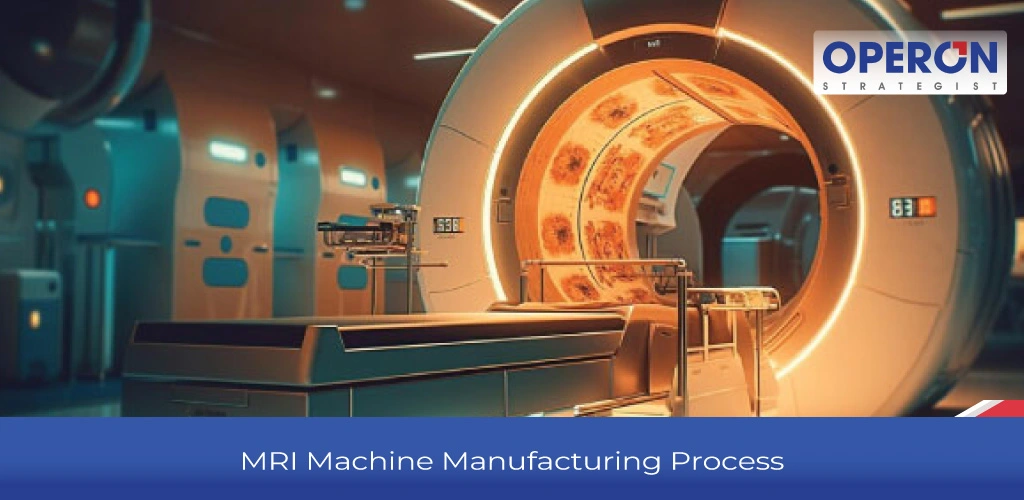
MRI Machine Manufacturing Process
MRI Machine Manufacturing follows seven core stages — feasibility research, design and development, core component manufacturing (magnet, gradient coils, RF system, cryogenics, software), clean room assembly, quality testing, regulatory approval (UKCA, CE, MDR 2017/745), and packaging/distribution. It’s a capital- and technology-intensive process governed by ISO 13485, IEC 60601, and regional medical device regulations.
Magnetic Resonance Imaging (MRI) is one of the most advanced medical imaging technologies used worldwide. As healthcare infrastructure expands, demand for MRI machines is growing steadily across the UK, Europe, and globally. For businesses entering this sector, understanding MRI Machine Manufacturing — from components to compliance — is essential before investing.
Talk to our expert
Why Invest in MRI Machine Manufacturing?
The global demand for MRI machines is being driven by:
- Growing prevalence of chronic diseases and need for accurate diagnostics
- Expansion of hospitals and diagnostic centers
- Technological advancements such as portable MRI and AI-assisted imaging
- Government support for healthcare innovation in the UK and EU
For startups, manufacturers, and medical device investors, MRI machine manufacturing represents a high-potential business opportunity.
Step-by-Step MRI Machine Manufacturing Process
Manufacturing an MRI machine is highly complex and requires precision engineering, regulatory compliance, and advanced technology integration. Below is a simplified step-by-step overview:
1. Research and Feasibility Study
The process starts with market research and feasibility analysis. This includes:
- Identifying target markets (UK, EU, or global)
- Assessing demand and competition
- Calculating investment requirements
- Understanding local regulations for medical devices
This step ensures your project is commercially viable before moving to product development.
2. Design and Development
MRI machines must be designed with safety, efficiency, and accuracy in mind. Key activities include:
- Defining specifications for field strength (1.5T, 3T, or higher)
- Designing patient comfort features (open MRI, noise reduction)
- Integrating advanced imaging software
- Conducting risk assessments and usability engineering
3. Core Component Manufacturing
An MRI system is made up of several specialized parts:
- Superconducting Magnet – Creates the magnetic field, usually cooled with liquid helium.
- Gradient Coils – Allow spatial encoding for image creation.
- RF System (Radiofrequency) – Transmits and receives signals.
- Cryogenics – Maintains the superconducting magnet at ultra-low temperatures.
- Computer and Software System – Processes signals into diagnostic images.
Each of these components requires high-end manufacturing technology and precision engineering.
4. Clean Room Assembly
The components are brought together in a controlled clean room environment to avoid contamination and ensure accuracy. Assembly includes:
- Installing the magnet system
- Integrating RF and gradient coils
- Connecting electronic and software systems
- Performing calibration for safety and accuracy
5. Quality Control and Testing
MRI machines undergo rigorous quality checks at every stage:
- Safety and electromagnetic compatibility testing
- Image quality validation
- Stress and durability tests
- Compliance with international standards like ISO 13485, IEC 60601, and CE marking requirements
This ensures the final device meets the highest standards of performance and safety.
6. Regulatory Approval
In the UK and EU, MRI machines are regulated as high-risk medical devices. Manufacturers must comply with:
- UKCA Marking (for the UK market)
- CE Marking (for the EU market)
- Compliance with Medical Device Regulation (MDR 2017/745)
- Adherence to Good Manufacturing Practices (GMP)
Without these approvals, an MRI machine cannot be marketed or sold.
7. Packaging and Distribution
Once approved, MRI machines are packaged using protective and sterile methods to ensure safe transport. Specialized logistics partners are often involved because of the large size and sensitive components.
Challenges in MRI Machine Manufacturing
Manufacturing MRI machines is capital- and technology-intensive. Key challenges include:
- High initial investment in R&D and infrastructure
- Dependence on cryogenic and superconducting technology
- Strict regulatory approvals
- Skilled workforce requirement
- Managing supply chain for critical components
Overcoming these challenges requires strategic planning, partnerships, and expert consultation.
Opportunities in the UK and Global Market
The UK is actively investing in healthcare modernization and research-driven medical technology. Opportunities include:
- Setting up MRI manufacturing units under UK medical device regulations
- Collaborating with diagnostic centers and hospitals
- Exporting MRI machines to global markets where demand is growing
Governments across Europe and other regions are also encouraging advanced medical device production, making it a suitable time to invest.
Role of Consultants in MRI Machine Manufacturing
For businesses looking to enter the medical device market, working with consultants can save time, cost, and effort. Expert consultants can assist with:
- Feasibility study and project planning
- Clean room and facility design
- Regulatory compliance (UKCA, CE, MDR, ISO 13485)
- Vendor and supply chain management
- Quality assurance and audit support
- End-to-end turnkey project execution
This helps businesses reduce risks and speed up their time-to-market.
How We Can Help
At Operon Strategist, we provide end-to-end consulting support for MRI machine manufacturing projects in the UK and global markets. From feasibility to regulatory approvals, our team ensures your business meets all compliance requirements while staying cost-effective and competitive.
If you are planning to set up or expand your MRI machine manufacturing unit, our experts can guide you through every step of the process.
Ready to start your MRI machine manufacturing journey?
Contact Operon Strategist today and let our experts help you build a compliant and profitable medical device business.
Schedule a Compliance Consultation
Ensure FDA QSR Compliance for Manufacturers with Expert Guidance
FAQ
What is the MRI machine manufacturing process?
The MRI machine manufacturing process includes product design and development, system engineering, component procurement, magnet manufacturing, gradient coil and RF system integration, electronic assembly, software development, mechanical assembly, quality control, verification and validation testing, and final system calibration before regulatory approval and commercialization.
Which international standards apply to MRI machine manufacturing?
MRI manufacturers commonly implement ISO 13485 for quality management systems, ISO 14971 for risk management, IEC 60601-1 for the safety and essential performance of medical electrical equipment, IEC 60601-2-33 for MRI equipment, IEC 62304 for medical device software lifecycle processes, IEC 62366-1 for usability engineering, and ISO 10993 where patient-contacting components require biological evaluation.
Is software validation required for MRI machines?
Yes. MRI systems rely extensively on embedded software for image acquisition, processing, system control, and user interface functions. Manufacturers should develop and maintain software in accordance with IEC 62304, perform software verification and validation, manage cybersecurity risks where applicable, and maintain comprehensive software lifecycle documentation.
What documents are required for MRI machine regulatory approval?
Manufacturers typically prepare technical documentation, ISO 13485 certification, ISO 14971 risk management files, design history records, software documentation, electrical safety and electromagnetic compatibility (EMC) test reports, clinical evaluation where applicable, verification and validation reports, labeling, Instructions for Use (IFU), post-market surveillance documentation, and a Declaration of Conformity for the applicable regulatory jurisdiction.