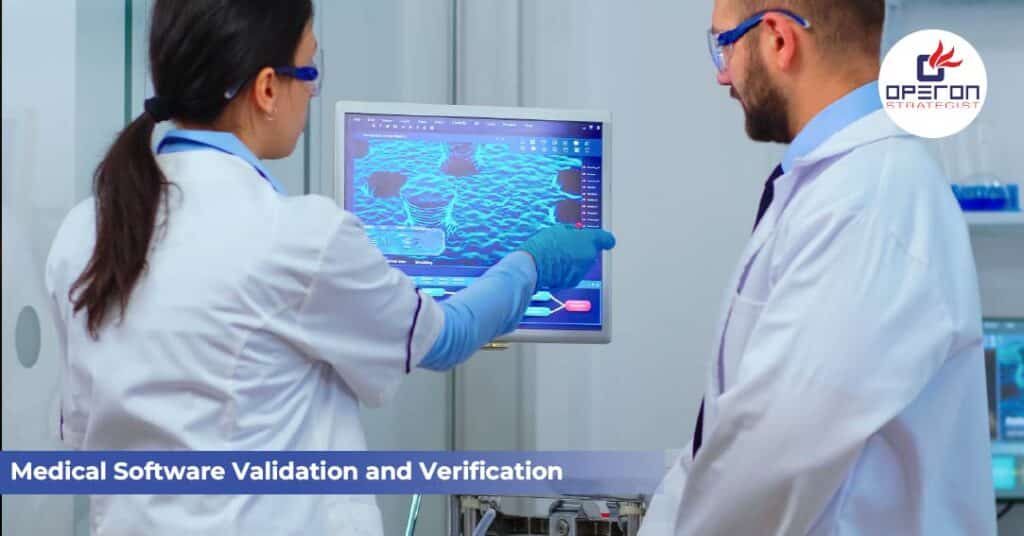
Understanding Medical Software Validation and ISO 13485 Requirements
In today’s rapidly evolving healthcare technology landscape, medical software validation and verification play a crucial role in ensuring device safety, functionality, and regulatory compliance. Whether it’s embedded software in a medical device or a standalone medical app, demonstrating conformity to ISO 13485 software validation requirements is essential for manufacturers seeking market access globally.
This comprehensive guide explains the principles, processes, and documentation involved in aligning software validation and verification activities with ISO 13485 and other international quality standards.
Looking For a Medical Device Regulatory Consultant?
Let’s have a word about your next project
What Is Medical Software Validation and Verification?
Medical software validation is the documented process of ensuring that a software system meets user needs and its intended use, while verification ensures that each design output meets its corresponding input requirements.
Simply put:
- Verification answers the question: Are we building the product right?
- Validation answers: Are we building the right product?
Both are essential components of software life cycle management and are fundamental to achieving ISO 13485 compliance for medical software.
Why ISO 13485 Requirements Matter for Medical Software?
ISO 13485 is the globally recognized quality management system (QMS) standard for medical devices, including those containing or controlled by software. It emphasizes risk management, design controls, and traceability throughout the product life cycle.
Key reasons why ISO 13485 software validation requirements matter include:
- Ensuring consistent software performance under expected conditions.
- Reducing patient and user risks.
- Demonstrating regulatory compliance for audits and market approval.
- Enhancing confidence among Notified Bodies and regulatory authorities such as the FDA, SFDA, and CDSCO.
Following ISO 13485, manufacturers align their processes with global expectations—facilitating smoother submissions and approvals across multiple regions.
ISO 13485 Validation and Verification Process
The ISO 13485 validation and verification process for medical software typically involves several structured stages:
- Software Planning
Establish a Software Development Plan (SDP) covering responsibilities, procedures, and verification of milestones. This plan should align with risk classification per IEC 62304.
- Requirements Definition
Identify functional, performance, and safety requirements that define the intended use of the software. These requirements form the foundation for all verification activities.
- Design and Development
Document the software architecture, modules, and data flow diagrams. Each design element should be traceable to its corresponding requirement.
- Verification Activities
Conduct code reviews, static analysis, and integration testing to confirm that the design outputs meet input requirements. Verification ensures that no unintended functionalities exist.
- Validation Testing
Perform system-level and user acceptance testing to demonstrate that the final software performs as intended in its real-world environment.
- Risk Management Integration
Integrate risk assessments per ISO 14971 throughout all stages of development. Any identified hazard should have a corresponding verification or validation of control.
- Documentation and Record Keeping
Maintain detailed documentation such as:
- Validation Plan and Report
- Verification Protocols
- Test Cases and Results
- Traceability Matrix
- Configuration Management Records
This documentation supports ISO 13485 process validation and facilitates regulatory audits.
Common Challenges in Software Validation for Medical Devices
Manufacturers often face several challenges during software validation in medical devices, including:
- Incomplete documentation or missing traceability.
- Poor linkage between risk management and validation activities.
- Inadequate test coverage or lack of independent review.
- Misinterpretation of regulatory differences between FDA and ISO standards.
Addressing these issues early ensures smoother audits and faster product launch timelines.
Global Regulatory Perspective on Software Validation
While ISO 13485 serves as the foundation, other authorities such as the U.S. FDA, European MDR, and SFDA (Saudi Food and Drug Authority) also mandate software validation and verification as part of product approval.
- The FDA emphasizes validation under 21 CFR Part 820.30 (Design Controls).
- EU MDR 2017/745 focuses on software as a medical device (SaMD) classification and clinical evaluation.
- SFDA follows a risk-based approach consistent with ISO and FDA guidelines.
By aligning software validation and verification with ISO 13485 requirements, manufacturers can streamline global submissions and ensure a harmonized quality approach.
Role of Operon Strategist in Medical Software Validation
Operon Strategist, a leading medical device regulatory consulting company, offers end-to-end assistance for medical software validation and verification under ISO 13485 and FDA guidelines.
Our services include:
- Preparation of validation and verification protocols.
- Development of risk-based validation documentation.
- Guidance on QMS integration for ISO 13485 certification.
- Support for technical file and design dossier preparation.
- Consulting for global regulatory submissions (FDA, CE, SFDA, CDSCO).
With a deep understanding of regulatory expectations, Operon Strategist ensures that your medical software complies with all relevant international standards.
Ready to Validate Your Medical Software with Confidence?
FAQ'S
To confirm that the software consistently performs as intended, ensuring patient safety and compliance with ISO 13485.
Verification confirms design accuracy, while validation confirms that the device fulfills its intended purpose under real conditions.
Yes. Any software classified as a medical device must demonstrate compliance with ISO 13485 standards.
Essential documents include the validation plan, risk assessment, test protocols, traceability matrix, and validation report.
Operon Strategist provides comprehensive consulting for planning, documentation, and implementation of validation and verification aligned with ISO 13485 and FDA expectations.