
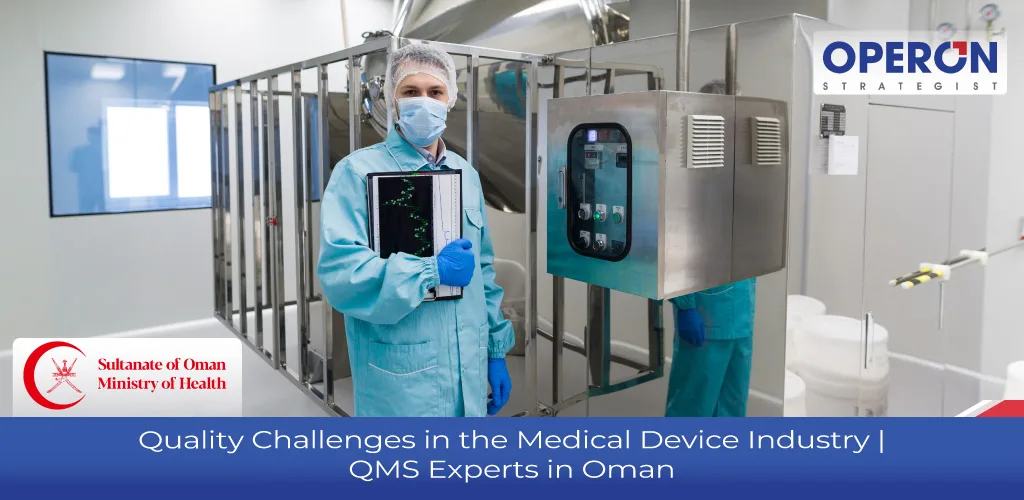
Quality Challenges in the Medical Device Industry | QMS Experts in Oman
Understanding Quality Challenges in the Medical Device Industry in Oman
As Oman strengthens its regulatory environment for healthcare, quality challenges in the medical device industry are becoming increasingly complex. Manufacturers in Oman must adapt to evolving international standards while aligning with Ministry of Health (MOH Oman) requirements.
At Operon Strategist, we specialize in helping manufacturers in Oman address these challenges by implementing robust Quality Management Systems (QMS) and achieving global compliance.
Looking For a Medical Device Regulatory Consultant?
Why a QMS is Crucial in Tackling Quality Challenges
A Quality Management System (QMS) forms the backbone of compliant and safe medical device manufacturing. Without a strong QMS, manufacturers risk non-compliance, recalls, and regulatory delays.
Here’s how QMS addresses Oman’s market needs:
- Regulatory Compliance: Stay aligned with Oman MOH, ISO 13485, EU MDR (CE Marking), and FDA 510(k) QMSR standards.
- Product Reliability: Build safe, effective devices through validation, testing, and traceability protocols.
- Standardized Processes: Minimize errors and documentation gaps across design, production, and post-market stages.
- Improved Market Access: Meet local and international regulatory expectations for faster approvals.
- Stakeholder Trust: Showcase your commitment to quality and patient safety.
Top Quality Challenges in the Medical Device Industry (2025 Outlook – Oman Focus)
- Keeping Up with Regulatory Changes: Global and regional regulatory landscapes—including EU MDR and Oman’s evolving MOH guidelines—are dynamic. Companies must continuously update their QMS to stay compliant and avoid market entry delays.
- Lack of Cross-Department Integration: Siloed teams can delay quality improvements. Effective QMS implementation in Oman requires coordinated efforts across QA, RA, engineering, and manufacturing.
- Outdated or Generic Quality Tools: Using spreadsheets or generic software won’t meet Oman MOH or ISO 13485 standards. Industry-specific QMS platforms provide better audit readiness and risk control.
- Weak Risk Management Integration: Incorporating ISO 14971-based risk management across product design, manufacturing, and post-market surveillance is key to ensuring device safety in Oman and abroad.
- Poor QMS Implementation Planning: A strong QMS rollout requires clear communication, trained teams, and tailored documentation. Without it, adoption fails and quality suffers.
Operon Strategist: Your QMS & Regulatory Partner in Oman
- Operon Strategist help medical device manufacturers in Oman overcome complex quality challenges by offering full-spectrum consulting services:
- Regulatory Guidance for Oman & Global Markets:
Navigate Oman MOH regulations, CE Marking, FDA 510(k), and ISO 13485 with confidence. - QMS Development & Optimization:
Design and implement QMS that fits your device class, market strategy, and risk profile—fully compliant with ISO 13485:2016. - Risk Management Implementation:
Integrate risk controls across the device lifecycle with ISO 14971-compliant processes. - Audit Readiness & Global Market Support:
Be prepared for MOH inspections, ISO audits, and international submissions with gap analysis and mock audits.
FAQ
What are the biggest quality challenges in the medical device industry?
Common quality challenges include maintaining regulatory compliance, implementing an effective ISO 13485 quality management system, supplier quality management, process validation, design control, risk management, CAPA implementation, document control, traceability, complaint handling, and ensuring consistent product quality throughout the device lifecycle.
How does ISO 13485 help overcome quality challenges?
ISO 13485 provides a structured quality management framework that helps manufacturers establish standardized processes, strengthen document control, improve supplier management, implement effective CAPA systems, enhance traceability, support risk management, and demonstrate compliance with applicable regulatory requirements.
Why is risk management important for medical device quality?
Risk management, typically implemented in accordance with ISO 14971, helps manufacturers identify, evaluate, control, and monitor risks throughout the product lifecycle. Integrating risk management into the quality management system improves product safety, regulatory compliance, and overall quality performance.
What role does a Quality Management System (QMS) play in regulatory compliance in Oman?
A Quality Management System aligned with ISO 13485 helps manufacturers demonstrate consistent product quality, maintain regulatory documentation, support technical file preparation, improve process control, facilitate manufacturer registration, and meet the expectations of the Oman Ministry of Health (MOH) for medical device compliance.