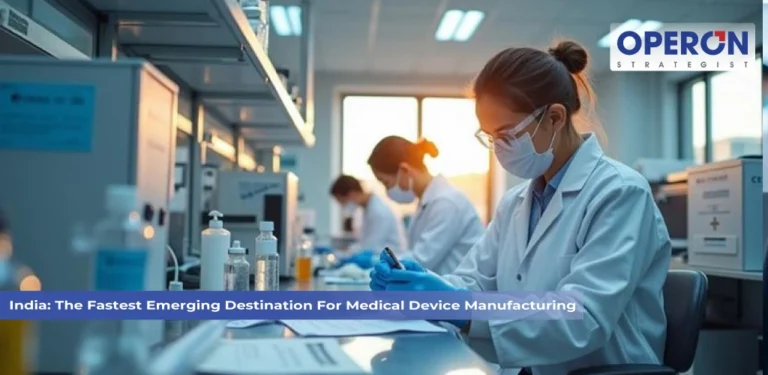
India: The Fastest Emerging Destination For Medical Device Manufacturing
Overview
Driven by a growing population, scientific advancements, expanding healthcare coverage, and government incentives like the “Make in India” initiative, medical device manufacturing in India has emerged as a top choice for global Original Equipment Manufacturers (OEMs). Offering significant cost advantages—such as competitive labor rates (3/hr vs. 9/hr in traditional hubs), specialized MedTech parks, robust Intellectual Property (TRIPS compliant) protection, and an advanced engineering ecosystem—India provides global medical device companies with an optimal destination for contract manufacturing, design-to-cost scaling, and global market expansion.
Contact Us
The Shift Toward India for Medical Device Contract Manufacturing
Global Original Equipment Manufacturers (OEMs) face mounting challenges in traditional manufacturing hubs like China, the U.S., and Ireland. High labor and raw material overheads, fragmented supply chains, trade policy uncertainties, and declining margins on imported finished goods have forced MedTech companies to seek resilient alternative manufacturing destinations.
| Aspect | Global Bottlenecks | India’s Strategic Advantage |
| Labor & Overhead Costs | High and escalating labor expenses ($9+/hr in traditional manufacturing hubs) | Highly competitive labor costs (~$3/hr) combined with a skilled engineering workforce |
| Supply Chain & Infrastructure | Fragmented supply chains and higher operational delays | Specialized MedTech industrial parks with shared testing infrastructure and streamlined logistics |
| Market Strategy & Trade Policies | Unfavorable trade policies and declining margins on imported finished goods | Government backing (“Make in India”, PLI schemes) with a strong design-to-cost manufacturing framework |
India has established itself as an attractive destination through its design-to-cost framework and an expanding industrial ecosystem. For companies aiming to enter this rapidly growing market, exploring a detailed medical device market analysis provides key data on local demand and competitive positioning.
5 Key Factors Driving Medical Device Manufacturing in India
India’s growth as a MedTech manufacturing hub rests on five structural advantages:
| Factor | Strategic Advantage in India | Global Impact |
| 1. Skilled Engineering Talent | Experienced technical workforce, proven product engineering expertise, and English proficiency. | Seamless international collaboration and high design-to-cost performance. |
| 2. Government Support & Infrastructure | “Make in India” policies, GST rationalization, and dedicated MedTech parks in Andhra Pradesh, Telangana, Kerala, and Tamil Nadu. | Shared testing facilities that lower capital expenditure and operational costs. |
| 3. Cost-Effective Operations | Highly competitive labor costs (3/hr vs. 9/hr in China) alongside raw material affordability. | Reduced cost of goods sold (COGS) without compromising quality standards. |
| 4. Robust Data Security & IP Protection | Alignment with TRIPS and the amended Patents Act, backed by audited cybersecurity protocols. | Secure environment for global OEMs outsourcing high-end IP and engineering. |
| 5. Advanced Tech Integration (IoT & AI) | Integration of Industry 4.0, smart automation, AR/VR, and IoT-driven supply chain tracking. | Optimized production schedules, zero-defect manufacturing, and asset tracking. |
Availability of Skilled Technical Workforce
Medical device OEMs require engineering partners capable of supporting complex instrument designs. India offers a large talent pool of qualified engineers with expertise in hardware, software, and mechanical development, enabling global firms to scale product engineering operations smoothly.
Also Read: New Medical Devices Bill 2023 Demands Recall: AiMeD.
Government Initiatives & Specialized MedTech Parks
Programs under the “Make in India” campaign have shifted the government’s role from a pure regulator to an industry facilitator. The establishment of specialized medical device parks across states such as Andhra Pradesh, Telangana, Kerala, and Tamil Nadu provides manufacturers with plug-and-play infrastructure and shared testing laboratories. Learn how broader regulations impact this landscape in our article on opportunities in medical device manufacturing.
Planning to set up a medical device manufacturing unit in India
Consult Operon Strategist’s facility setup experts to design a cGMP and CDSCO-compliant plant
Cost-Effective Operations & Engineering Excellence
India offers significant operational savings, with typical contract labor costs averaging around 3 per hour compared to 9 per hour in traditional manufacturing hubs. Concurrently, Indian manufacturing facilities handle complex miniaturization, connected device assembly, and high-precision production processes.
Also Read: Opportunities in Medical Device Manufacturing (2025–2035)
Intellectual Property Protection & Data Security
Indian engineering partners operate under strict international data security frameworks and TRIPS-compliant patent laws. Regular system audits and robust cybersecurity protections ensure that foreign OEMs maintain control over their intellectual property during contract manufacturing.
Advanced Production Ecosystem & Industry 4.0
The integration of Machine Learning (ML), IoT asset tracking, and automated Quality Management Systems allows Indian facilities to streamline raw material usage and meet tight delivery timelines reliably. For advanced applications like smart implants and diagnostic tools, read our post on nanomaterials in medical devices.
How Operon Strategist Accelerates Your Manufacturing Facility Setup in India
Establishing an audit-ready, compliant manufacturing facility requires thorough engineering and regulatory execution. Operon Strategist delivers turnkey facility layout, plant engineering, and regulatory consulting services tailored for medical device manufacturers setting up operations in India:
cGMP Plant Layout & Detail Engineering (Operon BuildNext): Architectural, structural, cleanroom (ISO 14644), and HVAC design engineered to prevent cross-contamination and ensure zero-crossflow material and personnel workflows.
CDSCO Manufacturing Licensing & Regulatory Approvals: Complete execution for obtaining CDSCO Test Licenses (Form MD-12/13) and commercial Manufacturing Licenses (Form MD-5/7/9/11) under the Medical Device Rules (MDR 2017).
ISO 13485 Quality Management System (Operon ElevatePlus): Turnkey QMS design, technical file compilation, Design History File (DHF) preparation, and risk management (ISO 14971) integration.
Cleanroom Validation & Equipment Qualification: Comprehensive support for Installation, Operational, and Performance Qualifications (IQ/OQ/PQ) across cleanrooms, utilities, and specialized production machinery.
Audit Defense & Pre-Inspection Audits: Conducting gap analyses, mock inspections, and providing on-site defense during CDSCO, US FDA, and Notified Body facility audits.
Also Read: Nanomaterials in Medical Devices
Need CDSCO manufacturing licensing
Connect with Operon Strategist today for complete technical guidance
FAQ's
Why is India an ideal destination for medical device manufacturing?
India offers low operational costs (3/hr labor), skilled engineering talent, strong IP protection, government incentives, and dedicated MedTech industrial parks with shared testing facilities.
What government policies support medical device manufacturing in India?
Policies like “Make in India”, GST rationalization, PLI schemes, and state-backed MedTech parks in states like Andhra Pradesh and Telangana help lower set-up costs and streamline manufacturing.
What regulatory standards govern medical device plants in India?
Medical device plants in India are governed by the CDSCO under the Medical Device Rules (MDR 2017), requiring ISO 13485 QMS compliance and cGMP-certified cleanrooms (ISO 14644).
How does India protect Intellectual Property (IP) for global OEMs?
India is a signatory to the TRIPS agreement and aligns its Patents Act with global standards, ensuring robust data security, detailed legal contracts, and regular cybersecurity audits for contract manufacturing.
How does Operon Strategist support setting up a manufacturing plant in India?
Operon Strategist provides end-to-end consulting, including cGMP plant layout engineering, cleanroom HVAC design, CDSCO licensing, ISO 13485 QMS setup, and audit defense support.