
Assistant Manager
Projects & Process Engineering | 14 Years of Experience
Introduction
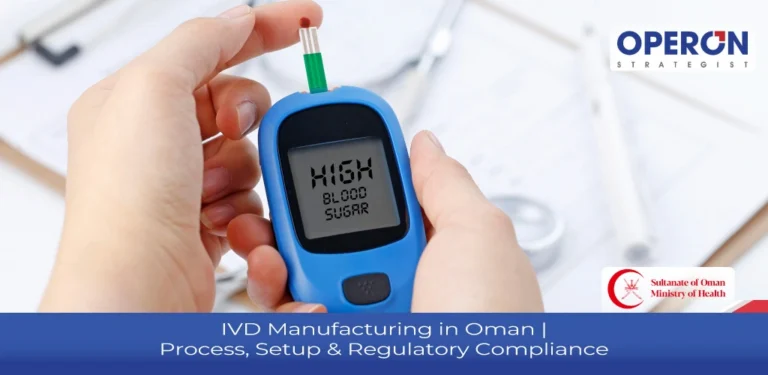
Oman-based IVD manufacturing is emerging as an area of great potential within healthcare innovation and increased local manufacturing capability. IVD devices are crucial to the diagnosis, monitoring and prevention of diseases. IVD devices include diagnostic kits, reagents, calibrators, control materials, specimen containers, software, and equipment for examining specimens obtained from the human body.
When starting a business of IVD manufacturing in Oman, manufacturers and investors have to do more than choose equipment and manufacturing site. For a successful implementation of an IVD manufacturing facility, they need feasibility studies, proper facility design including clean room design, raw material sources, manufacturing, quality management and testing procedures as well as regulatory considerations.
The MOH regulations on IVD registration and standards that should be considered by the manufacturer when making an IVD product in Oman have to be known.
This guide gives information on business opportunities, process of manufacturing, facility design, quality standards, regulations and the assistance that Operon Strategist can provide in IVD manufacturing in Oman.
Why Invest in IVD Manufacturing in Oman?
Oman provides prospects for development of the medical and diagnostic equipment manufacturing industries as the need for healthcare is increasing and Oman is aiming at developing its own industrial capacity. IVD companies should analyze the below mentioned business drivers before setting up a plant.
1. Increasing Need for Healthcare
The need for healthcare is increasing in Oman with diagnostics playing an important role in disease diagnosis and prevention. Hospitals, diagnostic centers and healthcare centers require reliable IVD products thus providing opportunities for manufacturers who can meet quality requirements and regulations.
2. Favorable Business Environment
Business people can look into the business environment of Oman and zones available to set up their plants along with government incentives related to such activities. Availability and suitability of government incentives will depend upon the location of the business, type of activity and prevailing investment environment in the country.
3. Import Substitution
The manufacture of IVD products locally could help decrease reliance on the imports of diagnostics products. Local manufacturing of the products could also help establish the supply chain locally and increase availability of the products to healthcare providers.
4. Export Opportunities
The geographical position of Oman could offer an opportunity to assess the market access of the GCC, Africa, and Asia. Exporting IVD products, however, will require the manufacturers to comply with regulatory requirements of the respective destination countries.
Step-by-Step IVD Manufacturing Process in Oman
Establishment of IVD manufacturing facility is a process which requires strategic coordination among feasibility, engineering, procurement, production, quality and regulatory functions. Below are the phases which give a good overview.
1: Feasibility Study and Market Research
Prior to establishment of IVD manufacturing facility in Oman, the manufacturers need to evaluate the feasibility and commercial potential of their products.
The activities which need to be undertaken include:
- Evaluation of demand for IVD products, testing kits and reagents in Oman as well as potential markets outside Oman.
- Identification of the target customer base including hospitals, diagnostic centers, distributors and healthcare facilities.
- Evaluation of competing products, degree of dependency on imports, cost and marketing.
- Feasibility study and preparation of feasibility report for the investors.
Evaluation of cost of the project, production capacity, equipment needs, operating cost and market demand.
Evaluation of the regulatory and quality needs for IVD product development.
2: Facility Layout
Facility planning is a key component of IVD manufacturing. The facility layout needs to provide for efficient flow of materials, people, processes, test and finished goods while avoiding contamination or misidentification.
Points to consider:
- Establish proper controlled environments and cleanroom facilities when required for the particular product and manufacturing process.
- Take into consideration the appropriate ISO 14644 cleanroom classification and environmental monitoring when required by cleanrooms.
- Plan for the material flow, people flow, storage, production, packaging and quality control operations.
- Design the manufacturing facility layout according to the requirements of MOH and quality management system based on ISO 13485.
- Provide for utilities, ventilation, environmental control and equipment space.
- Plan future production capacity and product line expansion.
The need for cleanroom will be established by the particular product, process, potential contaminants and environmental controls required. Not every IVD manufacturing will require cleanroom of the same classification.
3: Raw Material Procurement and Testing
Quality of raw materials has a direct impact on IVD product performance, consistency and reliability. An effective supplier qualification and incoming material inspection program is necessary for manufacturers.
Depending on the type of the IVD product, raw materials can consist of:
- Reagents and chemical components.
- Plastics and other materials for product housing, containers, consumables.
- Electrical components for instruments and other equipment.
- Packaging materials and product accessories.
- Major tasks to perform:
- Identify and qualify suppliers based on specific quality and technical criteria.
- Develop procedures for incoming inspection and acceptance of raw materials.
- Ensure material specifications and certificates (when applicable).
- Carry out raw materials, biocompatibility and sterility testing (if appropriate according to the design of the device, materials usage and applications).
- Keep track of raw materials and critical components.
Testing procedures should be selected according to the IVD product characteristics. For instance, biocompatibility and sterility testing can be appropriate for the device depending on its design, components contacting with the specimen or application. However, not every reagent and IVD kit requires such tests.
4: Manufacturing and Assembly
IVD manufacturing and assembly shall be done through well-controlled and documented procedures to ensure high-quality, precise and consistent product performance.
Manufacturers shall:
- Develop manufacturing procedures and work instructions.
- Follow Good Manufacturing Practice (GMP) and Quality Controls appropriate for the manufacturing process being used.
- Identify manufacturing process parameters and acceptance criteria.
- Perform in-process inspections and quality control tests.
- Automate processes when necessary to increase process consistency and precision, and efficiency of production.
- Train personnel in their manufacturing and quality responsibilities.
- Keep manufacturing records for materials, batches and finished products.
Manufacturing procedures will vary depending on the kind of product manufactured in the establishment (reagents, test kits, instruments or combinations of the above).
5: Packaging and Sterilization
The packaging must ensure that the performance and shelf life requirements of the IVD product are maintained during the handling, storage, and transport of the product.
Manufacturing companies must:
- Choose packaging materials compatible with the device and storage conditions.
- Set specifications for packaging and inspection methods.
- Test packaging integrity and product protection.
- Validate sterilization processes when the IVD device needs to be sold as a sterile device.
- Keep relevant records for packaging, sterilization, and validation of sterilization process.
ISO 11607 deals with packaging systems for terminally sterilized medical devices. Its applicability depends on the IVD product and the need for sterilization during manufacture. All IVD products do not necessarily have to be sterilized.
6: Quality Management System & Process Validation
A quality management system enables the manufacturer to manage design, procurement, manufacture, testing, documentation and activities after production.
In order to manufacture IVDs, manufacturers need to:
- Implement a quality management system according to ISO 13485.
- Apply ISO 14971 risk management principles, where appropriate to the IVD device.
- Implement document control and retention.
- Define supplier qualification and incoming inspection procedure.
- Validate manufacturing processes where necessary.
- Implement equipment qualification, calibration and maintenance control.
- Implement product verification, analytical performance and stability testing.
Implement procedures for non-conformities, corrective action and continual improvement.ISO 13485:2016 establishes the framework for quality management systems for the medical device organizations, while ISO 14971:2019 is the framework for risk management which can also be applied to IVD medical devices.
7: Regulatory Approval & IVD Registration in Oman
The IVD devices have to meet the appropriate Oman regulatory requirements before being marketed within the country. The Medical Devices Control Department of the Drug Safety Center (DSC) and its IVD Device Registration Section is responsible for IVD registration.
Oman developed a guideline titled ‘Guideline on Requirements of Class C & D In Vitro Diagnostic Devices Registration in the Sultanate of Oman’ in
The preconditions for registration of Class C and D IVDs are the following:
- The initial approval of wholesale activities.
- The local establishment approval.
- Registration of the medical devices manufacturer.
- Submittal of the application for IVD registration via the website.
- Payment of necessary fees in accordance with the risk class of the device.
An incorrect risk classification can lead to the need to resubmit the application in accordance with the correct class. The Drug Safety Center can also require additional documents according to the product category.
As for Class C and D IVD applications, the guidance describes the dossier information that can include:
- Type of application and IVD risk classification.
- Legal manufacturer information and Quality Management System description, including information on ISO 13485 certification, if applicable.
- Device name, model, purpose of the device, device category and identification information.
- Methodology for traceability, storage conditions, shelf life and warning(s) related to the product, if any.
- Product labeling, which includes IFU, device label, product labels, packaging and promotional material/catalogue.
- Documentation of conformity to essential requirements concerning safety and performance.
- Design verification and validation information, including information regarding manufacturing process, when applicable.
- Product verification and validation information, including certificates when applicable based on the regulation.
- Clinical and analytical performance documentation, stability and shelf life test results, and software validation, if applicable.
- Post market surveillance and safety update reporting, when applicable.
- Declaration of conformity, benefit-risk and risk management information.
The guidance document for Class C & D of Oman states that all sections of the dossier are mandatory for Class D of high risk IVD devices but Class C devices of moderate to high risk IVDs have exemptions from section 5 and section 6. Manufacturers need to consult the current guidance document.
8: Preparation for Meeting Requirements of Export Markets
If manufacturers intend to export the IVD device, then it would be necessary to consider each individual destination market on its own.
For instance:
- European Union: IVD devices marketed within the European Union have to comply with the appropriate version of the In Vitro Diagnostic Medical Devices Regulation (IVDR 2017/746).
- GCC markets: It will be important to review the individual country’s registration, quality, labelling, and import requirements in the destination market.
- Other international markets: Regulatory requirements will vary depending on the destination and could include product registration, quality system information, technical documentation, and representation in that market.
It should be noted that CE marking is relevant to exporting the IVD devices to the European Union and not every other destination market.
Regulatory Compliance Standards for IVD Manufacturing in Oman
The QMS for a compliant IVD manufacturer should take into account the purpose, risk profile, manufacturing process, and markets to which the product will be supplied.
1. Registration through Oman Ministry of Health
IVD devices are registered through the MOH Drug Safety Center and its Medical Devices Control Department. The Medical Devices Control Department has a section for IVD device registration for imported IVD devices or devices produced locally in Oman.
Before applying for registration, manufacturers should make sure about the specific guidelines and classifications for the particular product.
2. ISO 13485 Certification and Quality Management
The ISO 13485:2016 is an important international standard that applies to the QMS of any organization that designs, develops, produces, installs and services medical devices such as IVD devices.
It enables the organization to have controlled design and development, purchasing, manufacturing, quality control, documentation, and processes.
3. Risk Management – ISO 14971
The ISO 14971:2019 standard provides an effective process that includes hazard identification, risk assessment and evaluation, risk control measures, and monitoring the efficacy of risk control measures.
Risk management by IVD manufacturers should be linked to the intended use, design, production processes, performance, and post-market operations of the product.
4. CE Marking and GCC Market Entry
The CE marking according to EU IVDR standards is mandatory for all IVD devices sold within the European Union market. Manufacturers seeking entry into GCC countries should independently analyze the regulations of the destination markets.
It is important to consider the product registration, technical documentation, labeling, quality systems, and market representation requirements for each of those countries.
5. Labeling and Unique Device Identification (UDI)
The labeling and traceability of an IVD should conform to the registration dossier of the product as well as the regulation requirements.
Assessment of:
- Name of the device, model, and manufacturer.
- Intended use and instructions.
- Precautions and storage conditions.
- Lot number.
- Shelf-life information, wherever applicable.
- Packaging and labeling.
- UDI/any other identification requirements according to target market.
Class C & D IVD registration for Oman specifies the following as part of the labeling section of the dossier: IFU, device label, product labels, and packaging, and promotional/catalogue material.
Business Opportunities in Oman's IVD Sector
There could be various business and product areas in IVD manufacturing where manufacturers/investors may find business opportunities. The below mentioned could be some key business areas, which manufacturers/investors should consider while making their market entry and facility planning.
1. Cooperation with Hospitals & Diagnostic Centers
Local manufacturers may have opportunities to form partnership and supply relationships with the hospitals and diagnostic centers that would need reliable diagnostic devices.
2. Reagents & Consumables
Reagents, kits and other consumables are critical parts of laboratory tests. Manufacturers may want to identify opportunities to manufacture such products based on market needs and technical capacity.
3. OEM Manufacturing & Export Potential
Under OEM manufacturing, there would be chances of manufacturing products for other brands depending on technical/quality/regulatory responsibility. There may be opportunities for export of manufactured products in GCC, Africa and Asia regions.
4. Government-Supported Healthcare Manufacturing Initiatives
The manufacturers can consider the healthcare manufacturing and development projects, as well as the investments and procurement projects in Oman. The eligibility, project details, and applicable incentives need to be confirmed from the concerned authorities.
How Operon Strategist Helps Establish IVD Manufacturing Facilities in Oman
Operon Strategist provide full-service consultancy services in relation to manufacturing of IVD in Oman, starting from feasibility studies, business planning, facility engineering, quality systems, and regulatory compliance for the IVD manufacturing projects.
The services include:
- Feasibility studies and business planning: Market assessment for IVD manufacturing, feasibility studies and project planning in terms of demand, requirements and opportunity for IVD manufacturing.
- Facility setup and clean room designing: Facility planning, plant design and clean room design according to the relevant ISO requirements and manufacturing process requirements.
- Process engineering: Process planning, equipment, workflow and manufacturing process setup.
- Regulatory consultancy: MOH IVD registration planning and CE marking planning for companies intending to manufacture products in the European Union.
- Technical and quality system documentation: Technical documentation, quality system documentation and validation services.
- Personnel training: Training of staff in terms of ISO 13485 and GMP requirements.
Our goal is to assist manufacturers in planning a compliant, cost effective and scalable manufacturing set up of IVD.
FAQ
What are the regulatory requirements for IVD manufacturing in Oman?
IVD devices must meet applicable MOH registration requirements. Manufacturers should address local establishment approval, manufacturer registration, correct risk classification and product-specific dossier requirements.
Which quality standards are important for IVD manufacturing in Oman?
ISO 13485:2016 supports the quality management system, while ISO 14971:2019 provides a risk management framework. Other standards depend on the product and manufacturing process.
What documents are required for IVD registration in Oman?
Depending on the risk class, documents can include manufacturer and device details, QMS information, labeling and IFU, conformity evidence, performance data, risk management and post-market documentation.
How long does IVD registration take in Oman?
The timeline depends on the IVD risk class, dossier completeness, prerequisites and regulatory review. Confirm the current processing timeline with the MOH portal; the Class C and D guidance does not establish one universal timeline for every IVD application.
Is ISO 13485 certification required for IVD manufacturing in Oman?
ISO 13485 is an important QMS standard for IVD manufacturers. Oman’s Class C and D registration guidance requests manufacturer QMS information and relevant certificate details. Confirm the applicable requirements for your manufacturer and device category.
Assistant Manager – Projects & Process Engineering | 14 Years of Experience
Medical device manufacturing professional specializing in manufacturing plant feasibility, facility and cleanroom planning, process development, machinery selection, and equipment qualification (DQ, IQ, OQ, PQ). His expertise includes project cost estimation, procurement planning, and process optimization in alignment with ISO 13485:2016.