
Assistant Manager
Regulatory Affairs | 5.7+ Years of Experience
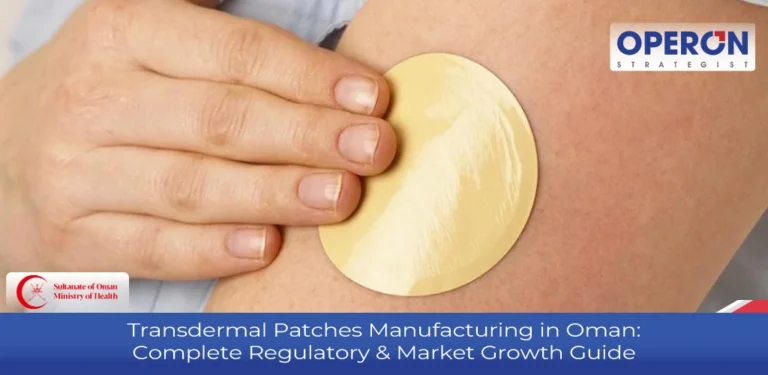
Transdermal patches are drug delivery systems designed to release therapeutic substances through the skin over a controlled period. They offer a non-invasive alternative to oral medicines and injections for selected treatments, including pain management, hormone therapy, cardiovascular conditions and smoking cessation.
For pharmaceutical manufacturers considering local production or regional expansion, transdermal patch manufacturing in Oman requires early planning around product classification, pharmaceutical GMP, manufacturing controls and market-specific regulatory requirements.
A transdermal patch combines an active pharmaceutical ingredient (API) with materials such as adhesives, polymers, backing films and release liners. Depending on the product design and the market, the patch may be assessed as a medicinal product or as a drug-device combination product. Manufacturers should establish the applicable regulatory pathway before finalizing the formulation, facility design and technical documentation.
What Are Transdermal Patches?
ransdermal patches are adhesive-based dosage forms that deliver a drug through the skin into systemic circulation. The formulation and patch design control how the active ingredient is released and absorbed over the intended application period.
Structure of a Transdermal Patch
A typical transdermal patch contains:
Drug reservoir or matrix layer: Holds the active pharmaceutical ingredient.
Adhesive layer: Keeps the patch attached to the skin.
Backing membrane: Protects the formulation and provides structural support.
Release liner: Covers the adhesive surface before application and is removed before use.
Types of Transdermal Patches
Matrix patches: The drug is dispersed within a polymer or adhesive matrix.
Reservoir patches: The drug is held in a separate reservoir, with a membrane controlling release.
Multi-layer patches: Multiple layers are used to support controlled or staged drug release.
Therapeutic Applications
Transdermal patches are used in several therapeutic areas, including:
Nicotine replacement therapy
Hormone replacement therapy, including estrogen and testosterone
Pain management, including fentanyl patches
Cardiovascular treatment, including nitroglycerin patches
Their potential benefits include controlled drug release, reduced dosing frequency, improved patient convenience and reduced gastrointestinal exposure compared with some oral dosage forms.
Regulatory Classification of Transdermal Patches in Oman
Transdermal patches contain an active pharmaceutical ingredient and a delivery system. Their regulatory classification depends on the product’s composition, intended purpose, claims and applicable national requirements.
In Oman, the Ministry of Health’s Drug Safety Center (DSC) oversees the regulation of medicines, medical devices and medical supplies. The former Directorate General of Pharmaceutical Affairs and Drug Control (DGPA&DC) was renamed the Drug Safety Center following the restructuring of the Ministry of Health.
How Oman Assesses Product Classification
The Drug Safety Center provides a product-classification process that considers factors such as:
Active ingredients in the formulation
Pharmaceutical dosage form
Medical claims stated on the packaging or product leaflet
Regulatory status in reference countries
Manufacturers should obtain clarity on the product category and applicable registration route before preparing the submission dossier. A patch whose principal intended action is pharmacological may follow a medicinal-product pathway, while the device-related elements may also require supporting quality and safety evidence.
The regulatory route should be confirmed for the specific formulation and presentation. Manufacturers should not assume that every transdermal patch follows an identical pathway.
Global Regulatory Requirements for Exporting Transdermal Patches
Companies manufacturing transdermal patches in Oman for international markets must assess the requirements of each destination country. The applicable framework can differ according to product classification and the role of the patch components.
United States
The US Food and Drug Administration (FDA) regulates combination products under 21 CFR Part 3, which addresses product classification and assignment of the lead center based on the primary mode of action.
Depending on the product and its constituent parts, manufacturers may need to consider:
21 CFR Part 4: Current Good Manufacturing Practice requirements for combination products.
21 CFR Parts 210 and 211: Current Good Manufacturing Practice requirements for drug products.
21 CFR Part 820, Quality Management System Regulation (QMSR): Medical device quality system requirements where applicable to the device constituent part.
The FDA’s QMSR became effective on February 2, 2026, and incorporates ISO 13485:2016 by reference. Manufacturers should use the current QMSR requirements rather than refer to the former Quality System Regulation as the current framework.
Europe
In the European Union, a medicinal product that achieves the principal intended action and is presented as a single integral product with a device component is regulated under pharmaceutical legislation.
Transdermal drug-delivery patches are identified by the European Medicines Agency as examples of integral products. Under Article 117 of the EU Medical Device Regulation, the marketing authorization application may need to include a CE certificate for the device part or, where applicable, an opinion from a notified body on its conformity.
The specific requirements depend on the product configuration and the regulatory status of the device component.
India
For export or collaboration with the Indian market, manufacturers should assess the applicable requirements of the Central Drugs Standard Control Organization (CDSCO). The regulatory route depends on the product’s classification, composition, intended use and applicable Indian requirements.
Manufacturers planning to enter multiple markets should prepare a regulatory strategy that accounts for the differences between pharmaceutical and medical device requirements.
Key Regulatory and Compliance Requirements in Oman
documentation controls applicable to the product and its manufacturing process.
Design and Development Controls
Design and development documentation should cover:
Design inputs and outputs
Design review records
Design verification and validation
Design change controls
Risk management in accordance with ISO 14971, where applicable to the device-related aspects
A structured design history file can help maintain traceability between product requirements, formulation development, testing and approved specifications.
Pharmaceutical GMP and Quality Management
Pharmaceutical manufacturing activities should follow applicable pharmaceutical GMP requirements. Where the product includes a medical device constituent or device-related manufacturing activities, the quality system should also address the relevant medical device requirements.
ISO 13485 can support the medical device quality management aspects of the operation. Its applicability should be assessed alongside the pharmaceutical GMP framework rather than treated as a substitute for pharmaceutical GMP.
Biocompatibility and Stability
Materials that come into contact with the skin should undergo an appropriate biological safety evaluation. ISO 10993 can support the assessment of skin-contact materials, with the applicable tests determined by the nature and duration of contact and the product’s risk profile.
Stability studies should evaluate the finished patch and its packaging under the storage conditions relevant to the intended markets. Testing should consider the drug’s stability, adhesive performance, physical integrity and release characteristics over the proposed shelf life.
Packaging and Labeling
Packaging and labeling controls should address:
Product identification and strength
Dosage and application instructions
Storage conditions and shelf life
Batch or lot identification
Manufacturer and registration details
Appropriate warnings and precautions
Arabic and English language requirements, as applicable to the product and Omani regulatory instructions
Tamper-evident packaging and clear storage instructions should be considered as part of the product’s packaging design and validation.
Clinical and Bioequivalence Evidence
The evidence required depends on the active ingredient, formulation, delivery system and claims.
Additional clinical, pharmacokinetic or comparative evidence may be required for new molecules, modified-release claims or novel adhesive technologies. Manufacturers should define the evidence strategy during product development rather than wait until the registration dossier is being prepared.
Manufacturing Requirements for Transdermal Patches in Oman
Establishing a transdermal patch manufacturing facility in Oman requires suitable infrastructure, controlled production conditions and validated manufacturing processes. Facility design should reflect the product formulation, process risks, GMP requirements and expected production capacity.
Cleanroom and Environmental Controls
The manufacturing environment should provide appropriate control of temperature, humidity, cleanliness and contamination risks.
ISO Class 8 or higher cleanroom conditions may be considered for relevant production stages where justified by the process and product risk assessment. The required classification should be established through facility and process design rather than applied as a universal requirement to every manufacturing area.
Core Transdermal Patch Manufacturing Process
The main stages of the transdermal patch manufacturing process include:
Drug-polymer mixing: The active pharmaceutical ingredient is mixed with the selected polymer and other formulation ingredients.
Coating: The formulation is applied to the specified backing or release surface at a controlled thickness.
Drying: Solvents or other processing media are removed under controlled conditions, where applicable.
Lamination: The coated layers are combined with the required backing, adhesive or membrane layers.
Die-cutting: The laminated material is cut into the required patch dimensions and shape.
Pouch packaging: Individual patches are packed in suitable protective pouches to maintain product quality and stability.
Each stage should be supported by defined operating parameters, in-process controls and appropriate production records.
Critical Validation Activities
Manufacturers should establish validation and testing activities based on the product and process design. These may include:
Coating uniformity validation
Adhesion and peel performance testing
In-vitro drug release studies
Process validation
Packaging validation
Stability studies
These activities help demonstrate that the manufacturing process consistently produces patches that meet their approved specifications.
How Operon Strategist Supports Transdermal Patch Manufacturing in Oman
Operon Strategist provides consulting support for manufacturers planning transdermal patch production, regulatory compliance and international market access.
Support can include:
Regulatory pathway planning: Assessment of product classification and regulatory requirements for Oman, the US, EU and India.
Combination product classification strategy: Review of the drug and device components and the applicable regulatory framework.
ISO 13485 and GMP support: Quality management system planning and implementation support for relevant manufacturing activities.
Cleanroom and facility layout consulting: Facility planning, cleanroom design and production-flow considerations.
Technical documentation: Support with design, risk management, validation and regulatory dossier documentation.
Oman registration support: Regulatory documentation and submission support for the applicable Omani pathway.
Export compliance planning: Assessment of regulatory requirements for intended international markets.
Operon Strategist can support different project types, including:
Startups planning a new transdermal patch manufacturing facility
Pharmaceutical companies expanding into drug-device combination products
GCC distributors exploring private-label manufacturing arrangements
Planning a transdermal patch manufacturing facility in Oman?
Discuss your product classification, facility requirements and regulatory pathway with Operon Strategist.
FAQ
What is transdermal patch manufacturing in Oman?
Transdermal patch manufacturing in Oman involves developing and producing adhesive-based drug delivery systems under applicable pharmaceutical GMP and product-specific regulatory requirements. Manufacturers must assess product classification, formulation, production controls and registration requirements.
Which authority regulates transdermal patches in Oman?
The Ministry of Health’s Drug Safety Center (DSC) oversees the regulation of medicines, medical devices and medical supplies in Oman. The applicable pathway for a transdermal patch should be confirmed through product classification.
What GMP requirements apply to transdermal patch manufacturing in Oman?
Manufacturers must follow applicable pharmaceutical GMP requirements. Where device-related components or activities are involved, relevant medical device quality system controls, including ISO 13485 where applicable, should also be considered.
Can transdermal patches manufactured in Oman be exported to the US and EU?
Yes, subject to meeting the regulatory requirements of each destination market. US requirements may include FDA combination product, drug GMP and QMSR provisions, while EU requirements depend on the medicinal product pathway and the device component’s conformity assessment obligations.
What are the key validation steps in transdermal patch manufacturing?
Key activities may include coating uniformity, adhesion performance, in-vitro drug release, process validation, packaging validation and stability studies. The final validation plan should be based on the product design and manufacturing risks.
Planning your next manufacturing project? Connect with Operon Strategist to discuss facility planning, quality systems and regulatory support for transdermal patch production in Oman.