
Senior Sales Executive | 3 Years of Experience
Vyankatesh Dhavale holds a Bachelor of Pharmacy (B.Pharm) and an MBA specializing in Operations and Supply Chain Management
Introduction to Disposable Syringe Manufacturing Industry
As Saudi Arabia strengthens its healthcare infrastructure under Vision 2030, the demand for quality disposable syringes has seen significant growth. With increasing investments in the medical devices sector, disposable syringe manufacturing in Saudi Arabia presents a profitable opportunity for investors and entrepreneurs alike.
In this article, we explore the market outlook, manufacturing requirements, and how Operon Strategist plays a vital role in ensuring a compliant and successful syringe manufacturing facility in the Kingdom.
Why Saudi Arabia is an Ideal Hub for Disposable Syringe Manufacturing
Saudi Arabia’s strategic push towards self-reliance in healthcare has created favorable conditions for the medical devices sector. Here are key factors driving syringe manufacturing growth:
- Healthcare Investments: With over $65 billion allocated to healthcare development, demand for locally produced syringes is expected to rise.
- Import Substitution: Currently, Saudi Arabia imports a significant portion of its medical disposables. Local manufacturing reduces dependency.
- Government Incentives: Industrial zones like MODON and King Abdullah Economic City offer tax benefits and infrastructure to medical manufacturers.
- Regulatory Framework: A well-structured regulatory environment under Saudi Food and Drug Authority (SFDA) ensures quality and patient safety.
Technical Aspects of Disposable Syringe Manufacturing
Key Components:
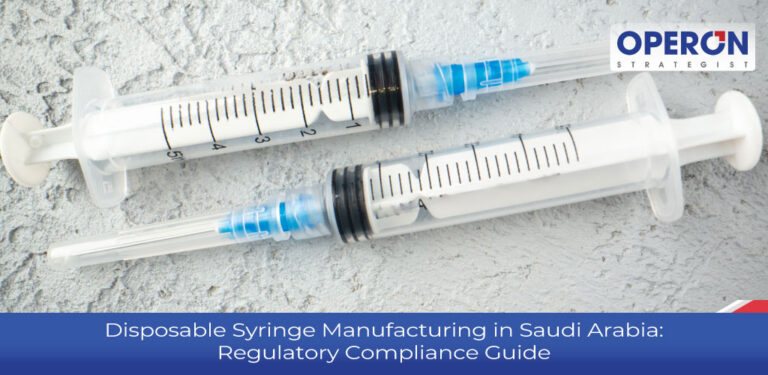
- Barrel
- Plunger
- Gasket
- Needle
Production Process:
- Raw Material Selection: Polypropylene and rubber (medical-grade).
- Injection Molding: Barrel and plunger molding with high precision.
- Assembly Line: Needles, plungers, and barrels are assembled.
- Sterilization: Using ETO (Ethylene Oxide) or Gamma Radiation.
- Packaging: Done in a cleanroom environment to maintain sterility.
- Quality Control: Inspection for leakage, calibration, and sterility.
Compliance with SFDA & ISO Standards
Manufacturing disposable syringes in Saudi Arabia mandates adherence to the following:
- SFDA Medical Device Marketing Authorization (MDMA)
- Good Manufacturing Practices (GMP)
- ISO 13485:2016 – Quality Management System
- ISO 7864 – Specific standard for sterile hypodermic syringes
- Sterilization Validation – Per ISO 11135 or ISO 11137
Navigating this regulatory framework is challenging — this is where Operon Strategist adds significant value.
FAQ
What are the regulatory requirements for disposable syringe manufacturing in Saudi Arabia?
Manufacturers must comply with SFDA medical device regulations, implement an ISO 13485-certified quality management system, establish validated manufacturing and sterilization processes, prepare technical documentation, and obtain the required manufacturing and product approvals before marketing disposable syringes in Saudi Arabia.
Which international standards apply to disposable syringe manufacturing?
Disposable syringe manufacturers commonly follow ISO 13485 for quality management, ISO 14971 for risk management, and the ISO 7886 series for sterile hypodermic syringes intended for single use. Additional standards may apply depending on the syringe design and intended use.
Is sterilization validation required for disposable syringes?
Yes. Since disposable syringes are supplied sterile, manufacturers must validate their sterilization process, maintain process controls, and demonstrate that the required sterility assurance level is consistently achieved in accordance with applicable international standards and SFDA requirements.
What documents are required for SFDA registration of disposable syringes?
Manufacturers typically need technical documentation, device specifications, quality management system records, risk management files, sterilization validation reports, biocompatibility data where applicable, labeling information, and other documents required by the SFDA based on the product classification.
Senior Sales Executive | 3 Years of Experience
Vyankatesh Dhavale holds a Bachelor of Pharmacy (B.Pharm) and an MBA specializing in Operations and Supply Chain Management, with a minor in Marketing. He brings experience in domestic and international business development, strategic client relationship management, and sales of medical device regulatory consulting and turnkey project services. His expertise includes supporting market entry and regulatory service requirements related to CDSCO registration, EU MDR CE marking, US FDA regulations, and ISO 13485 quality management systems.