
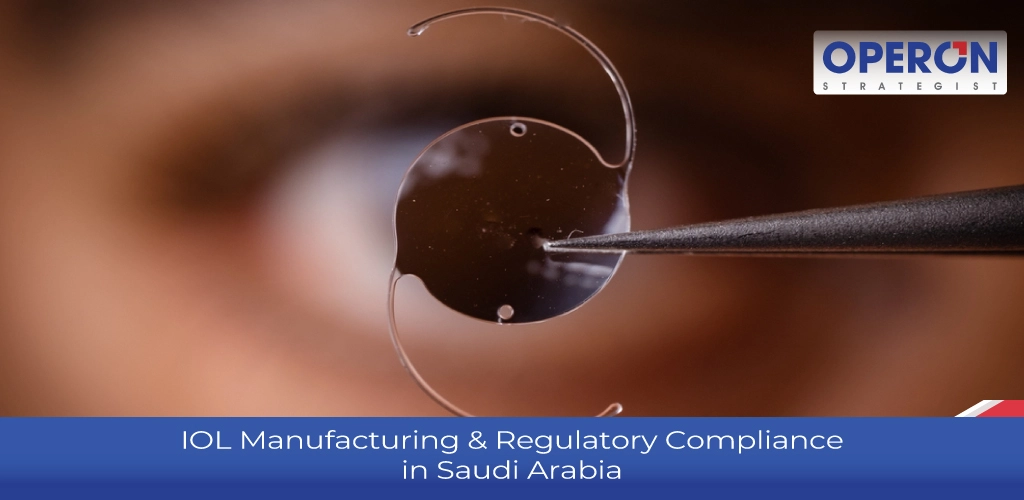
Intraocular Lens (IOL) Manufacturing: Process, Technologies, Regulatory Pathways & Market Opportunity

Introduction

Intraocular lens (IOL) manufacturing is one of the most precision-driven and tightly regulated segments within the medical device industry. With cataract remaining a leading cause of blindness globally and increasing adoption of advanced vision correction solutions, the demand for high-performance IOLs continues to grow. 

Success in this segment requires more than manufacturing capability. It demands optical precision, validated processes, biocompatibility assurance, and strict regulatory compliance across global markets. A structured, end-to-end approach is essential to ensure both patient safety and commercial success. 

What are Intraocular Lenses (IOLs)?

Intraocular lenses (IOLs) are artificial lenses implanted in the eye to replace the natural lens, most commonly during cataract surgery or refractive lens exchange. 

Types of IOLs 

  • Monofocal IOLs – Correct vision at a single focal point  
  • Multifocal IOLs – Enable near, intermediate, and distance vision  
  • Toric IOLs – Correct corneal astigmatism  
  • Extended Depth of Focus (EDOF) IOLs – Provide a continuous range of vision  

Insight: 
The shift toward premium IOLs (multifocal, toric, and EDOF) is increasing performance expectations, making manufacturing precision and material quality critical. 

Why is IOL Manufacturing a High-Growth Opportunity?

Key Market Drivers 

  • Rising global cataract burden driven by aging populations  
  • Increasing surgical volumes in emerging markets  
  • Growing demand for spectacle independence  
  • Rapid adoption of premium and customized lenses  

Industry Reality 

Despite strong growth potential, entry barriers include: 

  • High regulatory scrutiny (Class III device classification)  
  • Requirement for clinical validation  
  • Precision manufacturing infrastructure  
  • Long approval timelines 


Insight: 
Manufacturers who integrate regulatory strategy early in product development significantly reduce time-to-market and overall project risk. 

What is the Intraocular Lens Manufacturing Process?

IOL manufacturing combines optical design, micro-precision engineering, and controlled cleanroom production. 

Step-by-Step Process 

  1. Optical Design & Simulation
  • CAD-based modeling with optical ray tracing  
  • Control of diopter accuracy and aberrations  

  1. Material Selection
  • PMMA, silicone, hydrophobic or hydrophilic acrylic  
  • Compliance with ISO 10993 biocompatibility standards  

  1. Lens Formation
  • Cast molding (polymerization) or CNC lathe cutting  
  • Typical tolerances in the range of ±1–2 microns  

  1. Edge Finishing & Polishing
  • Ensures smooth edges to prevent tissue damage  
  • Controls surface roughness and optical clarity  

  1. Surface Modification
  • UV-blocking or blue-light filtering features  
  • Optional surface treatments for enhanced performance  

  1. Cleaning & Sterilization
  • Ethylene oxide (EtO) sterilization with controlled residuals  
  • Gamma sterilization with validated dose cycles  

  1. Cleanroom Packaging
  • ISO Class 7 or 8 environments  
  • Controlled pressure differentials (typically 10–15 Pa)  

  1. Labeling& Traceability 
  • Unique Device Identification (UDI) compliance  
  • Full batch traceability and documentation

What are the Key Manufacturing Technologies Used in IOL Production?

  1. Polymerization-Based CastMolding

Cast molding involves in-mold polymerization of liquid monomers, forming the lens directly into its final shape. 

Key Features 

  • High repeatability and batch consistency  
  • Superior optical surface quality with minimal polishing  
  • Efficient material utilization  

Technical Considerations 

  • Strict control of temperature, curing time, and material purity  
  • Mold precision directly impacts optical performance  
  • Risk of internal stress if polymerization is not uniform  

Typical Applications 

  • High-volume manufacturing  
  • Premium foldable IOLs  


  1. CNC Lathe Cutting

CNC lathe cutting is a subtractive process where lenses are machined from solid polymer blanks using ultra-precision diamond tools. 

Key Features 

  • High flexibility for design changes  
  • Suitable for prototyping and low-to-medium volumes  
  • Enables rapid product development  

Technical Considerations 

  • Requires extensive polishing for optical clarity  
  • Higher material wastage  
  • Longer production cycles compared to molding  

Typical Applications 

  • Research and development  
  • Custom or specialty lenses  

Technology Selection Overview

Parameter 

Cast Molding 

CNC Lathe Cutting 

Production Volume 

High 

Low to Medium 

Flexibility 

Limited 

High 

Surface Finish 

High (minimal polishing) 

Requires polishing 

Cost Efficiency 

High at scale 

Lower at small scale 

Development Speed 

Moderate 

Fast 

Industry Practice: 
A hybrid approach is often used—lathe cutting for development and validation, followed by cast molding for large-scale production. 

What Materials are Used in IOL Manufacturing?

  • PMMA (Polymethylmethacrylate) – Rigid and durable  
  • Silicone – Flexible and foldable  
  • Hydrophobic Acrylic – Preferred for premium lenses due to stability and optical performance  
  • Hydrophilic Acrylic – Flexible with specific clinical applications  

Insight: 
Material selection affects foldability, incision size, long-term stability, and clinical outcomes. 

What are the Regulatory Requirements for IOL Manufacturing?

Device Classification 

IOLs are classified as Class III (high-risk) medical devices. 

Key Regulatory Frameworks 

Applicable Standards 

  • ISO 14971 – Risk Management  
  • ISO 10993 – Biocompatibility 

Additional Requirements 

  • Clinical evaluation or clinical investigation  
  • Post-market surveillance (PMS)  
  • Vigilance and adverse event reporting 

Insight: 
Regulatory approval depends on both product performance and the robustness of manufacturing and quality systems.

What Testing and Validation are Required for IOLs?

Optical Testing 

  • Modulation Transfer Function (MTF)  
  • Refractive power and diopter accuracy  

Mechanical Testing 

  • Haptic strength and compression resistance  
  • Injector compatibility testing  

Biocompatibility Testing 

  • Cytotoxicity, sensitization, and irritation (ISO 10993)  

Sterilization Validation 

  • Sterility Assurance Level (SAL 10⁻⁶)  
  • Residual analysis for EtO sterilization  

Stability Studies 

  • Shelf-life validation  
  • Packaging integrity testing  

Insight: 
Early planning of validation and testing strategies significantly reduces regulatory delays. 

How to Set Up an IOL Manufacturing Plant?

Key Elements 

Facility Design 

  • GMP-compliant layout with defined cleanroom zones  
  • Controlled material and personnel flow 


Cleanroom Infrastructure 

  • ISO Class 7 or 8 environments  
  • HEPA filtration and HVAC systems 


Equipment Qualification 

  • Installation Qualification (IQ)  
  • Operational Qualification (OQ)  
  • Performance Qualification (PQ) 


Quality Management System 

  • CAPA, deviation control, and change management  
  • Internal audits and training systems 


Documentation 

What are Common Challenges in IOL Manufacturing?

  • Regulatory delays due to incomplete documentation  
  • Optical defects from inadequate finishing or process control  
  • Material-related performance issues  
  • Cleanroom contamination risks  
  • Scale-up challenges from development to commercial production

How Can Operon Strategist Support IOL Manufacturing Projects?

Operon Strategist provides end-to-end support for IOL manufacturing: 

Value Proposition: 
An integrated approach enables faster approvals, reduced risk, and efficient project execution. 

Planning to Enter the IOL Manufacturing Market?

Entering the IOL segment requires a precision-driven, compliance-focused, and strategically planned approach. 

Operon Strategist supports manufacturers across the entire lifecycle—from concept to commercialization—ensuring regulatory compliance and global competitiveness. 

Contact Operon Strategist to accelerate your IOL manufacturing project with confidence.

Frequently Asked Questions (FAQs)

Yes. IOLs are Class III devices requiring approvals such as FDA clearance or approval, CE Marking, CDSCO licensing, and ISO 13485 compliance.

Timelines generally range from 12 to 36 months depending on the target market and clinical data requirements.

Typically 6 to 18 months, depending on scale, infrastructure readiness, and regulatory planning.