
Why SaMD and SiMD Matter in Medical Device Innovation?
In today’s fast-paced healthcare technology landscape, software plays a transformative role in improving patient care and operational efficiency. However, not all medical software is treated equally from a regulatory standpoint. Two critical terms you must understand are SaMD (Software as a Medical Device) and SiMD (Software in a Medical Device). These classifications have significant implications for compliance, safety, and market entry strategies across global regions such as the USA, Europe, and India. In this guide, Operon Strategist, a trusted regulatory consulting partner, explains the nuances, risks, and requirements associated with SaMD and SiMD.
Regulatory Excellence for Global Medical Device Markets
What is SaMD and SiMD?
SaMD – Software as a Medical Device
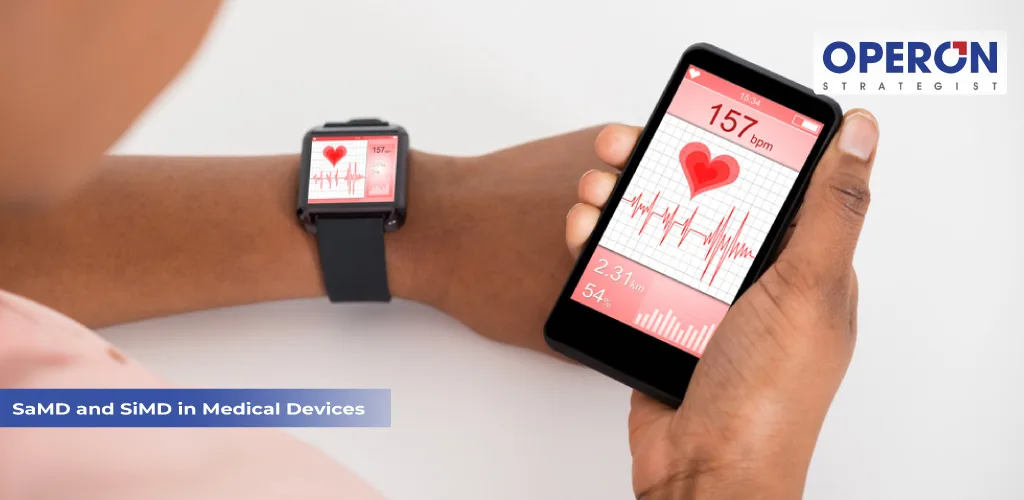
Software that is developed and intended for medical purposes but functions independently of any specific hardware. It may be distributed across various platforms, such as smartphones, cloud-based services, or standalone applications. Examples include apps that monitor heart rate, diagnostic tools, or AI-powered clinical decision systems.
SiMD – Software in a Medical Device
Software embedded within or integrated as part of a medical device’s hardware ecosystem. SiMD is essential for the operation, control, or processing functions of a device like infusion pumps, cardiac monitors, or imaging machines
SaMD vs SiMD – Key Differences Explained
Aspect | SaMD | SiMD |
Definition | Independent software intended for medical use | Software embedded or integrated within a hardware medical device |
Risk Level | Depends on intended medical purpose but generally lower | Higher due to direct interaction with hardware components |
Development Focus | Software-specific testing and compatibility | Software-hardware integration validation |
Regulatory Framework | Often regulated as a standalone device | Regulated alongside associated hardware |
Documentation | Clinical validation, lifecycle, and surveillance | Interface validation, compatibility, and integrated risk management |
Patient Safety | Relies on software’s medical accuracy | Integration failures could impact device performance |
Regulatory Compliance: What You Need to Know
Both SaMD and SiMD must meet strict safety and efficacy standards, but the approach varies depending on integration and intended use.
Standards Applicable to Both:
- IEC 62304 – Software lifecycle processes
- IEC 62366 – Usability engineering
- ISO 14971 – Risk management for medical devices
Additional Considerations for SiMD:
- Software-hardware interface validation
- Compatibility testing
- Integrated risk management strategies
Global Regulatory Frameworks:
- USA: FDA Software Precertification Program, 21 CFR Part 820
- Europe: Medical Device Regulation (MDR)
- India: CDSCO Registration for medical software
- Others: Local standards depending on healthcare infrastructure
SaMD often faces a simplified regulatory pathway compared to SiMD, which requires combined hardware assessments and validation protocols.
Risk Management: Avoiding Common Pitfalls
SaMD Risks:
- Incorrect medical advice or data interpretation
- Compatibility issues with platforms
- Lack of updates and post-market surveillance
SiMD Risks:
- Faulty integration with hardware
- Communication errors between components
- Compromised safety due to interface failures
Proper risk assessment, documentation, and validation processes are essential in both cases to safeguard patients and ensure compliance.
Documentation Requirements – A Step-by-Step Breakdown
SaMD Documentation Checklist:
- Clinical validation reports
- Software development lifecycle plans
- Risk assessment and mitigation strategies
- Post-market monitoring protocols
SiMD Documentation Checklist:
- Interface validation and testing reports
- Hardware-software compatibility data
- Integrated risk analysis
- Verification and validation processes aligned with device requirements
Thorough documentation not only ensures compliance but also builds trust with healthcare providers and patients.
Real-World Examples
SaMD Examples:
- Mobile apps that monitor blood glucose levels
- AI algorithms that detect abnormalities in imaging scans
- Cloud-based decision support tools for doctors
SiMD Examples:
- Infusion pumps controlled by embedded software
- Cardiac monitors using proprietary algorithms
- Diagnostic imaging machines with integrated processing software
Understanding these examples helps guide development strategies and compliance pathways.
How Operon Strategist Supports You?
At Operon Strategist, we guide innovators from concept to market with end-to-end regulatory consulting for SaMD and SiMD products.
Our Services Include:
✔ Regulatory assessment and classification
✔ Compliance strategy aligned with global standards
✔ Documentation preparation and review
✔ Submission support for FDA, CE, CDSCO, and other authorities
✔ Post-market surveillance and risk management
✔ Training on IEC 62304 and ISO 13485 standards
With our expert team’s hands-on experience, we help you minimize risks, avoid delays, and confidently navigate the regulatory environment.