
CE Marking for Medical Devices: Process & EU MDR Requirements
Entering the European medical device market isn’t just about having a great product—it’s about ensuring it meets strict regulatory standards and earns the trust of both regulators and users. Whether you’re working with medical devices or in vitro diagnostics (IVDs), understanding CE marking is a crucial first step toward successfully launching your product in Europe.
Navigating these requirements can often feel complex and time-consuming. This is where Operon Strategist supports manufacturers—by simplifying the compliance process, providing expert guidance, and helping bring products to market efficiently while meeting all regulatory expectations
What Is CE Marking for Medical Devices?
CE marking (Conformité Européenne) is a certification mark that indicates a medical device or in vitro diagnostic (IVD) complies with the essential safety, performance, and regulatory requirements set by the European Union. It demonstrates that the product has been assessed and meets the standards defined under the Medical Device Regulation (EU MDR 2017/745) for medical devices and the In Vitro Diagnostic Regulation (EU IVDR 2017/746) for IVDs.
By affixing the CE mark, manufacturers declare that their product is safe to use, performs as intended, and follows all applicable quality and risk management requirements. This certification is mandatory for placing medical devices and IVDs on the market across all European Union (EU) member states and European Economic Area (EEA) countries.
In simple terms, CE marking acts as a passport that allows medical devices and IVDs to be legally sold and distributed within the European market.
CE Marking Requirements Under EU MDR
To obtain CE marking for medical devices, manufacturers must comply with strict regulatory requirements defined under EU MDR.
Key requirements include:
- Device Classification based on risk level
- Technical Documentation demonstrating compliance
- Clinical Evaluation proving safety and performance
- Risk Management as per ISO 14971
- Quality Management System (QMS) such as ISO 13485
- Post-Market Surveillance (PMS) and vigilance systems
Manufacturers are fully responsible for ensuring continuous compliance throughout the product lifecycle
Medical Device Classification in Europe
Medical devices in Europe are classified based on risk:
- Class I – Low risk (e.g., non-invasive devices)
- Class IIa – Medium risk
- Class IIb – Medium to high risk
- Class III – High risk (e.g., implantable devices)
Higher classification results in more stringent regulatory requirements and mandatory involvement of a notified body.
How to Get a CE Marking for a Medical Device?
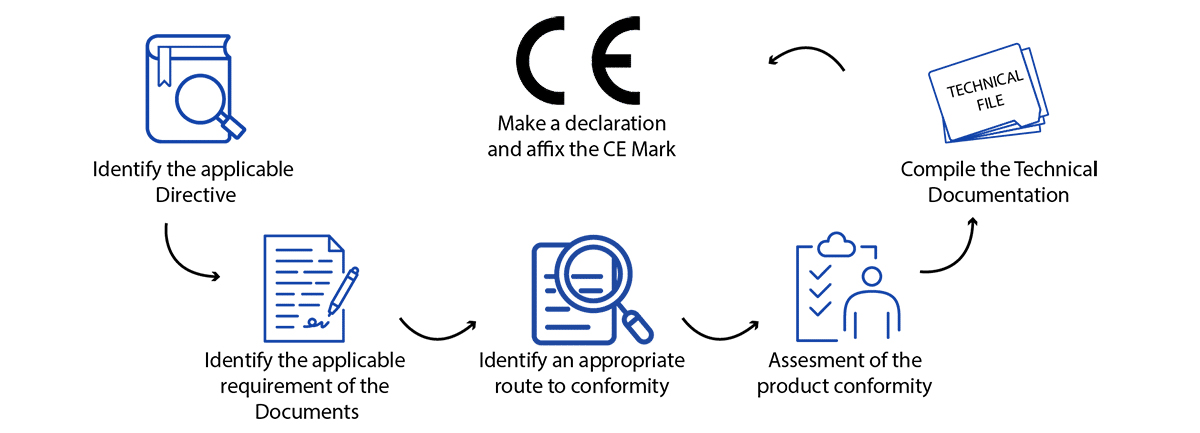
While “CE” isn’t a quality mark, adherence to the EU Medical Devices Regulation (MDR 2017/745) necessitates meeting precise standards of performance, quality, safety, and efficacy tailored to your product type. Operon Strategist’s comprehensive guide outlines the current European CE approval process for medical devices. Nonetheless, the fundamental procedure for obtaining a CE mark for medical devices typically involves the following steps:
- Determine if your product aligns with the definition of a medical device as outlined in the EU MDR.
- Determine the medical device classification in Europe for your medical devices.
- Implement a Quality Management System (QMS) if it applies to your device. Many companies utilize ISO 13485 to fulfill these requirements.
- Prepare a CE Marking Technical File or a Design Dossier.
- Compile a Clinical Evaluation Report (CER) following the guidelines of MEDDEV 2.7/1 rev4 and the MDR.
- Select and designate a European Authorized Representative (EC REP) to act on your behalf within the EU if you lack a physical presence in Europe.
- Subject your QMS and Technical File/Design Dossier to an audit by a Notified Body, unless your device falls under Class I, is non-sterile, and lacks a measuring function.
- Obtain CE certificate for medical devices and ISO 13485 certificates from your designated Notified Body.
- Prepare a EU Declaration of Conformity (DoC) confirming that your device complies with the regulations outlined in the MDR.
If you need more clarity on obtaining CE certification for your medical devices, contact us on WhatsApp or call 918767980322
Declaration of Conformity
After ensuring that the safety and performance criteria have been satisfied and the requisite technical documentation is ready, the manufacturer is obligated to date, sign, and maintain a declaration of conformity. This declaration serves as proof that the product adheres to the standards outlined in the executive order.
Recommended blog: EU Declaration of Conformity for Medical Devices
Quality Management Systems - Requirements for Regulatory Purposes.
- ISO 13485:2016 – The ISO 13485:2016 standard lays out the rules for how to manage the quality of medical devices. Most medical device makers follow this standard because it’s a good way to make sure they meet the quality management system (QMS) requirements in the MDR.
- FDA 21 CFR Part 820 – FDA 21 CFR Part 820 sets the quality system rules for medical device manufacturers. This regulation is the current standard for quality management systems for medical devices used in the United States.
CE Marking Cost and Effort Factors
The cost of CE marking for medical devices is not fixed and depends on multiple regulatory and technical factors.
Key influencing factors include:
- Device classification and risk level
- Product complexity and intended use
- Testing and clinical evaluation requirements
- Technical documentation scope
- Notified body involvement
Due to these variables, CE marking is evaluated on a case-by-case basis.
CE Marking Timeline
The timeline for CE marking varies depending on device complexity and regulatory pathway.
- Lower-risk devices typically follow a shorter approval process
- Higher-risk devices require more time due to clinical evaluation and regulatory review
Early planning and proper documentation can significantly reduce approval timelines.
Get Your Tailored CE Marking Roadmap with Clear Timelines and Expert Guidance
European Authorized Representative (EC REP)
Manufacturers outside the EU must appoint a European Authorized Representative (EC REP) to place devices in the European market.
The EC REP:
- Acts as a regulatory contact point
- Maintains technical documentation
- Communicates with EU authorities
- Supports compliance throughout the lifecycle
What Are Notified Bodies?
Notified Bodies are independent organizations designated by EU member states to assess medical device conformity.
They:
- Conduct audits and assessments
- Review technical documentation
- Issue CE certificates
- Perform ongoing surveillance
Notified body involvement is mandatory for Class IIa, IIb, and III devices.
How Can We Help You Achieve CE Marking Under EU MDR?
Achieving CE marking under EU MDR requires strong regulatory expertise, practical experience, and a clear understanding of compliance pathways. With over a decade of industry experience and a team of skilled regulatory professionals, Operon Strategist supports manufacturers with reliable, end-to-end guidance to simplify the CE marking process.
Our CE marking–related services include:
- Design & development documentation support
- Technical documentation (Technical File) preparation and review
- ISO 13485 Quality Management System consulting
- Regulatory approvals and certification guidance
With experience serving clients across multiple countries and handling diverse regulatory projects, Operon Strategist ensures a structured and compliant approach—helping you achieve CE marking efficiently and confidently enter the European market.
Get Your Medical Device CE Marked Fast and Easy With Operon Strategist!
FAQS
CE marking is a mandatory certification that indicates a medical device or in vitro diagnostic (IVD) complies with European Union regulations for safety, performance, and quality, allowing it to be legally marketed and sold in Europe.
CE marking is required to ensure that medical devices and IVDs meet strict EU standards for safety and performance before they can be sold in the European market.
CE marking for medical devices is governed by MDR 2017/745, while IVDs must comply with IVDR 2017/746.
CE marking confirms that the product meets essential requirements related to safety, performance, quality, and risk management.
The duration to acquire a CE mark for a medical device typically spans four to six weeks on average. However, the timeline can vary, influenced by factors such as test outcomes, necessary product adjustments, and the promptness of providing technical documentation. It’s important to note that the specific CE marking process varies for each product.
For Class 1 medical devices, obtaining CE marking can be accomplished through self-declaration according to the MDR. This means that neither Notified Body certification nor approvals from certification bodies are necessary. Class 1 devices are considered to have minimal risk, allowing manufacturers to self-certify them.
Simplify Your CE Mark Journey
Get expert guidance on CE marking for medical devices. From classification to clinical evaluations, technical documentation, and EC REP services, we handle it all. Ensure compliance with EU MDR seamlessly.