
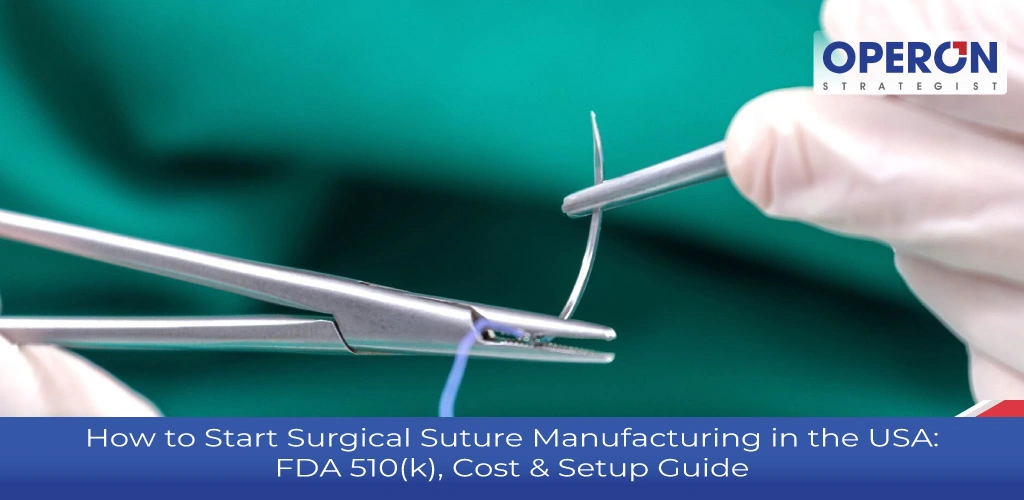
How to Start Surgical Suture Manufacturing in the USA: FDA 510(k), Cost & Setup Guide
A surgical suture manufacturing business in the USA can be highly profitable, but it Starting requires a clear understanding of FDA regulatory requirements, manufacturing processes, and quality standards.
With over 50–60 million surgical procedures performed annually in the US, the estimated demand reaches 150–250 million sutures per year, making it a high-volume, recurring medical consumable market worth USD 3–4 billion, growing at 5–7% CAGR.
Read Related Blog: IVD Manufacturing in the USA
Let's Grow Your Business Together
What Are Surgical Sutures?
Surgical sutures are sterile, implantable medical devices used to close wounds, surgical incisions, and tissues. They are classified based on:
- Absorbable vs non-absorbable
- Natural vs synthetic
- Monofilament vs multifilament
In the US, sutures are FDA-regulated Class II medical devices under 21 CFR Part 878 and must meet strict safety and performance standards.
They must comply with:
- USP standards (size and tensile strength)
- ISO 10993 (biocompatibility)
- ISO 11607 (packaging validation)
Step 1: Understand Regulatory Classification in the USA
Before setting up manufacturing, you must determine the FDA regulatory pathway.
- Most surgical sutures fall under Class II medical devices
- Require FDA 510(k) clearance before market entry
- Must comply with Quality System Regulation (21 CFR Part 820)
Key requirements:
- Device classification and product code identification
- Substantial equivalence to a predicate device
- Labeling and intended use definition
Industry insight:
- FDA review timeline: 90–180 days
- Total approval timeline: 6–9 months
- Around 30–40% of submissions receive FDA queries due to incomplete documentation
Step 2: Develop a Business and Investment Plan
A strong business plan helps you estimate costs and attract investors.
Key cost components:
- Facility setup and cleanroom
- Machinery and equipment
- Raw materials (silk, PGA, nylon, polypropylene)
- Sterilization setup (EO or gamma)
- Regulatory consulting and testing
Estimated Investment (USA):
- Total project cost:USD 2 – 5 million(mid-scale facility)
- FDA & validation cost contribution: 25–35% of total investment
Typical cost split:
- Facility:USD 0.5 – 1.5 million
- Machinery: USD 1 – 3 million
- Testing & validation: USD 150,000 – 400,000
- FDA approval: USD 75,000 – 250,000
Pro tip:
Many new manufacturers underestimate FDA validation, testing, and documentation costs, which can significantly impact timelines and budgets.
Step 3: Set Up Manufacturing Facility
Your facility must meet FDA and GMP-compliant medical device manufacturing standards.
Key requirements:
- Controlled environment (cleanroom recommended)
- Segregated zones for raw materials, production, and packaging
- Environmental monitoring systems
- Compliance with ISO 13485
Typical facility size:
- 10,000 – 25,000 sq. ft.
Cleanroom classification:
- ISO Class 7 (critical areas)
- ISO Class 8 (support areas)
Environmental controls:
- Temperature:18–25°C
- Humidity: 40–60% RH
- Pressure differential: 10–15 Pa
Step 4: Select Machinery and Equipment
Suture manufacturing involves precision and validated equipment.
Common machinery:
- Extrusion machines (for synthetic sutures)
- Braiding machines
- Needle attachment (swaging) machines
- Coating and drying units
- Cutting and winding machines
Automation improves consistency and reduces defects.
Typical setup:
- 2–4 extrusion lines
- 5–10 braiding machines
- 2–3 needle attachment units
Production capacity:
- 1–3 million sutures/month
- 12–36 million sutures/year
Automation improves consistency, reduces defects, and supports FDA process validation requirements.
Step 5: Raw Material Selection
Material choice directly impacts performance and regulatory approval.
Common materials:
- Absorbable: PGA,Vicryl, PDS
- Non-absorbable: Nylon, silk, polypropylene
Key considerations:
- Biocompatibility (ISO 10993)
- Tensile strength (USP compliance)
- Absorption rate (if applicable)
- Supplier qualification and traceability
Consumption (mid-scale):
- Polymers:500–1500 kg/month
- Needles: 1–3 million units/month
Raw materials contribute 30–40% of product cost.
Step 6: Manufacturing Process Overview
The typical process includes:
- Fiber extrusion or preparation
- Braiding or twisting
- Coating (optional)
- Cutting and sizing
- Needle attachment
- Packaging
Additional steps may include drawing, annealing, and surface treatment.
Industry benchmarks:
- Yield efficiency:85–95%
- Rejection rates:
- Extrusion: 2–5%
- Needle attachment: 1–3%
- Packaging: <1%
Each step must be validated (IQ/OQ/PQ) and documented as per FDA requirements.
Step 7: Sterilization Process
Sutures must be sterile before market release.
Common sterilization methods:
- Ethylene Oxide (EO)
- Gamma radiation
Requirements:
- Sterilization validation (ISO 11135 / ISO 11137)
- Residual analysis (for EO)
- Packaging compatibility
Cost benchmarks:
- EO:USD 0.02 – 0.10 per unit
- Gamma: USD 0.05 – 0.15 per unit
Validation cost (Aprox):
- USD 25,000 – 75,000
Step 8: Implement Quality Management System (QMS)
A compliant QMS is mandatory for FDA approval.
Must include:
- Design controls
- Risk management (ISO 14971)
- Process validation
- CAPA (Corrective and Preventive Actions)
- Document control
QMS scale:
- 300–600 controlled documents
- Batch records: 20–40 pages per product
Without a proper QMS, FDA clearance is not possible.
Step 9: Conduct Testing and Validation
Before submission, your product must pass multiple tests.
Key tests:
- Tensile strength (USP)
- Knot security
- Sterility assurance
- Biocompatibility (ISO 10993)
Cost estimates (Approx):
- Biocompatibility:USD 20,000 – 100,000
- Mechanical testing setup: USD 10,000 – 50,000
Testing must align with USP and FDA-recognized standards.
Step 10: FDA 510(k) Submission
This is the most critical regulatory step.
Includes:
- Device description
- Predicate comparison
- Performance testing data
- Sterilization validation
- Labeling
Approval timeline typically ranges from 3 to 9 months.
Key insights:
- Submission size:500–1500 pages
- First-pass success rate (well-prepared): 80–90%
- Poor documentation can delay approval by 6–12 months
Approval timeline typically ranges from 3 to 9 months.
Step 11: Packaging and Labeling Compliance
Packaging must maintain sterility and integrity.
Requirements:
- Sterile barrier system validation (ISO 11607)
- Shelf-life studies (3–5 years typical)
- UDI (Unique Device Identification)
- Clear instructions for use
Validation timeline:
- Accelerated:3–6 months
- Real-time: 1–3 years
Step 12: Go-to-Market Strategy
Once approved, focus on distribution and sales.
Channels:
- Hospitals and clinics
- Distributors
- Group Purchasing Organizations (GPOs)
- Government tenders
Revenue potential:
- Pricing:
- Standard sutures: USD 0.5 – 2/unit
- Premium sutures: USD 2 – 5/unit
Example:
2 million units/month × $1 =~USD 2 million/month revenue
Tip:
FDA approval builds trust, but pricing, consistency, and surgeon acceptance drive long-term success.
Common Challenges in Surgical Suture Manufacturing
- Delays in FDA approval
- High validation and compliance costs
- Maintaining consistent product quality
- Supplier reliability issues
- Strong competition
Working with experienced consultants can reduce these risks significantly.
Why Surgical Suture Manufacturing Is a Strong Opportunity
- High-volume demand (150–250 million units annually in the US)
- Repeat usage product
- Stable healthcare-driven demand
- High export potential with FDA approval
- Scope for innovation (coated, antibacterial, barbed sutures)
Why Choose Operon Strategist?
Setting up surgical suture manufacturing in the USA involves FDA complexity, technical expertise, and capital planning.
Operon Strategist helps you handle it end-to-end, from setup to market entry.
Our Key Services
- GMP-compliant plant layout and turnkey manufacturing setup
- Cleanroom design and ISO 14644 compliance
- Product design, development, and process engineering
- FDA 510(k) and global regulatory approvals (CE, CDSCO, UKCA, MDSAP)
- QMS setup and ISO 13485 certification support
- Detailed Project Report (DPR) and financial feasibility
- Product registration and import licensing
- Market intelligence for global expansion
Why Choose Operon Strategist for MHRA Registration?
At Operon Strategist, we specialize in:
✔ Hassle-free MHRA registration for medical device manufacturers.
✔ Expert guidance on UKCA marking & regulatory compliance.
✔ Comprehensive support from technical documentation to market approval.
Get expert consultation today! Contact us to simplify your MHRA medical device registration.
Talk to Our Experts and accelerate your UK market entry!
FAQ
Is FDA approval required for surgical sutures in the USA?
Yes, surgical sutures are regulated medical devices in the USA. Most sutures require FDA 510(k) clearance before they can be marketed.
What is the classification of surgical sutures in the US?
Most surgical sutures are Class II medical devices in the US and generally require FDA 510(k) clearance before marketing.
How long does it take to get FDA 510(k) approval for sutures?
The FDA 510(k) review typically takes 90–180 days, depending on the submission quality and whether additional information is requested.