
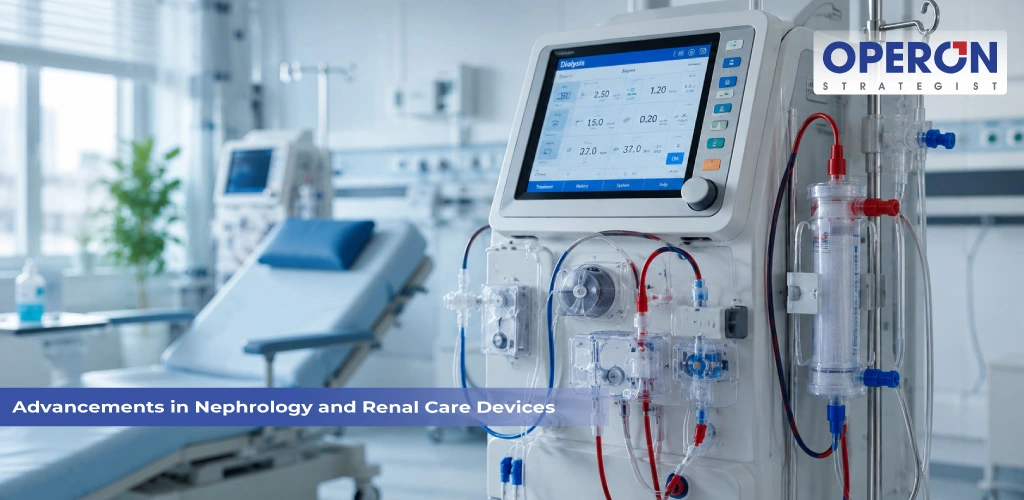
Advancements in Nephrology and Renal Care Devices
Overview: Advancements in Nephrology & Renal Care Devices
Advancements in Nephrology and Renal Care Devices include high-efficiency hemodialysis machines, wearable artificial kidneys, automated peritoneal dialysis (APD) systems, and robotic-assisted surgical platforms for complex nephrectomies and tumor removals. Driven by rising global chronic kidney disease (CKD) prevalence, manufacturers in India and worldwide are expanding production. Commercializing these renal care devices requires strict adherence to regulatory frameworks, including CDSCO registration in India (Manufacturing Form MD-7/MD-9, Import Form MD-15), US FDA 510(k) clearance, and EU MDR CE marking underpinned by an ISO 13485 Quality Management System.
Contact us
Introduction to Renal Care and Nephrology Innovations
Nephrology and renal care are evolving rapidly as rising global rates of chronic kidney disease (CKD), diabetes, and hypertension increase the demand for sophisticated renal management tools. The landscape of kidney disease diagnosis, monitoring, and treatment is undergoing a structural shift driven by technological innovation.
From portable peritoneal dialysis systems to high-precision surgical robots, medical device manufacturers are delivering advanced solutions that significantly raise patient care standards. For companies developing or importing these technologies, aligning engineering innovation with regulatory compliance is essential for market entry.
Understanding the regulatory framework early accelerates product launch. Learn more about specific compliance steps in our dedicated guide to nephrology and renal care medical device registration.
Key Technological Advancements in Nephrology and Renal Care Devices
1. High-Efficiency Dialysis & Hemofiltration Systems
Hemodialysis and peritoneal dialysis equipment remain the cornerstone of renal replacement therapy. Modern dialyzers feature biocompatible synthetic membranes, automated fluid balancing, and real-time clearance monitoring to optimize toxin removal while minimizing cardiovascular strain.
2. Robotic-Assisted Surgery in Urological & Renal Procedures
Surgical robotics has transformed renal interventions. Utilizing multi-arm robotic platforms for partial nephrectomy and robotic surgery for kidney tumor removal enables surgeons to execute complex anatomical dissections with enhanced precision. Benefits include:
Reduced intraoperative blood loss.
Minimal ischemia time during partial nephrectomies.
Shorter hospital stays and faster patient recovery.
3. Wearable & Bioartificial Kidney Concepts
Miniaturization in fluidics and sensor technologies is paving the way for wearable hemodialysis units and bioartificial kidney prototypes, offering continuous blood filtration and significantly improving patient quality of life.
When scaling from prototype to mass production, establishing an audit-ready production line is vital. Explore how our Plant Layout Detail Engineering and New Product Design Development services help structure compliant manufacturing facilities.
Global Market Demand & Export Opportunities for Indian Manufacturers
Driven by government programs like “Make in India” and “Atmanirbhar Bharat,” India has emerged as a key manufacturing hub for cost-effective, high-quality medical equipment.
Indian device producers export hemodialysis machines, peritoneal dialysis kits, vascular access catheters, and renal stents across emerging and highly regulated markets, including the United States, Europe, the Middle East, and Japan.
| Key Market Sector | Primary Product Focus | Growth Driver |
| Domestic Clinical Hospitals | Hemodialysis machines, blood tubing sets, dialyzers | Expanding public healthcare coverage & regional dialysis centers |
| Home Healthcare / Dialysis | Automated Peritoneal Dialysis (APD) cyclers | Growing preference for home-based renal therapy |
| Export Markets (US/EU/MENA) | Disposable catheters, renal stents, surgical instruments | Competitive manufacturing costs aligned with international standards |
Capitalizing on export opportunities requires detailed target market insights. Leverage our Market Analysis expertise to identify high-value global entry points.
Regulatory Compliance Requirements for Marketing Renal Care Devices
Whether manufacturing domestically or importing finished devices, strict regulatory clearance is mandatory before commercial distribution.
| Regulatory Stage / Parameter | Domestic Manufacturing Pathway | Device Importation Pathway |
|---|---|---|
| 1. Classification | Device Risk Classification (Class A, B, C, or D) | Device Risk Classification (Class A, B, C, or D) |
| 2. Mandatory Governance | ISO 13485 Quality Management System (QMS) | Power of Attorney / Authorized Agent Appointment (Form MD-14) |
| 3. Licensing Route | Manufacturing License Application (Form MD-7) | Import License Application (Form MD-14) |
| 4. Granted Certificate | Manufacturing License (Form MD-9) | Import License (Form MD-15) |
| 5. Final Outcome | CDSCO Market Approval | CDSCO Market Approval |
Under the Central Drugs Standard Control Organization (CDSCO) Medical Device Rules (MDR 2017), nephrology devices are categorized by risk from Class A (low risk) to Class D (high risk):
Class A & B Devices: Require manufacturing licenses issued via State Licensing Authorities (Form MD-7).
Class C & D Devices: High-risk equipment (e.g., hemodialyzers, blood lines, renal stents) requires Central Licensing Authority approval (Form MD-9).
Importers: Must secure an Import License in Form MD-15 via an Authorized Indian Agent using Form MD-14.
Ensure seamless approval by working with specialists in CDSCO (India) Registration.
2. International Regulatory Clearances
To export nephrology devices globally, manufacturers must meet regional requirements:
United States: Submit a Pre-Market Notification under US FDA 510(k) Registration.
European Union: Fulfill EU MDR 2017/745 requirements to earn a CE Marking (EU MDR / IVDR).
Saudi Arabia & Middle East: Obtain SFDA approval via SFDA (Saudi Arabia) Registration.
All regulatory jurisdictions require a certified Quality Management System (QMS) compliant with ISO 13485.
Developing a new renal care device
Consult with Operon Strategist’s regulatory team to streamline your CDSCO and global market approvals.
Navigating Renal Device Compliance with Operon Strategist
Establishing compliance for complex renal devices requires structured technical expertise. Operon Strategist provides end-to-end regulatory consulting to guide medical device companies from facility design to commercial release:
CDSCO Licensing & Import Approvals: End-to-end filing for manufacturing licenses (MD-7/MD-9) and import licenses (MD-15).
Turnkey Facility Layout & Engineering: Designing cleanroom and production layouts compliant with Schedule M-III and ISO standards.
ISO 13485 QMS Implementation: Structuring robust quality management processes, CAPA frameworks, and internal audit mechanisms.
Global Submissions (FDA, CE, SFDA): Compiling technical files, Design History Files (DHF), and performance evaluation reports for global market clearance.
Regulatory Due Diligence: Conducting comprehensive gap audits to identify and resolve compliance risks before formal submissions.
Expanding your medical device export footprint
Partner with Operon Strategist for fast-track Global Product Registration.
FAQ's
How are nephrology and renal care devices classified under CDSCO rules in India?
Nephrology devices are classified based on risk from Class A (low risk) to Class D (high risk). Critical equipment like hemodialyzers and blood tubing sets are typically Class C or D.
Is ISO 13485 certification required for manufacturing dialysis equipment?
Yes. ISO 13485 certification is the global standard for medical device quality management systems and is required by CDSCO, US FDA, and EU regulatory bodies.
What license is required to import renal care medical devices into India?
Importers must obtain a CDSCO Import License in Form MD-15 through an Authorized Indian Agent using Form MD-14.
Can Indian manufacturers export renal care devices with only CDSCO approval?
CDSCO approval permits sale within India. Exporting to foreign markets requires destination-specific clearances, such as US FDA 510(k) or EU MDR CE Marking.
How long does it take to obtain a CDSCO manufacturing license for Class C or D renal devices?
The process generally takes between 6 to 9 months, depending on technical documentation preparation, audit scheduling, and query resolution by the Central Licensing Authority.