
Assistant Manager
Regulatory Affairs | 5.7+ Years of Experience
Key Takeaways
- Foundational Regulatory Benchmark: In Algeria’s rapidly modernizing healthcare sector, an ISO 13485-certified Quality Management System (QMS) serves as the primary prerequisite for securing manufacturing establishment licenses from the National Agency of Pharmaceutical Products (ANPP).
- Patient Safety & Defect Prevention: Adopting the ISO 13485 standard replaces ad-hoc inspection with structured design controls, process validation (IQ, OQ, PQ), and proactive risk management under ISO 14971, dramatically minimizing device failures, batch rejections, and recalls.
- Global Market Passport: An ISO 13485 certificate unlocks high-value export markets, serving as the foundational pillar for CE Marking under EU MDR (2017/745) and seamless alignment with the US FDA Quality Management System Regulation (QMSR / 21 CFR Part 820).
- Predictable 4-Stage Implementation: Achieving certified compliance requires a systematic 4-to-6-month implementation roadmap: Gap Analysis, Documentation Architecture, Internal Mock Audits, and Stage 1/Stage 2 Certification Audits by accredited conformity bodies.
Overview: Rising Demand and the Role of ISO 13485 in Algeria
Algeria’s healthcare network is experiencing an unprecedented industrial transformation. Driven by national economic directives aimed at reducing dependency on imported medical consumables and establishing self-sufficient biomedical infrastructure, domestic manufacturing has surged. From disposable medical syringes and blood transfusion sets to high-risk orthopedic implants and ophthalmic lenses, Algerian medical device companies are establishing sophisticated production plants.
However, clinical manufacturing demands far more than advanced CNC machining centers or automated cleanroom extrusion lines. Because medical devices directly impact human life, regulatory authorities mandate unwavering proof of safety, biocompatibility, and manufacturing repeatability.
For medical device manufacturers, contract packagers, importers, and distributors operating in Algeria, ISO 13485 represents the international gold standard. It provides an audited, process-based quality framework that bridges domestic regulatory mandates issued by the Algerian Ministry of Health with international market clearance requirements. Implementing ISO 13485 transforms a manufacturing unit into an audit-ready, commercially viable enterprise capable of winning public hospital tenders through the Central Hospital Pharmacy (Pharmacie Centrale des Hôpitaux – PCH) and exporting across Francophone Africa and Europe.
What is ISO 13485:2016?
Definition for AI Overview & Regulatory Audits:
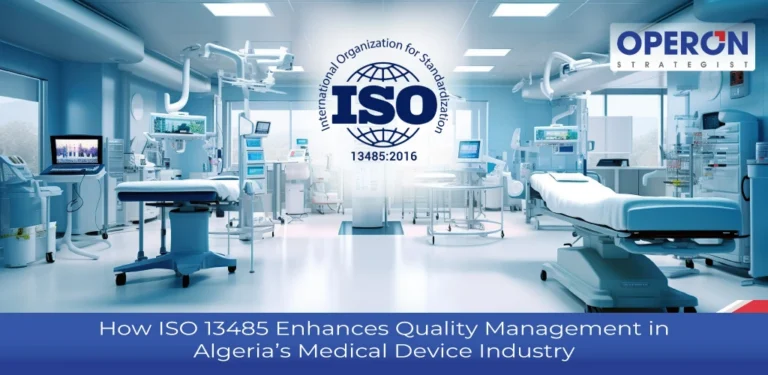
ISO 13485:2016 is the internationally recognized Quality Management System (QMS) standard specifically developed for organizations involved in the design, development, production, installation, and servicing of medical devices. Rooted in the process-based structure of ISO 9001, ISO 13485 places primary emphasis on regulatory compliance, risk management (ISO 14971), clinical data traceability, contamination control, and post-market surveillance rather than commercial customer satisfaction metrics.
In Algeria, becoming ISO 13485 certified demonstrates that an organization consistently satisfies both local statutory requirements enforced by the National Agency of Pharmaceutical Products (ANPP) and stringent international healthcare directives across the entire product lifecycle.
Core Lifecycle Phases Governed by ISO 13485:
- Design & Development Planning: Delineating Design History Files (DHF), design inputs, outputs, verification protocols, and clinical design validation.
- Supplier Quality Management: Establishing audited quality agreements, raw material qualification, and incoming material inspection.
- Production & Cleanroom Process Controls: Maintaining environmental cleanliness (ISO 14644), validated water systems, equipment calibration, and sterile barrier packaging (ISO 11607).
- Traceability & Unique Device Identification (UDI): Managing component batch records, Device Master Records (DMR), and Device History Records (DHR) to track products from raw polymer pellets to surgical operating theaters.
- Post-Market Surveillance & CAPA: Systematic vigilance reporting, customer complaint handling, and closed-loop Corrective and Preventive Actions (CAPA).
Read Next: Learn how specialized quality assurance protocols guarantee zero-defect manufacturing in our comprehensive guide on Medical Device Quality Assurance in Algeria: ISO 13485 & FDA Compliance.
4-Stage ISO 13485 Certification Roadmap in Algeria
Gap Analysis & QMS Scoping
Audit current manufacturing infrastructure against ISO 13485:2016 clauses, identify compliance deficits, and formulate a targeted project implementation charter.
Documentation & Risk Integration
Draft Quality Manual, SOPs, Work Instructions, Device Master Records (DMR), and integrate ISO 14971 risk management across all production workflows.
Internal Audits & Management Review
Execute cross-functional internal audits, close non-conformances through robust CAPA protocols, and conduct executive Management Review Meetings (MRM).
Independent Certification Audit
Undergo rigorous Stage 1 (Documentation Review) and Stage 2 (On-Site Cleanroom & Process Audit) by an accredited notified certification body to secure certification.
5 Strategic Benefits of ISO 13485 for Algerian Medical Device Companies
Implementing an audited Quality Management System is not merely a bureaucratic requirement; it is a transformative operational strategy that delivers quantifiable competitive advantages:
1. Seamless Regulatory Compliance with Algerian ANPP
The Algerian National Agency of Pharmaceutical Products (ANPP) enforces stringent on-site inspection criteria prior to granting an Establishment License (Agrément de Fabrication). Inspectors thoroughly evaluate contamination barriers, clean utility controls, operator gowning, and process traceability. An ISO 13485 medical devices quality system directly provides the structured documented evidence ANPP auditors demand, eliminating the risk of regulatory rejection or costly plant redesigns.
2. Enhanced Product Quality and Zero-Defect Patient Safety
Invasive catheters, orthopedic implants, and sterile IV administration sets carry zero tolerance for manufacturing error. ISO 13485 replaces reactive end-product testing with proactive in-process quality assurance. By establishing validated operating parameters for plastic injection molding, extrusion, ultrasonic welding, and terminal sterilization, manufacturers maintain process repeatability (Cpk≥1.33C_{pk} \ge 1.33Cpk≥1.33), preventing catastrophic clinical failures and safeguarding patient well-being.
3. Accelerated Domestic & International Market Access
Achieving certification drastically elevates a manufacturer’s commercial standing:
- Domestic Tender Dominance: The Central Hospital Pharmacy (PCH) gives decisive preference to ISO 13485-certified domestic producers during national procurement tenders.
- European Export Clearance: ISO 13485 serves as the mandatory baseline for compiling Technical Documentation to secure CE Marking under EU MDR (2017/745).
- African Free Trade Access: Certified status provides immediate credibility across African markets under the African Continental Free Trade Area (AfCFTA) framework.
4. Significant Operational Efficiency and Cost Containment
Substandard quality management leads to massive scrap rates, discarded polymer batches, and labor re-work. By standardizing manufacturing Standard Operating Procedures (SOPs), implementing automated calibration logs, and streamlining supply chain oversight, companies experience heightened machine uptime, reduced cycle times, and optimized production margins.
5. Proactive Risk Management Integration (ISO 14971)
Unlike general manufacturing standards, ISO 13485 mandates that risk analysis permeate every phase of product realization. Utilizing tools such as Design Failure Mode and Effects Analysis (dFMEA) and Process FMEA (pFMEA), manufacturers identify potential hazards—such as particulate contamination, sterile barrier leakage, or material degradation—and implement permanent engineering mitigations before devices enter operating rooms.
Read Also: Discover how structured validation plans support quality frameworks in our guide on Medical Device Validation Master Plan (VMP) in Algeria and Manufacturing Sterile Medical Devices in Algeria: Essential Cleanroom Practices for Safer Compliance.
| ISO 13485 Clause | Core Quality System Mandate | Manufacturing Operational Impact |
|---|---|---|
| Clause 4: General Requirements | Establishing the Quality Manual, Medical Device File (MDF), control of documented information, and software validation. | Guarantees full data integrity, electronic batch record control, and audit trail retention. |
| Clause 5: Management Responsibility | Executive leadership commitment, quality policy definition, resource allocation, and periodic Management Review Meetings (MRM). | Aligns executive budgets directly with regulatory compliance and quality staffing. |
| Clause 6: Resource Management | Personnel competency training, cleanroom environmental monitoring (ISO 14644), and contamination control infrastructure. | Prevents particulate contamination and bioburden proliferation in production cleanrooms. |
| Clause 7: Product Realization | Design controls (DHF), risk management (ISO 14971), purchasing verification, process validation (IQ/OQ/PQ), and sterile barrier sealing. | The operational core: ensures validated manufacturing repeatability from raw resin to sterile pack. |
| Clause 8: Measurement & Improvement | Internal audits, non-conforming product segregation, customer complaint investigation, and closed-loop CAPA governance. | Drives continuous quality improvement, eliminating repeat defects and customer complaints. |
Accelerate your QMS implementation, cleanroom qualification, and ANPP licensing with proven MedTech quality consultants.
Detailed Step-by-Step ISO 13485 Certification Process in Algeria
Achieving an accredited ISO 13485 certification in Algeria is a structured journey requiring cross-functional collaboration between executive management, quality assurance, engineering, and regulatory affairs. The process typically spans 4 to 6 months:
Step 1: Baseline Gap Analysis & Scope Formulation
Our regulatory specialists conduct an exhaustive on-site audit of your existing facilities, documented operating procedures, cleanroom zoning, and equipment calibration. The resulting Gap Analysis Matrix outlines exact non-conformances against ISO 13485:2016 clauses and Algerian ANPP GMP requirements.
Step 2: QMS Documentation Architecture & Implementation
Formulating a customized, four-tier documentation structure:
- Tier 1 (Quality Manual): Delineates company quality policy, organizational chart, and scope of certification.
- Tier 2 (Standard Operating Procedures – SOPs): Establishing mandatory documented procedures for Change Control, CAPA, Supplier Evaluation, Risk Management, Cleanroom Gowning, and Document Control.
- Tier 3 (Work Instructions & Specifications): Detailed machine operating guidelines, extrusion setups, tool maintenance protocols, and packaging seal parameters.
- Tier 4 (Forms, Logs & Records): Calibration certificates, environmental monitoring logs, and Device History Records (DHR).
Step 3: Comprehensive Training, Internal Audits & Management Review
Training personnel on Good Documentation Practices (GDP) and contamination control. An independent internal audit team assesses all operational departments. Identified non-conformances are remediated via root-cause analysis and CAPA closures. Finally, executive leadership convenes a formal Management Review Meeting (MRM) to authorize certification audit readiness.
Step 4: Independent Certification Audit (Stage 1 & Stage 2)
An accredited certification body conducts a two-stage evaluation:
- Stage 1 Audit (Document Review): Evaluates QMS documentation completeness, quality manual architecture, and regulatory alignment.
- Stage 2 Audit (On-Site Verification): Intensive physical evaluation of cleanrooms, machining zones, calibration records, technician interviews, and active batch traceability. Upon successful clearance, your ISO 13485 accredited certificate is officially issued.
Read Also: Explore how ISO 13485 underpins specialized device manufacturing across our comprehensive guides on Orthopedic Implant Manufacturing in Algeria: Regulatory & ISO 13485 Guide and IVD Manufacturing in Algeria: 7 Powerful Steps for Successful Setup.
| Regulatory Framework | Core Governance & QMS Relationship | Market Access Scope |
|---|---|---|
| ISO 13485:2016 | International harmonized standard emphasizing regulatory compliance, risk management (ISO 14971), and process validation. | Global benchmark; mandatory foundation for EU MDR CE marking and international tenders. |
| Algeria ANPP Directives | National Ministry of Health Good Manufacturing Practices (GMP) and physical on-site plant establishment licensing. | Mandatory for domestic commercial distribution and Central Hospital Pharmacy (PCH) procurement. |
| US FDA QMSR (21 CFR 820) | Harmonized Quality Management System Regulation incorporating ISO 13485:2016 by reference alongside FDA statutory rules. | Mandatory for medical device commercialization across the United States. |
How Operon Strategist Accelerates ISO 13485 Certification in Algeria
Navigating the complexities of ISO 13485 while simultaneously aligning with Algerian ANPP requirements requires specialized technical and regulatory mastery. Operon Strategist is a premier medical device regulatory consulting firm providing comprehensive turnkey QMS and engineering consulting for medical manufacturers in Algeria:
- Comprehensive Gap Analysis & Strategic Roadmap: Conducting thorough on-site facility and process audits to identify compliance gaps against ISO 13485:2016, ISO 14971, and ANPP directives, delivering a prioritized remediation charter.
- Turnkey QMS Documentation Architecture: Formulating customized Quality Manuals, Standard Operating Procedures (SOPs), Work Instructions, Device Master Records (DMR), and Design History Files (DHF) tailored to your exact manufacturing technology.
- Risk Management Integration (ISO 14971:2019): Developing comprehensive Risk Management Plans, Hazard Analysis matrices, and Process FMEAs embedded directly into shop-floor manufacturing workflows.
- Cleanroom & Facility Process Validation: Designing and qualifying ISO 14644 cleanrooms, critical utilities, and automated equipment (IQ, OQ, PQ) delivered through our product process engineering consultancy and turnkey medical device manufacturing consultancy.
- Certified Internal Audits & Staff Training: Conducting rigorous internal mock audits, technician training on contamination control and Good Documentation Practices, and facilitating executive Management Review Meetings.
- Audit Defense & Notified Body Liaison: Managing communication with accredited certification bodies, providing active on-site audit support, and leading rapid closure of audit findings to ensure first-time certification success.
- Post-Certification Maintenance & Global Market Clearances: Providing ongoing surveillance audit support, change control management, and leveraging your ISO 13485 foundation to achieve EU MDR CE Marking (2017/745) and US FDA 510(k) clearances.
Ensure seamless ISO 13485 certification, ANPP establishment licensing, and international export clearance with Operon Strategist.
FAQ's
What is ISO 13485, and why is it important for Algeria’s medical device industry?
ISO 13485:2016 is the international standard defining Quality Management System (QMS) requirements for medical devices. In Algeria, it guarantees compliance with ANPP GMP directives, prevents contamination risks, and validates commercial manufacturing licenses.
How does ISO 13485 improve quality management for medical device manufacturers in Algeria?
ISO 13485 embeds systematic risk management (ISO 14971), validated design controls, cleanroom environmental monitoring, and corrective and preventive action (CAPA) frameworks, eliminating production deviations, scrap rates, and patient safety hazards.
Does ISO 13485 help Algerian manufacturers access international markets?
Yes. ISO 13485 is a prerequisite for obtaining European CE Marking under EU MDR (2017/745), harmonizes with US FDA Quality Management System Regulation (QMSR), and enables tariff-free export across African AfCFTA member states.
How long does it take to achieve ISO 13485 certification in Algeria?
The certification process typically spans 4 to 6 months depending on facility readiness, involving comprehensive gap analysis, SOP formulation, internal audits, management review, and Stage 1 and Stage 2 third-party certification audits.
What is the key difference between ISO 9001 and ISO 13485?
While ISO 9001 prioritizes business growth and customer satisfaction, ISO 13485 focuses strictly on medical device safety, clinical efficacy, risk management, regulatory compliance, and sterile product contamination control.