
Senior Sales Executive | 3 Years of Experience
Key Takeaways
- High-Value Medical Sector: Orthopedic implant manufacturing in Algeria represents a vital biomedical frontier to replace costly foreign imports with domestically fabricated trauma, joint, spinal, and maxillofacial implants.
- High-Risk Regulatory Rigor: Implants are categorized as Class III / IV equivalent high-risk devices, demanding full pre-market authorization from the National Agency of Pharmaceutical Products (ANPP).
- Mandatory Quality & Risk Frameworks: Production facilities must integrate ISO 13485:2016 quality systems, ISO 14971:2019 risk management, ISO 10993 biocompatibility evidence, and lifetime Unique Device Identification (UDI) traceability.
- Technological Advancements: Transitioning to precision multi-axis CNC machining, additive 3D metal printing (DMLS), cleanroom passivation, and validated terminal sterilization unlocks international export competitiveness under EU MDR CE Marking (2017/745).
Overview: The Strategic Rise of Orthopedic Implant Manufacturing in Algeria
As Algeria accelerates investments in modernizing its national healthcare network, orthopedic implant manufacturing in Algeria has emerged as one of the most critical and technologically sophisticated industrial sectors. Driven by rising clinical demand for surgical interventions, national economic initiatives championing local manufacturing, and breakthroughs in biomedical metallurgy, Algeria is positioned to build a self-reliant orthopedic device ecosystem.
Historically dependent on foreign European and Asian imports for joint prostheses and trauma hardware, Algeria’s healthcare system faced elevated procurement costs and supply delays. Establishing domestic manufacturing units ensures continuous product availability for the Central Hospital Pharmacy (Pharmacie Centrale des Hôpitaux – PCH), eliminates foreign currency drain, and creates an export hub supplying Francophone North Africa and the Middle East.
Why Orthopedic Implants Are Essential in Algeria
Orthopedic implants are bio-inert mechanical devices engineered to restore joint function, stabilize skeletal fractures, and relieve chronic musculoskeletal pain. In Algeria, four primary demographic and epidemiological drivers underscore the urgent necessity for localized production:
- Aging Population & Osteoarthritis: Rising life expectancy has led to increased joint degeneration, sparking unprecedented demand for total hip and knee arthroplasty systems.
- Prevalence of Lifestyle Diseases: High rates of metabolic disorders, diabetes, and obesity exacerbate bone porosity and joint wear, requiring surgical reconstructive intervention.
- Trauma from Road Traffic Incidents: High road accident statistics across national highways drive emergency surgical demand for trauma bone plates, locking screws, and intramedullary interlocking nails.
- Decentralized Hospital Infrastructure: Expansion of modern specialized surgical centers into interior wilayas requires rapid, dependable local access to sterile implant sets and instrumentation.
Read Next: Explore how precision engineering supports specialized medical production in our detailed guide on Revolutionary IOL Cast Molding Technology in Algeria: Setup & Compliance.
Types of Orthopedic Implants Manufactured in Algeria
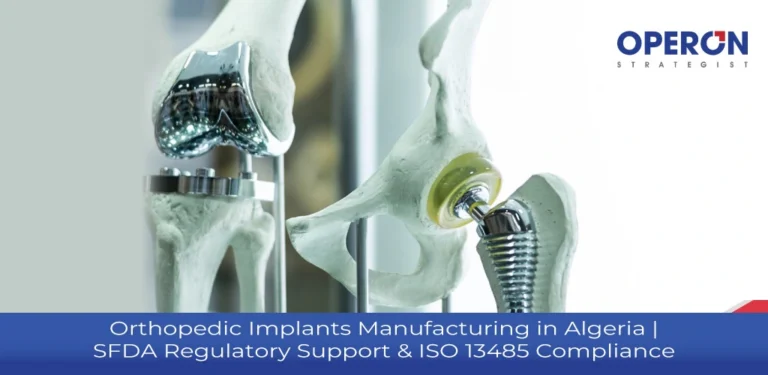
Modern orthopedic production lines in Algeria encompass a broad spectrum of implantable devices engineered from medical-grade titanium alloys (Ti-6Al-4V ELI), cobalt-chromium (CoCrMo), implantable stainless steel (316LVM), and biocompatible polymers like PEEK and UHMWPE:
| Implant Category | Device Types & Material Specifications | Clinical Application |
|---|---|---|
| Trauma Implants | Locking compression plates (LCP), cortical/cancellous screws, intramedullary nails, and external fixators in titanium and 316LVM. | Emergency fracture fixation, long-bone realignment, polytrauma management. |
| Joint Replacement Implants | Total hip femoral stems, acetabular cups, knee femoral/tibial trays, UHMWPE cross-linked liners, and shoulder hemiarthroplasty. | Severe joint osteoarthritis, avascular necrosis, elective joint reconstruction. |
| Spinal Implants | Monoaxial/polyaxial pedicle screws, connecting rods, cross-links, PEEK/titanium interbody fusion cages, and cervical plates. | Spinal deformity correction, degenerative disc disease, vertebral stabilization. |
| Dental & Maxillofacial | Endosseous dental screw implants, custom cranial mesh plates, and orbital/mandibular reconstruction reconstruction screws. | Restorative prosthodontics, facial reconstructive and trauma surgery. |
Additive Manufacturing & CAD/CAM Customization
Local manufacturing enables hospitals to transition from standard catalog implants to patient-specific customized implants (PSI). By utilizing computer-aided design (CAD/CAM), multi-axis Swiss-type CNC milling, and Selective Laser Melting (SLM) 3D titanium printing, Algerian manufacturers can fabricate bespoke implants based directly on pre-operative CT/MRI scans for complex oncological and reconstructive surgeries.
Regulatory Framework for Orthopedic Implants in Algeria
Because orthopedic implants remain inside the human body for extended durations or indefinitely, they are regulated as high-risk medical devices (Class III or Class IV equivalent) by the National Agency of Pharmaceutical Products (ANPP – Agence Nationale des Produits Pharmaceutiques).
Algerian Ministry of Health & ANPP
High-Risk Implantable Medical Devices Directorate
National ANPP Authorization
-
✓
Class III / IV Registration: Technical dossier evaluation with pre-clinical biomechanical bench testing.
-
✓
ANPP Establishment License: Full on-site physical GMP audit of machining, cleaning, and cleanroom packaging.
-
✓
Mandatory UDI System: Laser-etched 2D DataMatrix code for lifetime patient and hospital traceability.
-
✓
Bilingual Packaging & IFU: Full Arabic and French surgical technique guides and sterile barrier labels.
International Export Compliance
-
✓
ISO 13485:2016 QMS: Certified quality management system for orthopedic implant manufacturing.
-
✓
ISO 14971 Risk Analysis: Comprehensive risk management across implant fatigue, wear, and biocompatibility.
-
✓
EU MDR 2017/745 CE Mark: Class IIb / Class III CE certification with Notified Body technical file review.
-
✓
ISO 10993 Biocompatibility: Exhaustive chemical characterization, cytotoxicity, and wear particle toxicity clearance.
Essential Regulatory Compliance Pillars:
- Medical Device Registration & Technical File: Dossiers must include metallurgical mill test certificates, static and dynamic fatigue bench test data (e.g., ISO 7206 for hip stems, ASTM F1717 for spinal assemblies), and a Clinical Evaluation Report (CER).
- ISO 13485:2016 Certification: Implementation of a robust Quality Management System (QMS) covering design history files (DHF), device master records (DMR), and vendor qualifications, supported by our guide on ISO 13485 Quality Management in Algeria.
- Good Manufacturing Practices (GMP) & Cleanroom Hygiene: Implants must undergo validated ultrasonic multi-stage aqueous cleaning, citric/nitric acid passivation (ASTM A967/F86), and double-sterile barrier pouch packaging inside ISO 14644 Class 7 (Grade C) cleanrooms.
- Unique Device Identification (UDI) & Vigilance: Direct laser etching of 2D DataMatrix codes on metallic surfaces enables complete traceability from the CNC machine through hospital operating rooms, facilitating post-market clinical follow-up (PMCF) and vigilance reporting.
Read Also: Learn the step-by-step methodologies of validation protocols in our guide on Medical Device Validation Master Plan (VMP) in Algeria and Medical Device Quality Assurance in Algeria.
Benefits of Local Orthopedic Implants Manufacturing
Establishing domestic manufacturing facilities yields profound economic, clinical, and strategic advantages for Algeria:
| Strategic Benefit | Commercial & Healthcare Impact |
|---|---|
| Faster Delivery & Supply Security | Eliminates import customs backlogs, port congestion, and shipping lead times, ensuring immediate availability of emergency trauma kits for acute surgical interventions. |
| Substantial Cost Savings | Dramatically reduces international airfreight, import duties, and distributor markups, lowering surgical expenditure for the PCH and expanding access for patients. |
| Patient-Specific Customization | Enables orthopedic surgeons to order custom 3D-printed titanium implants for complex deformities, bone tumors, and revision arthroplasty within short turnarounds. |
| High-Tech Job Creation | Spurs skilled employment in biomedical engineering, CAD/CAM machining, cleanroom validation, quality control metallurgy, and regulatory affairs. |
| National Healthcare Independence | Shields the nation against global supply chain bottlenecks and currency fluctuations while advancing industrial manufacturing maturity. |
Accelerate your ISO 13485 certification, cleanroom engineering, and ANPP Class III licensing with proven MedTech specialists.
Industry Challenges & High-Growth Opportunities
While the orthopedic market provides unmatched returns, establishing an implant production facility involves overcoming specialized technical hurdles:
Key Operational Challenges:
- High Initial Capital Expenditure (CAPEX): Procuring multi-axis Swiss CNC turning centers, vacuum furnaces, ultrasonic cleaning lines, and ISO Class 7 cleanrooms requires substantial capital.
- Complex Biocompatibility & Mechanical Testing: High-risk Class III devices require expensive pre-clinical fatigue, corrosion, wear debris, and cytotoxicity testing.
- Skilled Talent Availability: Operating precision CNC tooling and maintaining sterile barrier systems demands specialized training programs for local technical personnel.
Lucrative Market Opportunities:
- Government Import Substitution Incentives: Preferential public procurement policies, duty exemptions on raw titanium bars, and tax holidays for high-tech medical manufacturers.
- International Technology Transfer Alliances: Partnering with established European or Asian manufacturers seeking a compliant manufacturing hub for the African Continental Free Trade Area (AfCFTA).
- Innovation & R&D Development Grants: Direct access to sovereign investment funds promoting biomedical research, 3D printing prototyping, and dental implant fabrication.
Read Also: For full details on health ministry submissions, review our complete guide on Simplifying Medical Device Registration in Algeria.
How Operon Strategist Accelerates Your Orthopedic Implant Setup in Algeria
Establishing an internationally compliant orthopedic implant facility requires integrated engineering precision and deep regulatory expertise. Operon Strategist provides end-to-end turnkey consulting for companies establishing or scaling orthopedic implant manufacturing in Algeria:
- Regulatory Compliance & ANPP Registration: Preparing complete registration dossiers, clinical evaluation reports (CER), and ISO 14971 risk management documentation in strict alignment with Algerian Ministry of Health guidelines.
- GMP-Compliant Facility & Cleanroom Design: Designing optimal plant layouts that segregate heavy CNC machining, chemical deburring, passivation, cleanroom assembly, and sterile packaging. Our product process engineering consultancy and turnkey medical device manufacturing consultancy manage projects from conceptual architecture to validation.
- ISO 13485:2016 QMS Implementation: Formulating customized Standard Operating Procedures (SOPs), Device Master Records (DMR), Design History Files (DHF), and metallurgical traceability frameworks.
- Audit Readiness & Technical Staff Training: Conducting rigorous mock audits, technician training for cleanroom hygiene, bioburden monitoring, and non-conformance management to guarantee first-time audit success.
- Product Development & Metallurgy Consulting: Advising on biomedical material selection (Ti-6Al-4V, CoCr, PEEK), tooling qualification, biocompatibility testing (ISO 10993), and fatigue test protocol development.
- Global Market Expansion (EU MDR CE Marking): Compiling General Safety and Performance Requirements (GSPR) documentation to secure CE Marking under EU MDR (2017/745) for European and MENA market exports.
Ensure seamless ISO 13485 certification, ANPP licensing, and international market clearance with Operon Strategist.
FAQ's
What are the regulatory requirements for orthopedic implants in Algeria?
Orthopedic implants are classified as high-risk devices (Class III/IV equivalent), requiring ANPP establishment licensing, an ISO 13485-certified QMS, an ISO 14971 risk management file, and comprehensive clinical evaluation data.
Why should companies invest in orthopedic implant manufacturing in Algeria?
Rising trauma cases, an aging population requiring joint replacements, national import-substitution policies, and tariff incentives make local manufacturing highly profitable with strong regional export potential.
How can foreign medical device companies enter the Algerian market?
Foreign companies can establish domestic joint ventures, execute technology transfer agreements with local manufacturers, or register their devices through authorized Algerian representatives under ANPP guidelines.
Is Unique Device Identification (UDI) mandatory for orthopedic implants?
Yes. UDI laser marking and system traceability are required to ensure lifetime patient safety, vigilance reporting, and seamless integration with hospital inventory tracking systems.
Can orthopedic implants manufactured in Algeria be exported to EU markets?
Yes. Algerian facilities adhering to ISO 13485 that secure CE Marking certification under EU MDR (2017/745) through an accredited Notified Body can export across the European Union and MENA markets.
Senior Sales Executive | 3 Years of Experience
He brings experience in domestic and international business development, strategic client relationship management, and sales of medical device regulatory consulting and turnkey project services. His expertise includes supporting market entry and regulatory service requirements related to CDSCO registration, EU MDR CE marking, US FDA regulations, and ISO 13485 quality management systems.