
Senior Sales Executive | 3 Years of Experience
Vyankatesh Dhavale holds a Bachelor of Pharmacy (B.Pharm) and an MBA specializing in Operations and Supply Chain Management
Introduction
Surgical bandages are essential medical consumables widely used for wound care, trauma management, and surgical dressings. With Algeria’s growing focus on local medical device production, the demand for high-quality surgical bandages is steadily increasing.
The surgical bandage manufacturing industry in Algeria plays a key role in strengthening the healthcare supply chain and reducing dependency on imports. By adhering to ISO 13485 quality management standards and the ANPP (Agence Nationale des Produits Pharmaceutiques) regulatory guidelines, Algerian manufacturers can meet domestic demand while exploring opportunities for export across North Africa and the MENA region.
Understanding Surgical Bandages
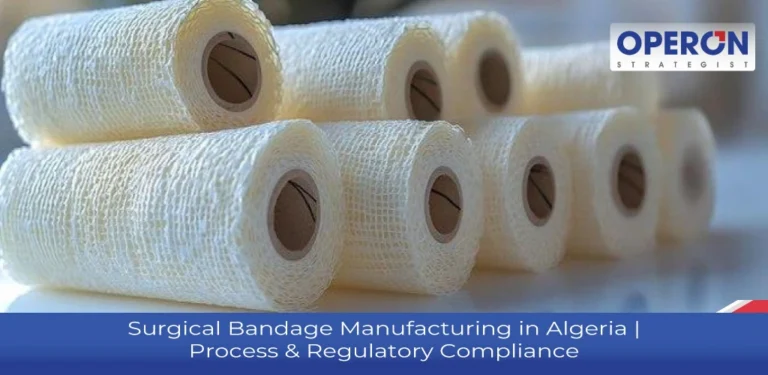
Surgical bandages are sterile or non-sterile strips made from cotton, gauze, or elastic materials. They are primarily used for:
- Securing wound dressings
- Applying controlled pressure
- Supporting injuries
- Absorbing wound exudates
Common types include:
- Gauze bandages
- Crepe bandages
- Elastic adhesive bandages
- Compression bandages
Surgical Bandage Manufacturing Process in Algeria
The manufacturing process requires strict hygiene, controlled environments, and regulatory compliance. The steps include:
1. Raw Material Selection
- Cotton-based gauze, elastic threads, and medical-grade adhesives.
- All materials must comply with ISO 13485 and be biocompatible.
2. Weaving & Knitting
- Specialized textile machines produce gauze fabric with defined porosity and elasticity.
3. Bleaching & Washing
- Removal of impurities through bleaching ensures a safe base material.
4. Drying & Calendaring
- Fabrics are dried and pressed for desired thickness and texture.
5. Coating & Adhesive Application (if applicable)
- For adhesive bandages, medical-grade adhesives such as zinc oxide are applied.
6. Cutting & Rolling
- Automated cutting and rolling ensure consistency in sizes.
7. Sterilization
- ETO (Ethylene Oxide) or Gamma Radiation sterilization is used, depending on the bandage type.
8. Packaging & Labeling
- Sterile packaging under controlled conditions.
- Labels must include batch number, expiry date, sterilization method, and instructions for use.
Regulatory Guidelines for Surgical Bandages in Algeria
In Algeria, surgical bandages are classified as Class I medical devices under the supervision of the ANPP (Agence Nationale des Produits Pharmaceutiques).
Key Regulatory Requirements:
- Manufacturer Establishment License (from ANPP)
- ISO 13485-certified Quality Management System (QMS)
- Good Manufacturing Practices (GMP) compliance
- Sterilization validation & biocompatibility testing
- Technical File submission, including:
- Device description & intended use
- Risk management report
- Safety & performance testing data
- Labeling & Instructions for Use (IFU)
Documents Required for Regulatory Compliance
To set up a surgical bandage manufacturing unit in Algeria, you need:
- Company profile & ISO 13485 certificate
- Device master file with product details
- Clinical justification or references
- Sterilization validation reports
- Packaging & labeling samples
- Risk assessment reports
- Importer/distributor agreement (if applicable)
Ensure Compliance for Manufacturers with Expert Guidance
How Operon Strategist Helps Surgical Bandage Manufacturers in Algeria
At Operon Strategist, we provide end-to-end consulting support for surgical bandage manufacturing projects in Algeria.
Our Services Include:
- Project feasibility & manufacturing plant layout design
- Assistance with ISO 13485 certification
- ANPP licensing & registration guidance
- QMS documentation & SOP drafting
- Sterilization validation support
- Technical file & regulatory dossier preparation
- Product classification & regulatory pathway planning
- Packaging & labeling compliance review
With our expertise, Algerian manufacturers can achieve faster approvals, reduced compliance risks, and improved market entry both locally and internationally.
Contact Operon Strategist today
FAQ's
What license is required to manufacture surgical bandages in Algeria?
You need a Manufacturer Establishment License from ANPP to produce medical devices locally.
Do I need ISO certification to start surgical bandage manufacturing in Algeria?
Yes, an ISO 13485-certified QMS is mandatory to comply with Algerian and international quality standards.
Are surgical bandages regulated under ANPP?
Yes, they are classified as Class I medical devices, requiring regulatory compliance, QMS, and post-market surveillance.
Which sterilization methods are suitable for surgical bandages?
Ethylene Oxide (EtO) gas sterilization and Gamma irradiation are the standard industry methods used for sterile surgical gauze and adhesive bandages.
Can Algerian surgical bandage manufacturers export to MENA and EU markets?
Yes. By aligning plant operations with ISO 13485 and obtaining CE marking (EU MDR compliance), Algerian manufacturers can export competitively across Africa, the Middle East, and Europe.
Senior Sales Executive | 3 Years of Experience
Vyankatesh Dhavale holds a Bachelor of Pharmacy (B.Pharm) and an MBA specializing in Operations and Supply Chain Management, with a minor in Marketing. He brings experience in domestic and international business development, strategic client relationship management, and sales of medical device regulatory consulting and turnkey project services. His expertise includes supporting market entry and regulatory service requirements related to CDSCO registration, EU MDR CE marking, US FDA regulations, and ISO 13485 quality management systems.