
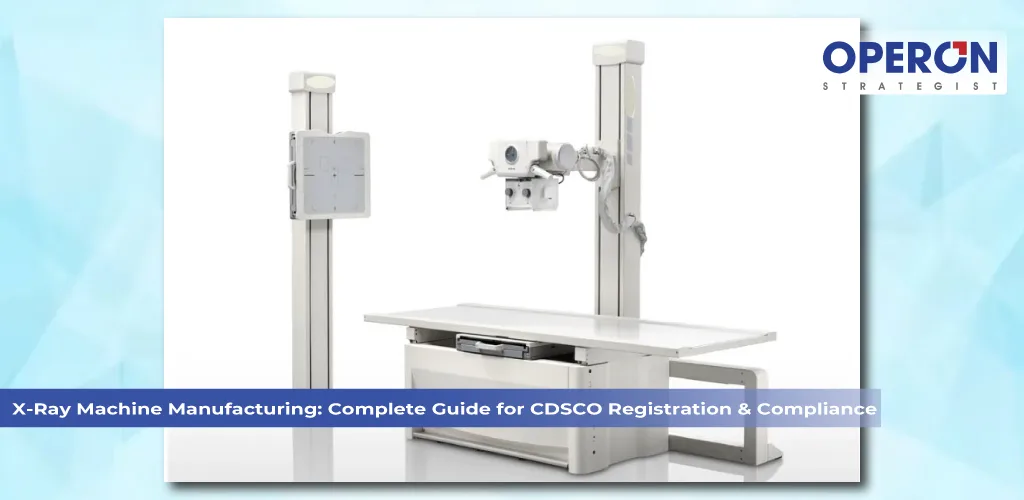
An Overview of X-Ray Machine Manufacturing:
X-Ray Machine Manufacturing plays a crucial role in modern healthcare by enabling accurate diagnosis through advanced imaging technology. X-rays are a form of electromagnetic radiation that help visualize internal body structures, making them essential for detecting fractures, infections, and diseases.
In the healthcare sector, X-Ray Machine Manufacturing must comply with strict regulatory standards to ensure patient safety, product quality, and performance. Manufacturers in India must follow CDSCO regulations before launching their devices in the market.
Regulatory Excellence for Global Medical Device Markets
What Are the Different Types of X-Ray Machines?
Types of X-Ray Machines
Understanding product categories is important in X-Ray Machine Manufacturing for regulatory classification and application.
Medical X-Ray Machines
- Radiography X-ray Machine – Used for capturing still images of bones and organs
- Fluoroscopy X-ray Machine – Provides real-time imaging during procedures
- CT Scanner – Generates detailed 3D images
- Mammography Machine – Used for breast cancer detection
- Dental X-ray Machine – Used in dental diagnostics
- C-arm X-ray Machine – Mobile imaging system used in surgeries
Industrial & Security X-Ray Machines
- Industrial X-ray Machine – Used for non-destructive testing (NDT)
- Baggage & Cargo Scanner – Used in airports and security checks
- Portable X-ray Machine – Used in emergency and remote conditions
- Veterinary X-ray Machine – Used for animal healthcare
X-Ray Machine Manufacturing Process
The X-Ray Machine Manufacturing process involves high precision engineering and strict quality control.
- Component Manufacturing: Includes anode, cathode, rotors, and generators
- Deep Drawing Process: Shapes metal components for durability
- Assembly: Integration of imaging systems and electronics
- Testing & Calibration: Ensures performance, safety, and compliance
Quality assurance is critical to ensure the device meets medical standards and performs reliably.
Why Registration is Necessary for X-Ray Machines?
Under India’s Medical Device Rules (MDR) 2017, X-Ray Machine Manufacturing falls under Class C (Moderate to High Risk) devices.
- Mandatory registration with CDSCO
- Ensures safety and performance
- Required for manufacturing, import, and sale
Without proper registration, devices cannot be legally marketed in India.
CDSCO Registration Process for X-Ray Machine Manufacturing
To successfully complete the X-Ray Machine Manufacturing registration, follow these steps:
Step 1: Device Classification
Confirm that the X-ray machine is a notified Class C medical device.
Step 2: Appoint Indian Authorized Agent (IAA)
Foreign manufacturers must appoint an IAA for regulatory representation.
Step 3: Prepare Documentation
- Application form
- ISO 13485 Certificate
- Device Master File (DMF)
- Free Sale Certificate
- Technical documentation
Step 4: Submission to CDSCO
Submit the application for review and approval.
Step 5: Grant of License
After approval, CDSCO issues the manufacturing or import license.
How Operon Strategist Can Help You?
Navigating X-Ray Machine Manufacturing regulations can be complex and time-consuming. Operon Strategist provides end-to-end regulatory support to simplify the process.
Our services include:
- CDSCO registration and compliance support
- Technical documentation (DMF, filings)
- ISO 13485 implementation
- QMS training and compliance
- Manufacturing facility and plant layout guidance
With our expertise, you can reduce approval time, avoid regulatory errors, and achieve faster market entry.
FAQ
What is X-Ray Machine Manufacturing?
X-Ray Machine manufacturing involves designing, assembling, and testing medical imaging devices that use electromagnetic radiation to diagnose internal body conditions.
Is CDSCO registration required for X-ray machines in India?
Yes, X-ray machines are classified as Class C medical devices under MDR 2017, and CDSCO registration is mandatory for manufacturing, importing, and selling them in India.
What documents are required for X-ray machine registration?
Key documents include ISO 13485 certification, Device Master File (DMF), application form, Free Sale Certificate, and technical documentation.
What are the types of X-ray machines?
Types include radiography, fluoroscopy, CT scanners, mammography, dental X-ray machines, C-arm systems, portable X-ray units, and industrial X-ray machines.
How long does CDSCO approval take for X-ray machines?
The approval timeline typically ranges from 3 to 6 months, depending on documentation accuracy and regulatory review.