
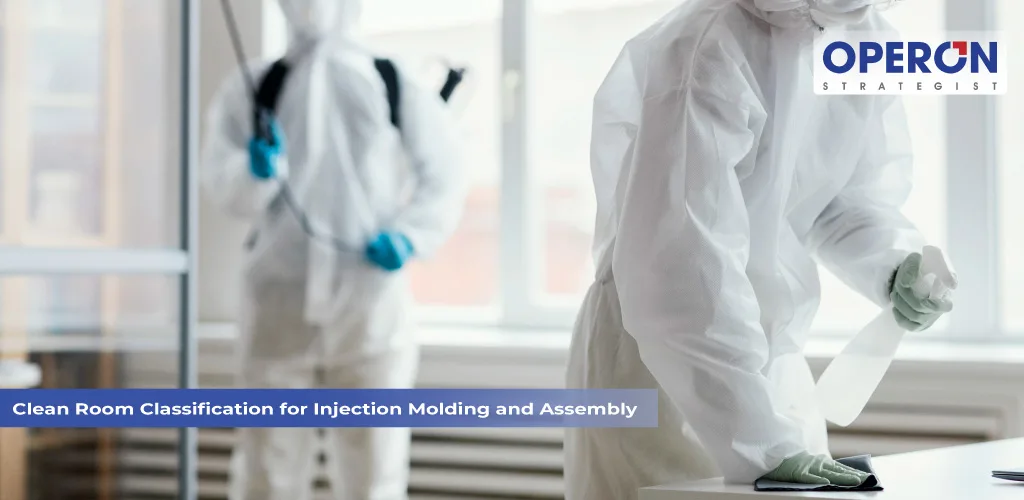
Clean Room Classification for Injection Molding and Assembly
If you are an aspiring business owner who wants to manufacture medical devices, then it is essential to have the right clean room classification for medical device injection molding and assembly. The ideal environment for your product will depend on the kind of medical device you want to manufacture.
Medical devices are classified into different risks (either A, B C D or I – III depending on regulatory body), the lower the class of product, the lower the risk to the patient. To ensure product quality and patient safety it is essential to have the right Clean Room Classification.
talk to our experts
The most widely used classification method is based on the International Organization for Standardization ISO standard. To ensure compliance and establish the cleanroom classification required for your medical device injection molding and assembly processes, it is advised that you refer to the ISO 14644-1 standard and related regulatory requirements.
ISO cleanroom cleanliness standards are based on particle levels inside a certain area of a room, which are determined by the quantity and size of particles per air volume.
The ISO cleanroom classification is based on the number of particles allowed per square foot of air. Below are some of the types of clean rooms based on the number of particles and the product requirements.
ISO 7 Clean Room
ISO 7 Cleanroom which maintains 10,000 particles per square foot of air. The temperature, humidity level, and pressure in the clean room are rigorously monitored and regulated by ISO 7 Cleanroom. It ensures that there will be no contaminants, particles, or dust in the area that may affect the quality, sanitation, or functionality of the medical device.
ISO 7 cleanrooms are recommended for applications with moderate particle concentration limitations. Stents, implanted prosthetics, catheters, medical balloons, and intravenous infusion pump systems are some examples of medical equipment created under ISO 7 clean room requirements.
ISO 8 Clean Room
ISO 8 cleanrooms are established according to the number and size of particles permitted per volume of air over a specific amount of time. ISO 8 Cleanroom which maintains 1,00,000 particles per square foot of air. The temperature, humidity level, and pressure in the clean room are rigorously monitored and regulated by ISO 8 Cleanroom.
ISO 8 clean rooms are frequently used to manufacture injection molded medical devices such as catheters, syringes, surgical equipment, medical prep equipment, and different medical housings and equipment casings. It ensures that no pollutants, particles, or dust are present in the region that might compromise the quality, cleanliness, or performance of the medical equipment.
White Room Manufacturing
Not every medical device needs to meet strict regulatory requirements for a clean room for manufacturing. While ISO 7/8 costs more, manufacturers prefer white rooms to save money while keeping an acceptable manufacturing environment.
These settings also help to maintain the production space clean by strictly controlling air pressure, temperature, and humidity, which are not strictly regulated. For uses such as dental equipment, x-ray equipment, latex gloves, and surgical masks, white rooms are advised.
The list above includes some of the most often used cleanroom classes, but if you want to get deeper into cleanroom classification, you can refer to this blog.
How Operon Can Help You Solve Your All Query Related to Clean Room
As a Clean Room Design Consultant, we work on cleanroom validation and design projects that adhere to international regulations and norms.
We can assist you in establishing a new manufacturing unit as a turnkey project consultant, as well as provide regulatory support for your facility and clean room design services. As a cleanroom design consultant, we have supported the successful completion of various cleanroom projects. Contact us for more details about the medical device manufacturing unit setup.
FAQ
What is clean room classification in medical device manufacturing?
Clean room classification defines the level of air cleanliness by measuring the number of airborne particles present in a controlled manufacturing environment.
Why are clean rooms important for injection molding and assembly?
Clean rooms help prevent contamination during the manufacturing and assembly of medical devices, ensuring product safety, quality, and regulatory compliance.
Which ISO standards are used for clean room classification?
ISO 14644 is the primary international standard used for clean room classification and monitoring.
What ISO clean room classes are commonly used in medical device manufacturing?
Common clean room classifications include:
- ISO Class 7
- ISO Class 8
- ISO Class 5 (for critical applications)
The required class depends on the type of medical device and manufacturing process.
What is the difference between ISO Class 7 and ISO Class 8 clean rooms?
ISO Class 7 has stricter particle control and cleaner air compared to ISO Class 8, making it suitable for more sensitive medical device manufacturing operations.