
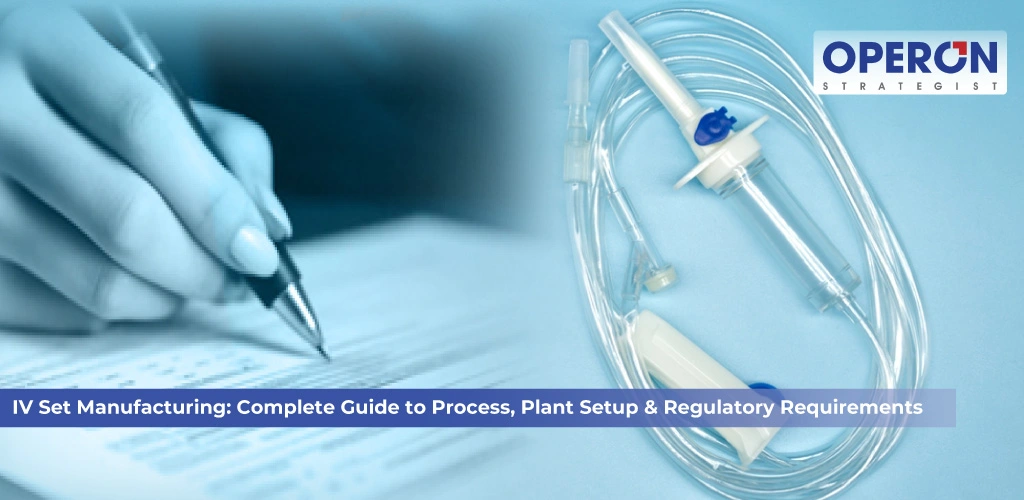
IV Set Manufacturing: Complete Guide to Process, Plant Setup & Regulatory Requirements
IV set manufacturing plays a crucial role in modern healthcare by enabling the safe delivery of fluids, medications, and nutrients directly into the bloodstream. As hospitals, emergency care units, and home healthcare services expand globally, the demand for disposable infusion products continues to rise.
IV infusion sets are essential for patient care, and their usage has increased significantly due to growing healthcare infrastructure, chronic disease management, and surgical procedures. This makes IV set manufacturing a high-demand and scalable opportunity for medical device manufacturers.
Setting up a compliant IV set manufacturing plant requires a clear understanding of manufacturing processes, cleanroom requirements, machinery selection, and regulatory approvals. Operon Strategist supports companies in establishing fully compliant and efficient IV-set manufacturing units with a strong focus on quality and regulatory success.
What is an IV Set?
An IV infusion set is a disposable medical device used to administer fluids such as saline, medications, blood products, or nutrients directly into a patient’s vein.
IV sets are commonly used for:
- Hospital patient care
- Emergency treatment
- Surgical procedures
- Chemotherapy
- Nutritional therapy
Because IV sets are single-use devices, healthcare facilities require continuous supply, making IV set manufacturing a consistent demand-driven industry.
Why is IV Set Manufacturing in High Demand?
Understanding market demand is essential before investing in an IV set manufacturing plant.
Key demand drivers:
- Growth in hospital infrastructure and critical care facilities
- Increasing number of surgical procedures worldwide
- Rising prevalence of chronic diseases requiring IV therapy
- Expansion of home healthcare and infusion therapy
- Shift toward single-use disposable medical devices
Industry insight:
Disposable medical consumables, including IV sets, form a significant share of the global medical device market, which is projected to exceed $600 billion by 2030 as per market analysis experts.
What are the Components of an IV Infusion Set?
An IV set consists of multiple components designed to regulate fluid flow and ensure safe administration.
Key components include:
- Spike
Used to connect the IV set to the fluid container - Drip Chamber
Allows monitoring and control of fluid flow - Roller Clamp
Regulates the flow rate of fluid - IV Tubing
Flexible medical-grade tubing that carries fluid - Injection Port
Allows additional medication to be administered - Luer Connector
Connects the IV set to the patient’s catheter.
Each component must be manufactured using medical-grade materials and assembled under controlled conditions to maintain sterility and safety.
What is the IV Set Manufacturing Process?
IV set manufacturing involves multiple controlled and validated steps to ensure product quality and compliance.
Step-by-step manufacturing process:
1) Raw Material Selection
- PVC (Polyvinyl Chloride)
- Polypropylene
- Polyethylene
Elastomer components
Materials must meet biocompatibility standards
2) Injection Molding
Used to produce components like drip chambers, connectors, and clamps with high precision
3) Tube Extrusion
Produces flexible medical-grade tubing with controlled diameter and transparency
4) Component Assembly
- Spike attachment
- Drip chamber connection
- Clamp and port installation
Performed in controlled environments to prevent contamination
5) Sterilization
- Ethylene Oxide (EO) sterilization
Gamma radiation
This is a critical step to ensure product safety
6) Packaging
Sterile packaging protects the product until use and maintains integrity during storage and transport
Critical control point:
Sterilization validation is essential, as improper sterilization can lead to product rejection and regulatory non-compliance.
What Machinery is Required for IV Set Manufacturing?
To establish an IV set manufacturing unit, the following machinery is required:
Core machinery:
- Injection molding machine
- Tube extrusion machine
- Assembly machines
- Sealing and packaging machines
- Sterilization plant
Supporting equipment:
- Air compressor
- Chilling plant
- Water system
- Scrap grinder
- Quality control instruments
Expert insight:
Automation in the manufacturing line improves consistency, reduces rejection rates, and supports regulatory compliance.
What are the Cleanroom Requirements for IV Set Manufacturing?
Lorem ipsum dolor sit amet, consectetur adipiscing elit. Ut elit tellus, luctus nec ullamcorper mattis, pulvinar dapibus leo. IV set manufacturing must be carried out in controlled cleanroom environments to prevent contamination.
Typical cleanroom requirements:
- ISO Class 8 environment
- HEPA filtered air systems
- Controlled temperature and humidity
- Particle and microbial monitoring
Cleanroom design directly impacts product quality and regulatory approval outcomes.
What Regulatory Requirements Apply to IV Set Manufacturing?
Compliance is a critical factor in IV set manufacturing.
Key regulatory requirements include:
- Medical device manufacturing license
- ISO 13485 Quality Management System
- Risk management as per ISO 14971
- Biocompatibility testing (ISO 10993)
- Sterilization validation
Global compliance pathways:
- US market: FDA 510(k) and QSMR compliance
- European market: CE marking under MDR
- Other markets: Country-specific regulatory approvals
Industry insight:
Most regulatory delays occur due to incomplete documentation and lack of validated sterilization processes.
What are the Common Challenges in IV Set Manufacturing?
Manufacturers often face challenges during setup and operations.
Key challenges include:
- Improper cleanroom design
- Unvalidated sterilization processes
- High rejection rates due to quality issues
- Regulatory non-compliance
- Documentation gaps
Real-world observation:
Many projects are delayed not due to manufacturing issues but due to lack of regulatory planning and validation strategy.
How Can You Set Up a Compliant IV Set Manufacturing Plant?
Practical approach:
- Define product specifications and target market
- Develop regulatory compliance strategy early
- Design facility as per cleanroom requirements
- Select appropriate machinery and automation level
- Validate all critical processes
- Implement ISO 13485 quality system
A structured approach helps reduce risks and ensures faster market entry.
How Can Operon Strategist Help You Set Up an IV Set Manufacturing Plant?
Setting up a compliant IV set manufacturing unit requires both regulatory expertise and practical execution.
Operon Strategist supports with:
- Process validation and documentation
- Product and process technology with machinery guidance
A well-planned setup reduces compliance risks, minimizes delays, and ensures faster commercialization.
Conclusion
IV set manufacturing is a high-potential segment driven by continuous healthcare demand and the shift toward disposable medical devices.
Success in this industry depends on:
- Regulatory compliance
- Sterilization validation
- Cleanroom-controlled manufacturing
- Strong quality management systems
Manufacturers who focus on these factors can build scalable and compliant IV set manufacturing plants with long-term growth potential.
FAQs
What is IV set manufacturing?
It is the process of producing disposable infusion sets used to deliver fluids into the bloodstream
What is the most critical step in IV set manufacturing?
Technical documentation and clinical evaluation are the most critical challenges.
What materials are used in IV set manufacturing?
What materials are used in IV set manufacturing
What cleanroom class is required?
Typically ISO Class 8 cleanroom is required
Is regulatory approval mandatory?
Yes, manufacturers must comply with medical device regulations and quality standards
Can IV sets be exported globally?
Yes, but manufacturers must comply with country-specific regulatory requirements