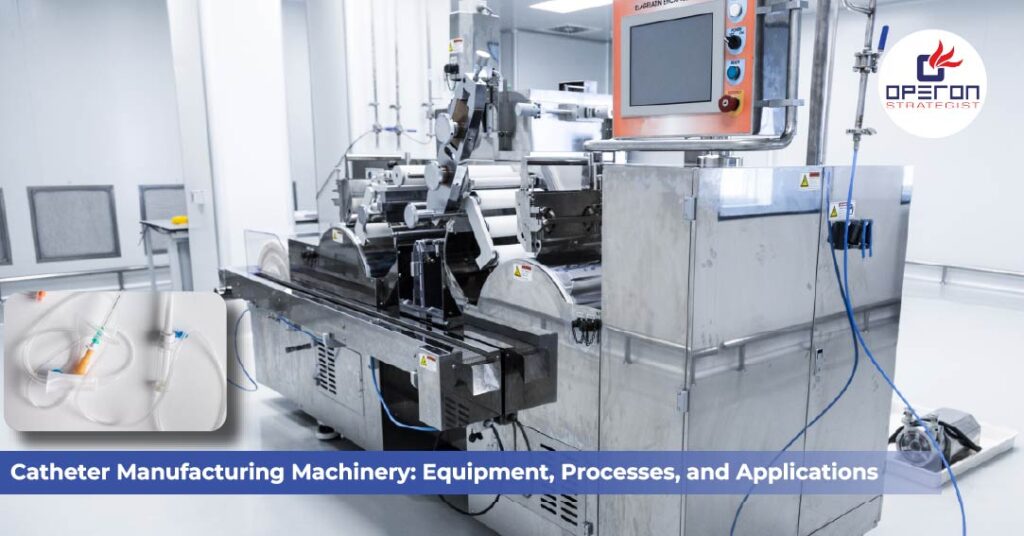
Catheter manufacturing is a high-precision medical device process where machinery selection directly impacts product performance, regulatory approval, scalability, and time to market. From catheter extrusion and balloon forming to braiding, laser cutting, assembly, and inspection, each stage requires specialized catheter manufacturing machinery capable of processing medical-grade materials within tight tolerances.
For catheter manufacturers planning new production lines, facility expansion, or FDA 510(k) submissions, selecting the right catheter manufacturing equipment is not just a technical decision—it is a critical regulatory and business strategy.
Overview of Catheter Manufacturing Machinery
Catheter manufacturing machinery includes specialized equipment used to convert medical-grade polymers and metals into finished catheter components and assemblies. These machines operate under controlled environments and validated processes to ensure repeatable, high-quality output.
The primary objectives of catheter manufacturing equipment include:
- Precise OD/ID and dimensional control
- Consistent material properties and mechanical performance
- Scalable and automated production capability
- Compliance with FDA 21 CFR Part 820 and ISO 13485
Early alignment between product design, manufacturing processes, and machinery selection is essential to avoid scale-up failures and regulatory delays.
Looking For a Medical Device Regulatory Consultant?
Let’s have a word about your next project
Key Types of Machinery Used in Catheter Manufacturing
1. Catheter Extrusion Machinery
Catheter extrusion machinery forms the backbone of catheter manufacturing and is used to produce single-lumen and multi-lumen tubing with precise dimensional control.
Applications:
- Diagnostic catheters
- Guide catheters
- Balloon catheter shafts
Key capabilities:
- Tight OD/ID tolerance control
- Multi-lumen extrusion capability
- Compatibility with Pebax, Nylon, PTFE, and Polyurethane
High-quality catheter extrusion machines ensure flexibility, kink resistance, burst strength, and consistent flow performance—critical parameters for both clinical use and regulatory compliance.
2. Balloon Catheter Manufacturing Machinery
Balloon catheter manufacturing relies on specialized forming and bonding machinery to achieve uniform balloon geometry, compliance, and mechanical strength.
Typical balloon catheter manufacturing equipment includes:
- Balloon forming and blow-molding machines
- Balloon necking and heat-setting systems
- Thermal, RF, or laser bonding equipment
Applications:
- Angioplasty balloon catheters
- Drug-coated balloon catheters
- Specialty and high-pressure balloons
Precision balloon catheter manufacturing machinery ensures consistent burst pressure, fatigue resistance, and dimensional repeatability.
3. Braiding and Coiling Machines
Braiding and coiling machines are used to reinforce catheter shafts and improve torque transmission, pushability, and flexibility.
Applications:
- Cardiovascular catheters
- Neurovascular catheters
Controlled braid angles and wire configurations allow manufacturers to tailor catheter performance to specific clinical requirements.
4. Laser Cutting and Precision Machining Equipment
Laser cutting machinery is used to create complex patterns and slots in metal hypotubes and reinforced catheter shafts.
Applications:
- Slotted catheter shafts
- Structural reinforcement components
Medical-grade laser cutting systems support high-precision geometries while maintaining mechanical integrity and dimensional accuracy.
5. Tip Forming, Bonding, and Assembly Machinery
Tip forming and assembly equipment is used to produce atraumatic catheter tips and integrate multiple components into a finished medical device.
Supported processes include:
- Thermal bonding
- RF welding
- Adhesive bonding
Automated and semi-automated catheter assembly machinery improves consistency, reduces operator variability, and enhances throughput.
6. Quality Inspection and Testing Equipment
Quality inspection and testing machinery is essential for verifying catheter performance and ensuring batch-to-batch consistency.
Typical inspection equipment includes:
- Vision inspection systems
- Tensile, burst, and fatigue testing machines
- Leak, flow, and dimensional testing systems
These systems support design verification, process validation, and batch release as required by regulatory authorities.
Automation in Catheter Manufacturing Machinery
Automation plays a critical role in modern catheter manufacturing by improving process stability, traceability, and compliance.
Benefits of automated catheter manufacturing equipment include:
- Reduced human error and variability
- Improved repeatability and yield
- Enhanced data capture for regulatory documentation
Automated extrusion lines, bonding stations, and inspection systems are increasingly essential for high-volume, FDA-regulated catheter production.
Applications of Catheter Manufacturing Machinery by Catheter Type
| Catheter Type | Key Machinery Used |
|---|---|
| Balloon Catheters | Extrusion, balloon forming, bonding |
| Diagnostic Catheters | Extrusion, tip forming, inspection |
| Neurovascular Catheters | Braiding, laser cutting, assembly |
| Urology Catheters | Extrusion, molding, testing |
Common Challenges in Catheter Manufacturing Machinery Selection
Catheter manufacturers frequently face challenges such as:
- Extrusion machines unable to maintain tight tolerances during scale-up
- Inconsistent balloon forming leading to burst pressure failures
- Limited process repeatability in braiding or laser cutting
- Incomplete IQ/OQ/PQ documentation from equipment suppliers
- FDA 510(k) delays due to unvalidated manufacturing processes
Addressing these challenges early through proper machinery evaluation, process development, and validation planning significantly reduces regulatory and commercial risk.
Regulatory Considerations for Catheter Manufacturing Machinery
Catheter manufacturing machinery must operate within validated and controlled processes to meet regulatory requirements.
Key regulatory expectations include:
- Compliance with FDA 21 CFR Part 820 and ISO 13485
- Equipment qualification (IQ/OQ/PQ)
- Process validation and documented quality controls
During FDA 510(k) submissions, manufacturers must demonstrate that catheter manufacturing processes are controlled, repeatable, and supported by qualified equipment. Gaps in machinery validation or documentation commonly lead to regulatory delays.
Explore compliant catheter manufacturing solutions with expert support.
How to Select the Right Catheter Manufacturing Machinery?
Key factors to consider when selecting catheter manufacturing machinery include:
- Compatibility with catheter materials and designs
- Process capability and tolerance control
- Automation and scalability requirements
- Validation and documentation support
- Supplier technical expertise and after-sales service
Early alignment between design, manufacturing, and regulatory strategy reduces development timelines and supports efficient commercialization.
How Operon Strategist Supports Catheter Manufacturing Machinery & Process Setup?
Operon Strategist supports catheter manufacturers across the full lifecycle of catheter manufacturing setup and scale-up.
Our support includes:
- Catheter manufacturing machinery selection and supplier evaluation
- Process design and optimization for greenfield and brownfield facilities
- Equipment qualification (IQ/OQ/PQ) and process validation
- FDA 510(k), ISO 13485, and global regulatory readiness
By integrating manufacturing engineering with regulatory strategy, Operon Strategist helps catheter manufacturers establish compliant, scalable production processes and accelerate time to market.
FAQs
Catheter manufacturing machinery includes extrusion machines, balloon forming equipment, braiding or coiling machines, laser cutting systems, bonding equipment, and quality inspection tools.
Catheter extrusion machinery ensures precise tubing dimensions, consistent material properties, and repeatable performance essential for catheter safety and regulatory compliance.
Catheter manufacturing equipment must comply with FDA 21 CFR Part 820 and ISO 13485, including IQ/OQ/PQ, process validation, and documented quality controls.
FDA 510(k) submissions require evidence of controlled and repeatable manufacturing processes, making validated catheter manufacturing machinery essential.
A complete catheter manufacturing line setup typically takes 6–12 months, depending on product complexity, automation level, and regulatory requirements.
Operon Strategist helps catheter manufacturers select the right machinery, validate processes, and achieve global regulatory readiness.