
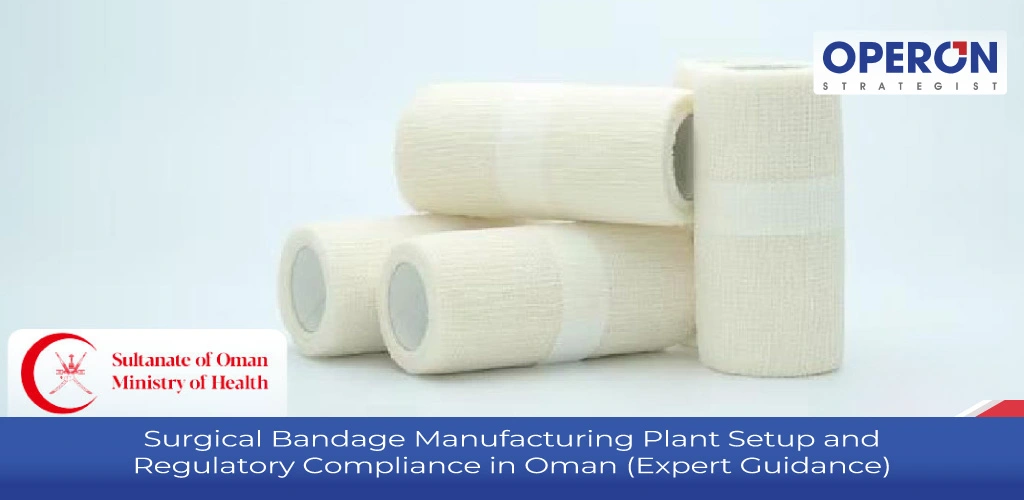
Surgical Bandage Manufacturing Plant Setup and Regulatory Compliance in Oman (Expert Guidance)
Surgical Bandage Manufacturing Plant Setup: An Overview
With the rising demand for quality healthcare supplies in the Middle East, setting up a surgical bandage manufacturing plant in Oman presents a promising opportunity for investors and manufacturers. The country’s expanding healthcare infrastructure and government initiatives to boost local medical device manufacturing make it an ideal destination for surgical bandage production. However, understanding the regulatory framework and establishing a compliant manufacturing plant is essential for successful market entry.
Looking For a Medical Device Regulatory Consultant?
Why Invest in Surgical Bandage Manufacturing in Oman?
Oman’s healthcare sector is witnessing significant growth due to population expansion, increasing medical needs, and government investment in public and private hospitals. Surgical bandages are essential consumables across all healthcare facilities, and currently, a significant portion is imported. This opens a gap for domestic manufacturing of surgical bandages to meet national demand and reduce import dependency.
Key Opportunities:
- Rising demand for surgical consumables across public and private hospitals
- The government pushes for local medical device manufacturing
- Free Trade Agreements (FTAs) and access to the Gulf Cooperation Council (GCC) market
Types of Surgical Bandages You Can Manufacture
To cater to a broad market, your manufacturing plant in Oman can produce a variety of surgical bandages, such as:
- Gauze Bandages
- Adhesive Bandages
- Compression Bandages
- Triangular Bandages
- Liquid Bandages
- Tubular Bandages
Each type has unique uses in wound care, support, and surgical dressing applications.
Raw Materials Required
To begin operations, you’ll need to procure and manage the following materials:
- White bleached cotton gauze
- Non-stick pads
- Adhesive materials
- Sterilization agents (ethylene oxide, gamma ray)
- Plastic film and paper for packaging
- Colorants/dyes (if applicable)
Regulatory Compliance for Medical Devices in Oman
In Oman, medical devices, including surgical bandages, fall under the regulatory purview of the Department of Pharmacy and Drug Control at the Ministry of Health (MoH).
Key Regulatory Requirements:
- Product Registration with the Ministry of Health (MoH), Oman
- Submit product dossier
- Provide evidence of quality and safety (clinical data, manufacturing standards, etc.)
- Free Sale Certificate (FSC)
- Usually required from the country of origin
- ISO 13485 Certification
- The QMS standard mandatory for medical device manufacturing facilities
- Labeling Requirements
- Must include Arabic and English instructions, usage info, manufacturer details, expiry, and lot number
- Import Permit (for initial raw materials or equipment)
Required before bringing manufacturing machines or inputs into Oman
Quality & Certification Standards
Manufacturers must comply with:
- ISO 13485:2016 – Medical Device Quality Management System
- GMP (Good Manufacturing Practices) for cleanliness and traceability
- Sterilization validations based on ISO 11135 (for ETO) or ISO 11137 (for Gamma)
- Product safety testing including biocompatibility and absorbency standards
Steps to Set Up a Surgical Bandage Manufacturing Plant in Oman
- Market Research & Feasibility Report
- Analyze market size, competition, and business model
- Business Registration
- Register the company in Oman through the Ministry of Commerce, Industry & Investment Promotion (MOCIIP)
- Location & Facility Setup
- Choose a compliant industrial zone with utilities and export access
- QMS Implementation (ISO 13485)
- Establish SOPs, documentation, validation, and training protocols
- Equipment Procurement & Installation
- Surgical bandage cutting, rolling, and packaging machines
- Hire Qualified Staff
- Operators, QA/QC specialists, and regulatory professionals
- Regulatory Filing with MoH Oman
- Submit product dossier, company documents, and quality certifications
- Start Trial Production & Compliance Testing
- Validate manufacturing and sterilization processes
- Begin Full-Scale Manufacturing
- Distribute domestically and export to other GCC countries
- Distribute domestically and export to other GCC countries
Export Potential to GCC and Beyond
Oman’s strategic location makes it a hub for exporting surgical bandages to:
- UAE, Saudi Arabia, Bahrain, and Qatar (within GCC, with minimal trade barriers)
- African countries with emerging healthcare infrastructure
- South Asia, given proximity and existing trade ties
Obtaining regulatory clearances, such as CE Marking or a US FDA 510(k) clearance, can help further expand exports.
How Operon Strategist Helps
At Operon Strategist, we support businesses across all stages of setting up a surgical bandage manufacturing plant in Oman, including:
- Feasibility study & project report
- ISO 13485 QMS implementation
- Regulatory submissions for Oman MoH, FDA, CE marking, and SFDA approval
- Turnkey plant setup – layout, machine sourcing, installation
- Product testing & validation protocols
- Staff training and documentation support
FAQ
What are the regulatory requirements for manufacturing surgical bandages in Oman?
Manufacturers must comply with the Oman Ministry of Health (MOH) medical device regulations administered through the Drug Safety Center (DSC). This generally includes manufacturer registration, product registration, implementation of an ISO 13485-compliant Quality Management System (QMS), application of ISO 14971 risk management, preparation of technical documentation, and validation of manufacturing, sterilization, and packaging processes where applicable before placing surgical bandages on the Omani market.
Which international standards apply to surgical bandage manufacturing?
Manufacturers commonly implement ISO 13485 for quality management systems and ISO 14971 for risk management. For sterile surgical bandages, additional standards such as ISO 11135 (ethylene oxide sterilization), ISO 11137 (radiation sterilization), ISO 17665 (moist heat sterilization), ISO 11607 (packaging for terminally sterilized medical devices), and ISO 11737 (bioburden and sterility testing) are commonly applied depending on the manufacturing process.
Is a cleanroom required for surgical bandage manufacturing?
The requirement for a cleanroom depends on the manufacturing process and whether the surgical bandages are supplied as sterile. Manufacturers should establish appropriately controlled production environments, implement environmental monitoring, validate critical manufacturing processes, and maintain contamination control measures to ensure product quality and compliance.
What documents are required for surgical bandage registration in Oman?
Manufacturers typically prepare technical documentation, ISO 13485 certification, ISO 14971 risk management files, product specifications, manufacturing process information, sterilization validation reports (for sterile products), packaging validation records, labeling, Instructions for Use (IFU), and other documents required by the Oman MOH based on the device classification and intended use.