
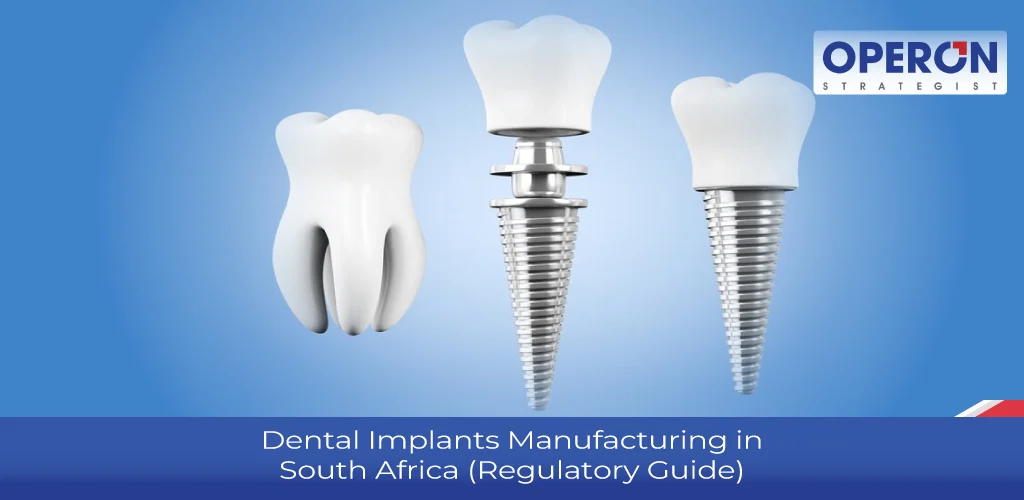
Dental Implants Manufacturing in South Africa
Introduction to dental implants manufacturing
The dental industry in South Africa is experiencing significant growth, driven by increasing demand for high-quality dental care and advanced oral restoration solutions. Among the most sought-after dental products are dental implants, offering a durable and aesthetically pleasing solution for tooth replacement.
With the rise in demand, dental implants manufacturing in South Africa has become a promising sector. However, entering this market requires a clear understanding of regulatory pathways, quality standards, and the manufacturing process.
Looking for Medical Device Manufacturing Consultant
What are Dental Implants?
Dental implants are medical devices designed to be surgically implanted into the jawbone to support dental prosthetics like crowns, bridges, or dentures. They serve as artificial roots that mimic the function of natural teeth. Most implants are made from titanium or zirconia due to their strength, corrosion resistance, and biocompatibility.
Machinery Used in Dental Implant Manufacturing
- CNC Turning and Milling Machines – For shaping and threading titanium rods.
- Laser Welding Machines – To assemble small components.
- Ultrasonic Cleaning Systems – For decontamination and cleaning.
- Passivation Units – To enhance corrosion resistance of implants.
- Surface Treatment Equipment – For sandblasting, acid etching, and anodizing to increase osseointegration.
- 3D Coordinate Measuring Machines (CMM) – For dimensional inspection and quality assurance.
Short Process of Dental Implants Manufacturing
- Raw Material Selection: High-purity titanium or zirconia is selected.
- CNC Machining: Implants are machined into the desired shape and threaded for fixation.
- Surface Treatment: Techniques like sandblasting and acid etching improve the surface roughness for better bone bonding.
- Cleaning & Sterilization: Ultrasonic and chemical cleaning ensure sterility.
- Quality Inspection: Each implant undergoes rigorous dimensional and mechanical checks.
- Packaging: Final products are packed in sterile, validated medical-grade packaging.
Regulatory Aspects in South Africa
In South Africa, dental implants are classified as medical devices and are regulated under the South African Health Products Regulatory Authority (SAHPRA).
Key regulatory requirements include:
- Medical Device Establishment Licensing – For manufacturers, importers, or distributors.
- Device Registration – Based on the classification of the device (dental implants usually fall under Class B or C).
- Compliance with ISO 13485 – Quality Management System for medical device manufacturing.
- Conformance with ISO 14801 – For fatigue testing of dental implants.
- Technical Documentation – Required to support safety, performance, and risk analysis.
Documents Required for Compliance
- Quality Management System Manual (ISO 13485)
- Device Master File (DMF)
- Risk Management File (ISO 14971)
- Product Drawings & Specifications
- Sterilization Validation Report
- Biocompatibility Testing Reports (ISO 10993)
- Clinical Evaluation Report
- Instructions for Use (IFU) and Labeling
- Declaration of Conformity
- Establishment License (from SAHPRA)
Role of Operon Strategist
Operon Strategist plays a crucial role in supporting dental implant manufacturers in South Africa by offering end-to-end regulatory and technical consulting services. We help manufacturers:
- Obtain SAHPRA Establishment Licenses
- Develop ISO 13485-compliant QMS systems
- Prepare and compile technical documentation
- Set up manufacturing facilities as per GMP standards
- Provide equipment and validation support
- Train personnel on regulatory and quality standards
With our expertise, you can reduce time-to-market while ensuring full regulatory compliance.
FAQ
What are the regulatory requirements for manufacturing dental implants in South Africa?
Manufacturers must comply with SAHPRA medical device regulations, implement an ISO 13485-compliant quality management system, establish risk management according to ISO 14971, prepare comprehensive technical documentation, and obtain the required regulatory approvals before marketing dental implants in South Africa.
Which international standards apply to dental implant manufacturing?
Dental implant manufacturers commonly implement ISO 13485 for quality management systems, ISO 14971 for risk management, ISO 10993 for biological evaluation of medical devices, and applicable sterilization standards such as ISO 11135, ISO 11137, or ISO 17665, depending on the sterilization method used.
Is biocompatibility testing required for dental implants?
Yes. Dental implants are intended for long-term contact with bone and soft tissue, so manufacturers are generally expected to conduct biological evaluation in accordance with the ISO 10993 series and include the supporting evidence in their technical documentation for regulatory review.
What documents are required for SAHPRA registration of dental implants?
Manufacturers typically need technical documentation, ISO 13485 certification, ISO 14971 risk management files, biocompatibility test reports, sterilization validation records (if supplied sterile), labeling, clinical evaluation or performance evidence where applicable, manufacturing information, and other supporting documentation required by SAHPRA based on the device classification.