
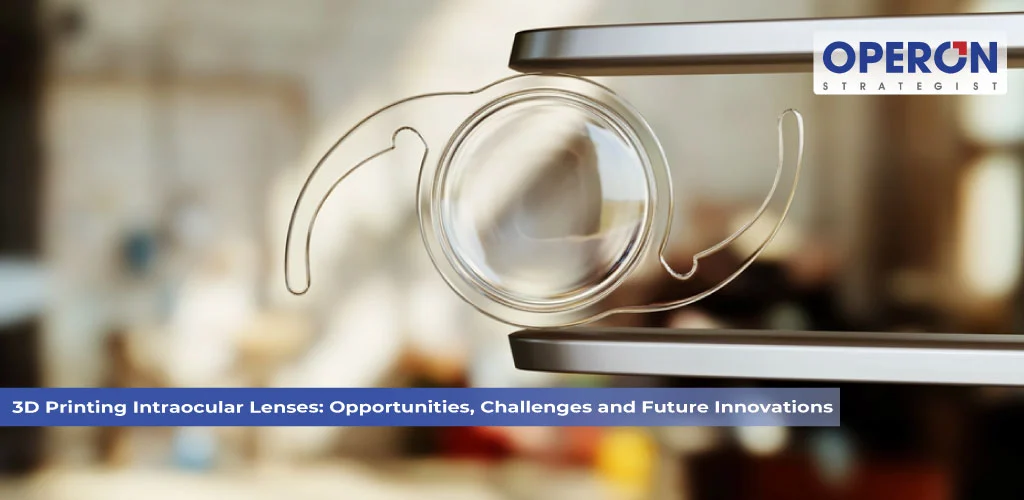
3D Printing Intraocular Lenses: Opportunities, Challenges and Future Innovations
What Is 3D Printing in Intraocular Lens Manufacturing?
3D printing in intraocular lenses (IOLs) is an advanced manufacturing technology that uses additive manufacturing to produce customized ophthalmic implants layer by layer. Unlike conventional cast molding or lathe-cut manufacturing, 3D printing enables the development of patient-specific intraocular lenses with improved precision, faster prototyping, and greater design flexibility.
As cataract surgeries continue to increase worldwide, manufacturers are exploring 3D printing to improve visual outcomes, accelerate product development, and reduce manufacturing complexity. The technology also supports innovation while helping companies comply with international medical device regulations.
Talk to Our Medical Device Experts
Why Is 3D Printing Important for Intraocular Lens Manufacturers?
Traditional manufacturing methods often limit design flexibility and require expensive tooling. In contrast, 3D printing allows manufacturers to rapidly develop and evaluate new intraocular lens designs without lengthy production cycles.
For medical device manufacturers, this means shorter development timelines, improved customization, reduced material waste, and faster product innovation. The ability to create complex optical geometries also opens new opportunities for premium intraocular lenses with enhanced visual performance.
What Are the Benefits of 3D Printing Intraocular Lenses?
Personalized Lens Design
One of the biggest advantages of 3D printing is the ability to manufacture customized intraocular lenses based on individual patient requirements. Personalized lens designs can improve refractive accuracy and support better visual outcomes after cataract surgery.
Faster Product Development
Additive manufacturing enables rapid prototyping, allowing manufacturers to evaluate multiple lens designs before commercial production. This significantly reduces development time while encouraging continuous innovation in multifocal, toric, and extended depth-of-focus (EDoF) lenses.
Complex Optical Structures
Modern 3D printing technologies can produce intricate optical geometries that are difficult or impossible to manufacture using traditional techniques. These advanced designs improve lens stability, optical performance, and patient satisfaction.
Sustainable Manufacturing
Because material is added only where required, 3D printing minimizes waste and lowers production costs for prototype and low-volume manufacturing. It also supports localized production, reducing supply chain dependence.
What Challenges Exist in 3D Printed Intraocular Lens Manufacturing?
Although the technology offers significant advantages, manufacturers must overcome several technical and regulatory challenges before large-scale commercialization.
Material Performance
Materials used for intraocular lenses must demonstrate excellent optical clarity, long-term stability, and biocompatibility. Selecting suitable printable biomaterials remains one of the biggest challenges for manufacturers.
Surface Quality
Intraocular lenses require exceptionally smooth optical surfaces. Manufacturers often need additional polishing and finishing processes to achieve the required optical quality after printing.
Regulatory Compliance
Since intraocular lenses are high-risk medical devices, manufacturers must demonstrate compliance with FDA regulations, EU MDR, ISO 13485, ISO 14971, and other international standards. Product validation, risk management, and clinical evidence are essential before commercialization.
Production Scalability
While 3D printing is highly effective for prototyping and customized production, scaling the technology for high-volume manufacturing continues to present economic and technical challenges.
Accelerate Your 3D Printed Intraocular Lens Development
Ready to develop next-generation intraocular lenses?
Future Innovations in 3D Printed Intraocular Lenses
The future of 3D printed intraocular lenses extends far beyond conventional implants. Researchers and manufacturers are developing next-generation technologies that improve patient outcomes and expand clinical applications.
Future innovations include drug-eluting intraocular lenses for controlled medication delivery, light-adjustable lenses that enable post-surgical vision correction, smart intraocular lenses with integrated sensing technologies, and AI-assisted lens design that optimizes optical performance for individual patients.
These advancements are expected to transform cataract surgery and personalized ophthalmic care over the coming decade.
Global Market Outlook
The demand for premium intraocular lenses continues to grow due to aging populations and increasing cataract procedures worldwide. Markets across North America, Europe, Asia-Pacific, and the Middle East are investing heavily in advanced ophthalmic technologies.
As additive manufacturing becomes more mature, 3D printing is expected to improve manufacturing efficiency, reduce production costs, and increase global access to advanced intraocular lenses.
Why Choose Operon Strategist?
Operon Strategist supports medical device manufacturers throughout the complete lifecycle of intraocular lens development. Our experts assist with manufacturing technology selection, facility setup, technology transfer, regulatory strategy, quality management systems, risk management, validation, and global regulatory approvals.
Whether you are developing a prototype or establishing a commercial manufacturing facility, we help you accelerate innovation while ensuring compliance with FDA, EU MDR, ISO 13485, CDSCO, and other international regulatory requirements.
Schedule a Compliance Consultation
Talk to Our Medical Device Experts Today
FAQ's
What is a 3D printed intraocular lens?
A 3D printed intraocular lens is an ophthalmic implant manufactured using additive manufacturing technology to provide improved customization, rapid prototyping, and advanced optical designs.
What are the advantages of 3D printing intraocular lenses?
The main advantages include patient-specific customization, faster product development, reduced material waste, complex optical designs, and improved manufacturing flexibility.
Are 3D printed intraocular lenses regulatory compliant?
Yes. Manufacturers must demonstrate compliance with FDA regulations, EU MDR, ISO 13485, ISO 14971, and other applicable medical device standards before commercialization.
What challenges do manufacturers face?
The biggest challenges include printable biomaterials, surface finishing, regulatory validation, quality assurance, and scaling production for commercial manufacturing.
What is the future of 3D printed intraocular lenses?
Future developments include smart intraocular lenses, drug-eluting implants, AI-driven lens optimization, and personalized ophthalmic devices designed specifically for individual patients.