
PCCP VS Change Control: What is the Difference?
Introduction
One of the most common misunderstandings among SaMD manufacturers is that a Predetermined Change Control Plan (PCCP) is simply another name for software change control. It is not. Both mechanisms address software modifications, but they serve different regulatory purposes.
What is Change Control?
Change control is a Quality Management System process used to control modifications to a medical device.
It may be used when the manufacturer proposes:
- Software changes
- Hardware changes
- Design changes
- Documentation changes
- Manufacturing changes
- Supplier changes
- Cybersecurity changes
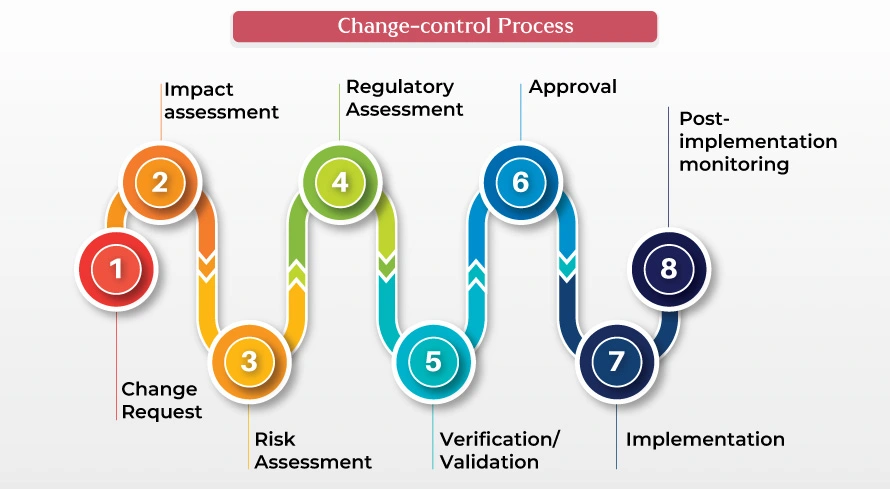
A typical change-control process includes:
What is PCCP?
PCCP is a regulatory plan submitted as part of an FDA marketing submission. It identifies certain future modifications and establishes the methodology under which those modifications will be developed, evaluated and implemented.
Therefore:
- Change Control
- QMS mechanism
- PCCP
- FDA regulatory mechanism
How Do They Work Together?
They should work together rather than replace one another.
Consider this example.
A manufacturer has an FDA-cleared AI SaMD with an authorized PCCP.
The manufacturer proposes an algorithm update.
Step 1 – Change Control
The manufacturer initiates a change-control process.
↓
Step 2 – Regulatory Assessment
The manufacturer determines whether the change falls within the authorized PCCP.
↓
Step 3 – PCCP Assessment
If the modification is within the PCCP:
↓
Apply the predefined modification protocol.
↓
Perform required verification/validation.
↓
Perform risk assessment.
↓
Review acceptance criteria.
↓
Approve implementation.
If the modification does not fall within the PCCP, the manufacturer must perform the appropriate regulatory assessment and determine whether a new FDA submission is required.
PCCP vs Change Control – Comparison
| Aspect | PCCP | Change Control |
|---|---|---|
| Primary purpose | Defines authorized planned future modifications | Controls changes under the QMS |
| Regulatory status | FDA-reviewed | QMS process |
| Timing | Generally established during marketing submission | Used throughout product lifecycle |
| Scope | Specific predefined modifications | Potentially any controlled change |
| Risk assessment | Required as applicable to modifications | Required as part of change evaluation |
| V&V | Defined methodology for planned modifications | Determined based on change impact |
| FDA submission | Reviewed as part of applicable marketing submission | May trigger regulatory submission if required |
| AI/ML relevance | Particularly useful for planned model/algorithm changes | Applies to all applicable controlled changes |
Swipe left or right to view the full table →
Accelerate Market Access with End-to-End Regulatory Guidance
Can PCCP Replace Change Control?
No.
Even when a modification is covered by an authorized PCCP, the manufacturer still needs to follow its applicable QMS procedures.
PCCP does not eliminate:
- Change control
- Risk management
- Software V&V
- Configuration management
- Design controls
- Complaint handling
- Post-market monitoring
Instead, PCCP provides the regulatory framework within which certain changes can be implemented.
Can Every Change Be Included in PCCP?
No. A PCCP should be appropriately bounded. For example, suppose an AI radiology device is cleared for:
Assisting radiologists in detecting predefined findings in chest X-rays.
A PCCP might potentially cover:
Improving the existing algorithm’s performance while maintaining the same intended use, patient population, clinical indication and output.
But a completely different change such as:
Adding an independent treatment recommendation function for a new disease would require a much more significant regulatory assessment and should not simply be assumed to be covered by the existing PCCP.
PCCP and the Regulatory Assessment Process
A useful way to visualize the relationship is:
Proposed software change
↓
QMS Change Control
↓
Risk & Impact Assessment
↓
Is the change within the authorized PCCP?
YES
↓
Follow PCCP methodology
↓
V&V
↓
Risk evaluation
↓
Acceptance
↓
Implementation
NO
↓
Regulatory assessment
↓
Determine whether additional FDA submission is required
↓
Proceed accordingly
Why This Distinction Matters
Understanding the difference between PCCP and change control is particularly important for SaMD manufacturers. A company may have a very robust QMS change-control procedure, but that does not mean every future change is automatically covered from an FDA regulatory perspective.
Similarly, having an FDA-authorized PCCP does not mean the manufacturer can bypass its QMS. The two mechanisms must operate together.
How Can Operon Strategist Help With PCCP and Change Control?
Operon Strategist supports medical device manufacturers with regulatory consulting, Quality Management System (QMS) documentation, risk management, and regulatory submission planning. For SaMD and AI-enabled medical devices, our team can help assess applicable FDA requirements, review change-control procedures, support Predetermined Change Control Plan (PCCP) documentation, and align software modification processes with regulatory expectations.
Our support can help manufacturers establish a structured approach to software changes, verification and validation documentation, risk assessment, and regulatory impact assessment throughout the device lifecycle.
Conclusion
PCCP and change control are complementary, not interchangeable. Change control is a QMS mechanism for controlling product changes, while PCCP is an FDA-reviewed regulatory framework for certain predefined future modifications.
For SaMD and AI-enabled medical devices, manufacturers should establish a clear relationship between:
Change Control → PCCP Assessment → Risk Management → V&V → Regulatory Assessment → Implementation
A well-integrated approach can help manufacturers manage software evolution while maintaining regulatory compliance throughout the device lifecycle.
Get Your Medical Device Market-Ready with Expert Regulatory Support
FAQ's
What is the main difference between PCCP and change control?
A Predetermined Change Control Plan (PCCP) defines planned future modifications that may be implemented under an FDA-authorized framework. Change control is a Quality Management System (QMS) process that evaluates, documents, approves, and manages changes to a medical device throughout its lifecycle.
Is PCCP mandatory for all Software as a Medical Device (SaMD)?
No. PCCP is not mandatory for every SaMD. It is particularly relevant when manufacturers plan certain future modifications, including eligible AI/ML algorithm changes. Its applicability depends on the device, proposed modifications, and applicable FDA requirements.
Can PCCP replace the change-control process?
No. Manufacturers must continue to follow their applicable QMS procedures, including change control, risk management, and software verification and validation. An authorized PCCP does not eliminate these responsibilities.
When should a manufacturer submit a PCCP to the FDA?
A manufacturer should consider PCCP during regulatory planning when it anticipates future modifications that may be suitable for a predefined change framework. The PCCP is reviewed as part of the applicable FDA marketing submission.
What happens if a software modification falls outside an authorized PCCP?
The manufacturer must assess the proposed modification under its QMS and determine the applicable regulatory requirements. Depending on the nature and impact of the change, a new FDA marketing submission or other regulatory action may be required.