
Senior Sales Executive | 3 Years of Experience
Vyankatesh Dhavale holds a Bachelor of Pharmacy (B.Pharm) and an MBA specializing in Operations and Supply Chain Management
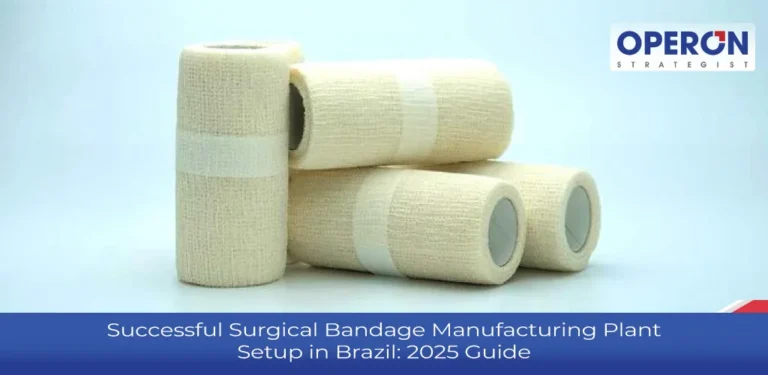
Surgical Bandage Manufacturing Plant setup in Brazil represents a fast-growing and profitable opportunity in the country’s booming medical device industry. With a thriving healthcare infrastructure, rising demand for disposable medical consumables, and increasing surgeries in cities like São Paulo, Rio de Janeiro, and Porto Alegre, investing in this sector can bring both financial stability and lasting healthcare value.
In this guide, we outline everything you need to know to successfully start and scale a surgical bandage manufacturing plant in Brazil, from ANVISA regulations and types of bandages to the entire production process and turnkey consulting support.
Why Surgical Bandage Manufacturing Matters in Brazil
Surgical bandages are a fundamental medical consumable for hospitals, clinics, emergency centers, and first aid kits. In Brazil, the demand for such medical devices has risen significantly with the:
- Expansion of public and private healthcare infrastructure
- Sustained efforts under SUS (Sistema Único de Saúde)
- Higher rate of trauma care, chronic injuries, and surgical interventions
Setting up a surgical bandage manufacturing plant in Brazil not only meets a steady market demand but also supports the national push toward self-reliant medical device production.
Market Demand & Opportunities
Brazil has the largest healthcare market in Latin America. The market for surgical bandages is:
- Active throughout the year with stable demand
- Driven by government tenders, hospitals, and large distributors
- Supported by initiatives to reduce dependence on imports
- Growing due to healthcare investments in rural and urban regions
ANVISA Regulatory Framework for Manufacturing
To establish a surgical bandage manufacturing plant in Brazil, compliance with ANVISA (Agência Nacional de Vigilância Sanitária) is mandatory.
Key Regulatory Highlights:
- Device Classification: Class I (low-risk) disposable medical device
- Regulating Body: ANVISA Medical Devices Division
- Compliance Requirements:
Cleanroom production with GMP
Standardized plant layout
Sterile packaging facilities
ISO 13485-based Quality Management System
Accurate device dossier submission
Types of Surgical Bandages
The surgical bandage industry offers a range of product formats based on clinical and first-aid needs:
Bandage Type | Description |
Adhesive Bandage | Small plasters for minor cuts |
Liquid Bandage | Forms protective film on skin wounds |
Gauze Bandage | Absorbent cotton strips; widely used in surgeries |
Compression Bandage | Reduces swelling / controls blood flow |
Triangular Bandage | Slings or support devices in first aid |
Tube Bandage | Elastic bandages for limbs or head |
Ensure FDA QSR Compliance for German Manufacturers with Expert Guidance
Raw Materials Required
To manufacture standard-compliant surgical bandages, the following raw materials are needed:
- Bleached cotton gauze cloth
- Absorbent cotton wool
- Pressure-sensitive medical adhesives
- Food-grade packaging polyfilms or pouches
- Sterilization-grade wrapping materials
Read More – wound care dressing medical devices
Surgical Bandage Manufacturing Process – Step by Step
The manufacturing process for surgical bandages involves multiple stages focused on hygiene and precision:
- Raw Material Prep – Cotton gauze is bleached, dried, and inspected
- Weaving/Cutting – Gauze cloth is woven then cut to specific lengths
- Rolling & Packaging – Bandages are rolled and sealed under sterile conditions
- Sterilization – Gamma or ETO sterilization to ensure medical safety
- Labeling & QC – Products undergo quality inspection and legal labelling
- Distribution – Packed items are shipped to hospitals, wholesalers, and public tenders
Role of Operon Strategist in Plant Setup
Offers end-to-end turnkey solutions for establishing a surgical bandage manufacturing plant in Brazil:
🔹 ANVISA Registration Support
🔹 Standard Plant Layout & Cleanroom Design
🔹 Machinery Procurement & Installation
🔹 ISO 13485 Implementation Support
🔹 CE, FDA 510k, SFDA, WHO-GMP Certifications
🔹 Process Scale-Up & Staff Training
Want to set up a profitable surgical bandage plant in Brazil? Contact Operon Strategist today to turn your idea into a compliant, scalable business.
Ensure FDA QSR Compliance for German Manufacturers with Expert Guidance
FAQ's
Can I start a surgical bandage manufacturing plant on a small scale in Brazil?
Yes. Small- to medium-scale manufacturing is feasible with proper planning and regulatory compliance.
Is ISO 13485 required for surgical bandage production?
While not compulsory for domestic markets, ISO 13485 strengthens your quality system and makes exporting easier.
How does Operon Strategist help in turnkey projects?
We handle everything — from regulatory licensing to plant design, equipment sourcing, implementation, and certification.
Senior Sales Executive | 3 Years of Experience
Vyankatesh Dhavale holds a Bachelor of Pharmacy (B.Pharm) and an MBA specializing in Operations and Supply Chain Management, with a minor in Marketing. He brings experience in domestic and international business development, strategic client relationship management, and sales of medical device regulatory consulting and turnkey project services. His expertise includes supporting market entry and regulatory service requirements related to CDSCO registration, EU MDR CE marking, US FDA regulations, and ISO 13485 quality management systems.