
Senior Regulatory Affairs Executive
5 Years of Experience Pharmaceutical research and medical device regulatory
Overview
Submitting an FDA 510(k) for medical devices is a critical step in demonstrating that device is substantially equivalent to a legally marketed predicate device, thereby supporting its safety and effectiveness. However, many submissions face early rejection due to incomplete or incorrect documentation. Understanding the FDA 510(k) RTA Checklist is essential to ensure your application meets acceptance criteria. Partnering with experts like Operon Strategist can help streamline the submission process and minimize regulatory risk.
What is the FDA 510(k) RTA Checklist?
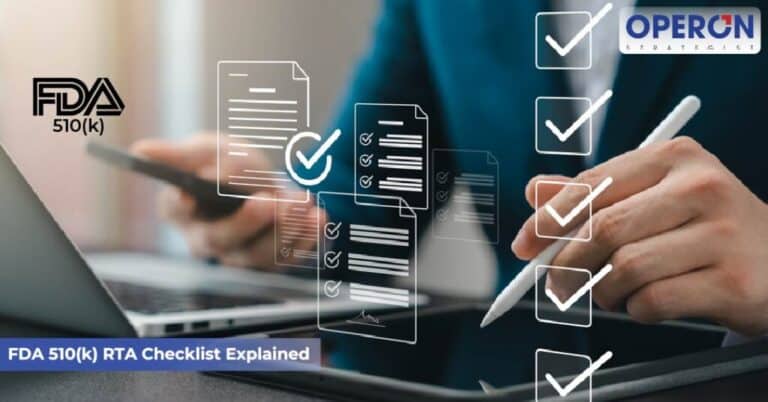
The FDA 510(k) RTA Checklist is a structured screening tool used by the FDA to assess whether a 510(k) submission is administratively complete and ready for review. It is based on the FDA’s Refuse-to-Accept (RTA) policy and serves as the first checkpoint in the evaluation process.
The checklist covers the minimum required elements for administrative completeness, rather than full scientific adequacy, including administrative information, device description, substantial equivalence data, labeling, and supporting test documentation. FDA reviewers use this checklist to verify that each required section is present, properly organized, and adequately addressed.
If any critical information is missing, incomplete, or unclear, the submission may be placed on hold or refused for acceptance. Therefore, the FDA 510(k) RTA Checklist acts as a quality control mechanism, helping ensure that only complete and well-prepared submissions proceed to substantive review.
Why is the FDA 510(k) RTA Checklist Important?
The FDA 510(k) RTA Checklist is important because it determines whether your submission proceeds to substantive review or is rejected at an early stage. Failing the Refuse-to-Accept (RTA) stage can result in delays, additional costs, and resubmission efforts. Meeting FDA 510(k) acceptance criteria helps:
- Accelerate review timelines
- Reduce regulatory queries
- Improve submission quality
- Increase chances of successful clearance
Passing the RTA stage is the first major milestone in the FDA 510(k) submission process.
What Does the FDA 510(k) RTA Checklist Include?
Administrative Information
- Cover letter and submission type a
- FDA Form 3514 and user fee confirmation
- Submitter and contact details
Device Description
- Intended use and indications for use
- Device design and specifications
Substantial Equivalence
- Predicate device identification
- Comparison table demonstrating equivalence
Labeling
- Instructions for use (IFU)
- Packaging and labeling details
Performance Testing
- Bench testing data
- Biocompatibility and safety testing
- Software validation (if applicable)
Sterilization and Shelf Life
- Sterility assurance level
- Shelf-life validation data
Each section must align with FDA 510(k) submission requirements to avoid refusal.
What Are the Steps in the FDA 510(k) Submission Process?
The FDA 510(k) submission process steps involve structured preparation and review phases.
Step-by-Step Process
- Device Classification
Confirm if your device requires a 510(k). - Identify Predicate Device
Select an appropriate legally marketed device. - Prepare Documentation
Compile data using an FDA 510(k) documentation checklist. - Submit the Application
Include all required administrative and technical information. - RTA Review (15 Days)
FDA evaluates completeness using the RTA checklist. - Substantive Review
Detailed scientific and regulatory evaluation. - Final Decision
Clearance, additional information request, or denial
Accelerate Market Access with End-to-End Regulatory Guidance
What Are Common Reasons for FDA RTA Rejection?
The most common reasons for FDA RTA rejection involve missing or inconsistent information.
Common FDA 510(k) Submission Mistakes
- Missing required forms or incorrect documentation
- Incomplete device description or intended use
- Lack of substantial equivalence comparison
- Missing or insufficient performance testing data
- Inconsistent labeling information
- Failure to follow FDA formatting and structure
Identifying these issues early can significantly reduce rejection risk.
How to Avoid FDA 510(k) Rejection?
- Use the FDA 510(k) RTA Checklist proactively – Validate all sections before submission
- Perform internal reviews and gap assessments – Identify missing elements early
- Maintain consistency across documents. – Align intended use, labeling, and testing
- Follow FDA formatting guidelines strictly – Ensure proper structure and organization
- Seek expert support – Consider medical device 510(k) submission help for complex cases
A well-prepared submission improves acceptance rates and reduces delays.
How Operon Strategist Can Help?
Operon Strategist supports medical device companies with FDA 510(k) submissions, including RTA readiness, documentation review, and gap assessments. We also provide comprehensive support across multiple regulatory and compliance areas, including:
- Quality systems (QMS, ISO 13485)
- Risk management (ISO 14971)
- Clinical evaluation and CER writing
- Post-market surveillance (PMS & PMCF)
- EU MDR and UKCA regulatory compliance
- Technical documentation and STED preparation
- Regulatory strategy and pathway planning
Our end-to-end support ensures a smooth and efficient path to market while maintaining full regulatory compliance.
Read Next: Certificate to Foreign Government FDA (CFG): Rules Guide
Ensure Seamless Regulatory Compliance for Your Device
Get Your Medical Device Market-Ready with Expert Regulatory Support
FAQ's
What is the FDA 510(k) RTA Checklist used for?
The RTA checklist is used by the U.S. Food and Drug Administration to determine whether a 510(k) submission is administratively complete and suitable to proceed to substantive review. It ensures that all required elements are present at an acceptable level of detail.
Does passing the RTA stage mean my device will be cleared?
No. RTA acceptance only confirms that the submission is administratively complete. It does not reflect the quality of the scientific evidence or the likelihood of clearance, which is determined during substantive review.
Is the RTA checklist the same for all device types?
The core RTA framework is consistent, but specific expectations may vary depending on device type, risk classification, and applicable FDA guidance documents. Device-specific requirements must still be addressed beyond the general checklist.
What are the most commonly overlooked elements in RTA submissions?
Frequent gaps include inconsistencies between intended use and labeling, incomplete substantial equivalence comparisons, missing declarations (e.g., standards, sterilization), and improperly organized documentation.
Is the RTA checklist mandatory for all submissions?
All 510(k) submissions are evaluated against the FDA’s RTA policy criteria. While the checklist itself is an internal FDA tool, compliance with its requirements is effectively mandatory for acceptance.

Dr. Ankita N. Yawalkar
Senior Regulatory Affairs Executive | 5 Years of Experience
Pharmaceutical research and medical device regulatory professional specializing in EU MDR technical documentation, US FDA 510(k) submissions, clinical evaluation, and risk management. Her expertise includes regulatory documentation for medical devices, Software as a Medical Device (SaMD), and drug–device combination products across US and EU markets.
Research and Publications: RA1 | RA2 | RA3 | RA4 | FDA Regulatory Dashboard