
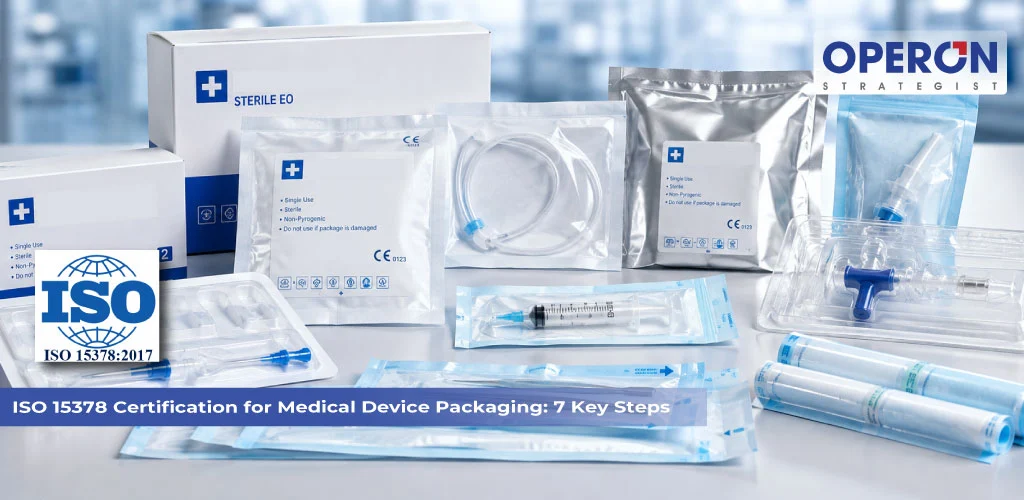
ISO 15378 Certification for Medical Device Packaging: 7 Key Steps
What Is ISO 15378 Certification?
ISO 15378 certification demonstrates that an organization has established a quality management system specifically addressing the manufacture of primary packaging materials for medicinal products, with GMP principles incorporated into the quality system.
For organizations involved in pharmaceutical and healthcare packaging, ISO 15378 provides a structured framework for controlling manufacturing processes, managing risks, preventing contamination, maintaining traceability, and consistently meeting customer and regulatory requirements.
When discussing medical device packaging, manufacturers should first determine whether ISO 15378 is applicable to their product and intended use. For sterile barrier systems and packaging of terminally sterilized medical devices, ISO 11607 is a key standard to consider, while ISO 13485 is the principal QMS standard for medical device manufacturers.
Planning to achieve ISO 15378 certification?
Why Is ISO 15378 Important for Packaging Manufacturers?
Packaging can directly affect the quality, safety, integrity, and shelf life of healthcare products. Poorly controlled packaging processes can result in contamination, mix-ups, defects, loss of integrity, or traceability issues.
An ISO 15378-based quality system helps organizations establish controls for:
- Manufacturing process consistency
- Risk management
- Contamination and mix-up prevention
- Raw-material control
- Traceability
- Documentation and records
- Change control
- Supplier management
- Corrective and preventive actions
- Training and competency
- Internal audits
- Continuous improvement
For manufacturers serving regulated healthcare markets, these controls can strengthen customer confidence and support regulatory compliance.
ISO 15378 Certification Process: 7 Key Steps
1. Determine the Applicable Standard and Certification Scope
Before beginning the ISO 15378 certification process, define exactly what your organization manufactures and which products and processes will be covered.
For example, determine whether you manufacture:
- Primary packaging materials for medicinal products
- Plastic packaging components
- Glass containers
- Closures
- Other packaging components used in pharmaceutical applications
If your organization specifically manufactures medical device packaging, evaluate whether ISO 11607, ISO 13485, or other applicable standards should also be included in your compliance strategy.
Expert insight
Do not select a certification standard simply because it is commonly used in the healthcare packaging industry. A documented regulatory and standards applicability assessment should come first.
2. Conduct a Gap Assessment
A gap assessment compares your existing quality and manufacturing practices against the applicable requirements.
For ISO 15378, the assessment may examine:
- Quality management processes
- GMP controls
- Manufacturing operations
- Cleanliness and contamination controls
- Personnel training
- Equipment maintenance
- Supplier qualification
- Document control
- Traceability
- Risk management
- Complaint handling
- CAPA
- Change management
- Internal audits
The outcome should be a documented gap report identifying what is already compliant, what requires improvement, who is responsible, and when corrective actions should be completed.
- Establish the Quality Management System
The next step is to implement a QMS appropriate to your manufacturing activities. A robust system should establish controlled procedures for areas such as:
- Document and record control
- Quality objectives
- Training and competency
- Supplier qualification
- Production controls
- Inspection and testing
- Nonconforming product
- CAPA
- Change control
- Risk management
- Customer complaints
- Internal audits
- Management review
For organizations operating across pharmaceutical and medical device sectors, the QMS should be designed so that overlapping requirements are managed without unnecessary duplication.
4. Implement GMP and Manufacturing Controls
ISO 15378 integrates GMP principles into the quality management framework.
Manufacturers should establish controls that help prevent:
- Product contamination
- Packaging mix-ups
- Incorrect labeling
- Material identification errors
- Cross-contamination
- Manufacturing defects
Depending on the packaging process, controls may include environmental monitoring, personnel hygiene, equipment controls, line clearance, cleaning procedures, process monitoring, and controlled storage.
Why this matters
For regulated packaging, quality cannot depend only on final inspection. Process controls must be designed to prevent defects before the finished product reaches the customer.
Develop Risk Management, Validation and Traceability Controls
Risk-based thinking is an important part of a compliant packaging operation. Manufacturers should identify potential risks associated with:
- Raw materials
- Manufacturing processes
- Equipment
- Contamination
- Packaging integrity
- Product identification
- Storage and transportation
- Supplier performance
Where applicable, critical processes should be appropriately qualified or validated. Traceability should also allow the organization to identify relevant:
Raw material → Production batch → Inspection/testing → Release → Customer
This becomes particularly important when investigating complaints, deviations, recalls, or quality incidents.
6. Conduct Internal Audit and Management Review
Before certification, the organization should verify that its QMS is functioning effectively.
Internal audits should assess whether:
- Procedures are implemented
- Employees follow documented processes
- Records are complete
- GMP controls are effective
- Deviations are appropriately managed
- CAPA is effective
- Risks are adequately controlled
Management review should then evaluate the overall performance of the QMS and determine whether additional resources or improvements are required.
7. Complete the Certification Audit
Once the QMS has been implemented and internally audited, the organization can proceed with the certification audit through an appropriately accredited certification body.
The process generally includes:
Stage 1 Audit → Stage 2 Certification Audit → Corrective Actions → Certification Decision
If nonconformities are identified, the organization must investigate the root cause, implement corrective actions, and provide appropriate evidence to the certification body. After successful completion, the organization receives its ISO 15378 certification within the defined certification
ISO 15378 vs ISO 13485 vs ISO 11607
Understanding the difference between these standards is particularly important when working with medical device packaging.
Standard | Primary Focus | Typical Application |
ISO 15378 | Quality management + GMP for primary packaging materials | Pharmaceutical/medicinal product packaging |
ISO 13485 | Medical device quality management system | Medical device manufacturers and relevant organizations |
ISO 11607 | Packaging for terminally sterilized medical devices | Sterile barrier and packaging systems |
Which standard should a medical device packaging manufacturer use?
There is no universal answer. The appropriate framework depends on the organization’s product, packaging function, manufacturing activities, customers, sterilization method, and target market.
A manufacturer may therefore need to assess multiple standards rather than treating ISO 15378 as a standalone requirement.
Key Documentation for ISO 15378 Certification
Depending on the organization’s scope and processes, certification preparation may involve:
- Quality manual and QMS documentation
- Quality policies and objectives
- Manufacturing procedures
- GMP procedures
- Risk management documentation
- Supplier qualification records
- Training records
- Equipment qualification and maintenance records
- Process validation documentation
- Inspection and testing procedures
- Batch/production records
- Traceability records
- Nonconformance records
- CAPA records
- Change-control records
- Complaint-handling records
- Internal audit reports
- Management review records
The exact documentation should be determined based on the organization’s certification scope and applicable requirements, rather than using a generic checklist.
Need help with ISO 15378 certification?
Talk to our experts today.
Common Challenges in ISO 15378 Certification
Manufacturers commonly face challenges such as:
1. Incorrect Certification Scope
The organization may not clearly define which products, sites, and processes are included.
2. Weak GMP Implementation
Having procedures on paper is not enough; manufacturing controls must be effectively implemented.
3. Inadequate Traceability
Poor batch, material, or production records can create significant compliance gaps.
4. Incomplete Supplier Controls
Critical raw materials and components require appropriate supplier evaluation and monitoring.
5. Ineffective CAPA
Repeated problems can indicate that root-cause analysis and corrective actions are not sufficiently effective.
6. Poor Change Control
Changes to materials, processes, equipment, suppliers, or specifications should be appropriately assessed and controlled.
Benefits of ISO 15378 Certification
For organizations within the applicable ISO 15378 scope, certification can help:
- Strengthen quality management
- Improve manufacturing consistency
- Enhance GMP controls
- Improve traceability
- Reduce quality-related risks
- Increase customer confidence
- Support supplier qualification
- Establish documented and repeatable processes
- Improve readiness for customer and certification audits
However, ISO 15378 certification should be viewed as part of a broader compliance strategy, not as a replacement for product-specific regulatory requirements.
How Operon Strategist Can Help With ISO 15378 Certification
Operon Strategist supports organizations involved in regulated healthcare and pharmaceutical packaging with quality and regulatory consulting.
Our support can include:
- ISO 15378 applicability assessment
- Gap assessment
- QMS documentation
- GMP implementation
- Supplier qualification systems
- CAPA and change-control implementation
For organizations involved in medical device packaging, we can also help assess the applicability of ISO 13485, ISO 11607, risk management, sterilization, and other relevant requirements based on the product and intended market.
Also Read: US FDA Establishment Registration Renewal for Medical Devices
Contact Operon Strategist for compliance support.
Is your medical device or pharmaceutical packaging facility ready for ISO 15378?
FAQ's
What is ISO 15378 certification?
ISO 15378 certification demonstrates that an organization has implemented a quality management system incorporating GMP principles for the manufacture of primary packaging materials for medicinal products.
Is ISO 15378 applicable to medical device packaging?
It depends on the packaging product and its intended use. ISO 15378 is specifically focused on primary packaging materials for medicinal products. Medical device packaging manufacturers should also evaluate standards such as ISO 13485 and ISO 11607 where applicable.
What are the main steps for ISO 15378 certification?
The process generally includes defining the scope, conducting a gap assessment, implementing the QMS and GMP controls, establishing risk and validation controls, conducting internal audits, completing management review, and undergoing the certification audit.
Is ISO 15378 the same as ISO 13485?
No. ISO 15378 focuses on quality management and GMP for primary packaging materials for medicinal products, while ISO 13485 specifies QMS requirements relevant to medical devices.
What is ISO 11607 used for?
ISO 11607 addresses packaging systems for terminally sterilized medical devices, including requirements related to materials, sterile barrier systems, and packaging processes.