
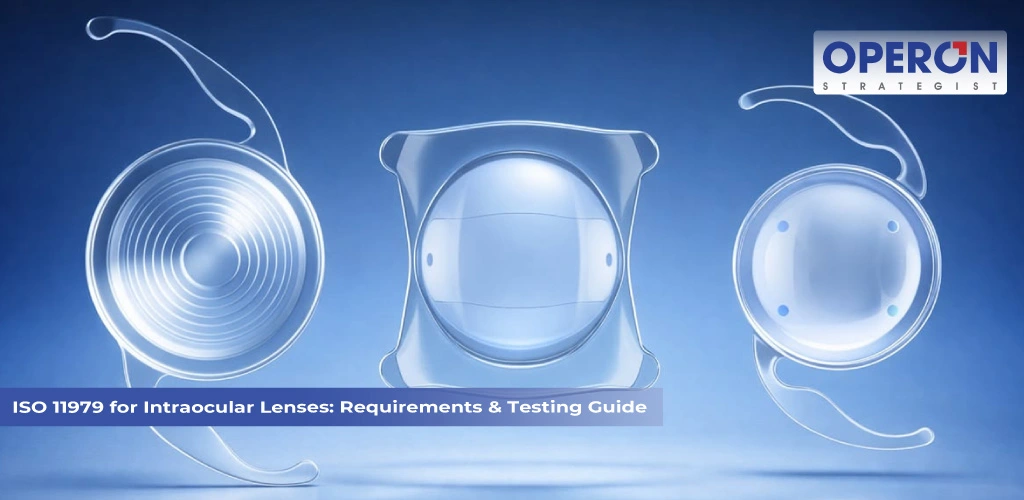
ISO 11979 for Intraocular Lenses Requirements
ISO 11979 is a series of international standards covering intraocular lenses (IOLs) used in ophthalmic applications.
The series addresses areas such as terminology, optical and mechanical properties, labeling, biocompatibility, shelf life, clinical investigations, and fundamental requirements for IOLs.
For manufacturers developing or commercializing intraocular lenses, understanding the applicable parts of ISO 11979 can help establish appropriate design, testing, clinical, and documentation strategies.
Several ISO 11979 standards are also recognized by the U.S. FDA as consensus standards for medical devices.
Must Read: IOL Cast Molding Technology for Precision Lens Manufacturing
Talk to Our Regulatory Experts
What Is ISO 11979?
ISO 11979 is a family of standards for ophthalmic implants, specifically intraocular lenses. Rather than being one single testing requirement, the series contains different parts covering specific aspects of IOL design, performance, safety, labeling, and clinical evaluation.
The applicable requirements depend on the type and design of the IOL. For example, ISO 11979-2 addresses optical properties and test methods, while ISO 11979-5 addresses biocompatibility. ISO 11979-7 covers clinical investigations of IOLs for correction of aphakia, and ISO 11979-10 addresses clinical investigations of phakic IOLs intended to correct ametropia.
What Are the Main Parts of ISO 11979?
The ISO 11979 series includes several parts, each addressing a particular aspect of intraocular lens evaluation.
| ISO 11979 Part | Main subject |
|---|---|
| Part 1 | Vocabulary |
| Part 2 | Optical properties and test methods |
| Part 3 | Mechanical properties and test methods |
| Part 4 | Labeling and information |
| Part 5 | Biocompatibility |
| Part 6 | Shelf life and transport stability testing |
| Part 7 | Clinical investigations for correction of aphakia |
| Part 8 | Fundamental requirements |
| Part 9 | Multifocal intraocular lenses |
| Part 10 | Clinical investigations of phakic IOLs |
The current ISO catalogue shows that several parts have been revised over time. For example, ISO 11979-1:2026 is the current published vocabulary edition, while ISO 11979-2:2024 is the current published edition for optical properties and test methods.
Manufacturers should therefore confirm the applicable edition before preparing a testing or regulatory strategy.
What Does ISO 11979-2 Cover?
ISO 11979-2 addresses optical properties and test methods for IOLs. The 2024 edition applies to IOLs with monofocal, toric, simultaneous-vision, and/or accommodative optics, and its scope also includes phakic intraocular lenses.
Depending on the IOL design, optical evaluation can form an important part of demonstrating that the lens performs according to its specified characteristics. FDA recognizes ISO 11979-2:2024 as a consensus standard and lists its recognition as complete.
What Does ISO 11979-3 Cover?
ISO 11979-3 addresses mechanical properties and test methods for intraocular lenses. Mechanical evaluation is important because an IOL must maintain its intended characteristics during handling, implantation, and use. Depending on the device design, manufacturers may need to evaluate relevant mechanical characteristics and demonstrate that the IOL meets applicable specifications. FDA’s recognized standards database includes ISO 11979-3 as an ophthalmic consensus standard.
What Does ISO 11979-5 Cover?
ISO 11979-5 focuses on the biocompatibility evaluation of materials used for intraocular lenses, including consideration of processing conditions.
The standard addresses physicochemical properties relevant to biocompatibility and provides guidance related to ocular implantation testing. FDA recognizes ISO 11979-5:2020 as a consensus standard. Biocompatibility assessment should also be considered within the broader device risk-management and biological evaluation strategy rather than treated as an isolated test.
What Does ISO 11979-6 Cover?
ISO 11979-6 addresses shelf life and transport stability testing for intraocular lenses. Manufacturers need evidence that the IOL and its packaging maintain relevant characteristics throughout the claimed shelf life and under applicable transportation conditions. The current ISO catalogue lists ISO 11979-6:2014 as the published edition, with a newer revision under development.
What Does ISO 11979-7 Cover?
ISO 11979-7:2024 addresses clinical investigations of intraocular lenses intended for correction of aphakia. Clinical investigations can generate evidence related to the safety and performance of an IOL in its intended clinical use. FDA recognizes the 2024 edition, although its recognition is partial, with specific provisions excluded from recognition.
This is an important regulatory consideration: manufacturers should not assume that FDA recognition of an ISO standard means every provision is automatically accepted for a particular submission.
What Does ISO 11979-8 Cover?
ISO 11979-8 establishes fundamental requirements for intraocular lenses. These requirements provide an important foundation for evaluating whether an IOL has been designed and manufactured with appropriate consideration of its intended performance and safety characteristics. FDA lists ISO 11979-8:2017 among its recognized consensus standards.
What Does ISO 11979-10 Cover?
ISO 11979-10:2018 addresses clinical investigations of phakic IOLs used to modify refractive power in the anterior segment of the eye. The standard covers phakic monofocal, multifocal, and toric IOL categories and includes requirements specific to these device types. FDA also recognizes ISO 11979-10:2018 as a consensus standard.
Get ISO 11979 Regulatory Support
Talk to our medical device regulatory experts about your IOL testing and submission requirements.
What Testing May Be Relevant for an IOL?
The applicable testing program depends on the device design, intended use, materials, and regulatory pathway. Depending on the IOL, manufacturers may need to consider:
- Optical performance testing
- Mechanical performance testing
- Biocompatibility evaluation
- Shelf-life and stability testing
- Packaging and transportation considerations
- Clinical investigation or clinical evidence
- Labeling and information requirements
- Risk management
- Material and manufacturing process evaluation
Testing should be planned based on the specific IOL rather than applying every ISO 11979 part automatically.
How Does ISO 11979 Support Regulatory Submissions?
ISO 11979 can provide recognized technical and clinical frameworks for generating evidence supporting IOL safety and performance. For the U.S. market, manufacturers should review the FDA’s current recognized consensus standards database and determine whether the applicable ISO 11979 edition and provisions are recognized for the intended regulatory submission.
FDA recognition can be complete or partial, so the recognition details should be reviewed carefully. For other markets, the applicable regulatory requirements and conformity-assessment framework should also be considered.
What Should Manufacturers Prepare for ISO 11979?
A practical IOL compliance strategy can include:
- Define the IOL’s intended use and design.
- Identify the applicable ISO 11979 parts.
- Review the current editions of the relevant standards.
- Establish applicable optical and mechanical testing.
- Develop the biocompatibility evaluation strategy.
- Establish shelf-life and transport stability testing.
- Determine clinical evidence or investigation requirements.
- Integrate testing with risk management.
- Prepare technical documentation and test reports.
- Map the evidence to the applicable regulatory submission.
How Can Operon Strategist Help With ISO 11979?
Operon Strategist provides regulatory consulting, technical documentation, risk-management, clinical evaluation, and market registration support for medical device manufacturers. These services can support manufacturers of specialized devices such as intraocular lenses when developing a regulatory pathway for applicable ISO 11979 requirements.
Operon Strategist can help assess applicable regulatory requirements, identify relevant standards, develop regulatory and testing strategies, organize technical documentation, support clinical evaluation and evidence planning, review risk-management documentation, and prepare regulatory submissions for target markets.
The specific ISO 11979 requirements, testing, clinical evidence, and regulatory pathway should be determined based on the IOL’s design, intended use, materials, classification, and target market.
Need Support With ISO 11979 Requirements?
Are you developing or preparing regulatory documentation for an intraocular lens?
FAQ's
What is ISO 11979?
ISO 11979 is a series of standards covering requirements and test methods for intraocular lenses (IOLs), including optical, mechanical, biocompatibility, clinical, and other performance considerations.
What does ISO 11979-2 cover?
ISO 11979-2 covers optical properties and test methods for intraocular lenses, including applicable requirements for different IOL optical designs.
What does ISO 11979-3 cover?
ISO 11979-3 covers mechanical properties and associated test methods for intraocular lenses.
What does ISO 11979-5 cover
ISO 11979-5 addresses biocompatibility considerations for intraocular lenses and their materials.
What is ISO 11979-6 used for?
ISO 11979-6 addresses shelf-life and transport stability testing for intraocular lenses.