
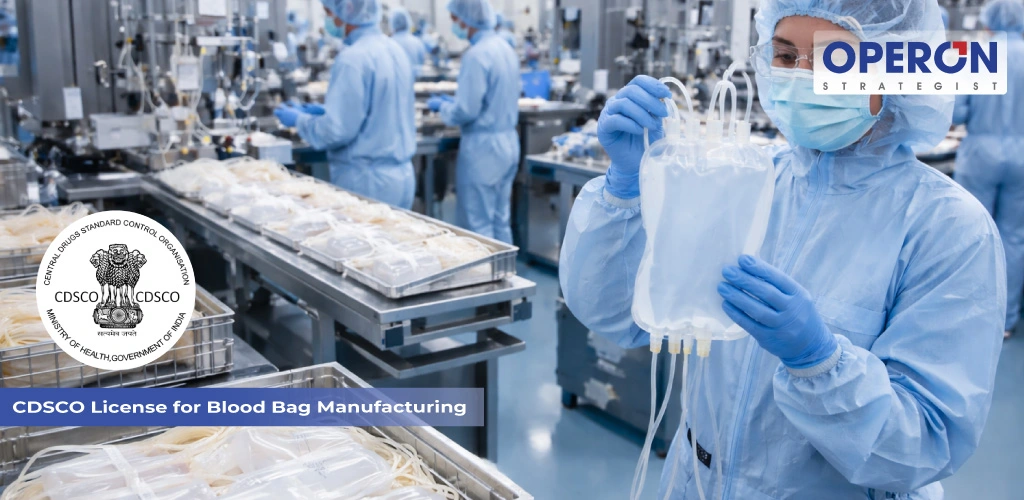
CDSCO License for Blood Bag Manufacturing in India: Regulatory & Manufacturing Guide
Blood collection bags are critical single-use medical devices essential for the collection, separation, storage, and transfusion of human blood and blood components. Because they directly contact human blood and preservation solutions, their quality, sterility, and biocompatibility are paramount to patient safety.
Manufacturing blood bags in India is strictly governed by the Central Drugs Standard Control Organization (CDSCO) under the Medical Device Rules (MDR), 2017. Securing a CDSCO license for blood bag manufacturing is a mandatory prerequisite before setting up commercial production.
This comprehensive guide breaks down the classification, technical documentation, facility setup requirements, and step-by-step regulatory licensing roadmap for aspiring and expanding manufacturers.
Talk to Our Medical Device Experts
What is CDSCO and Why Compliance is Mandatory
The Central Drugs Standard Control Organization (CDSCO) acts as India’s national regulatory authority overseeing pharmaceuticals and medical devices. Under the Medical Device Rules (MDR), 2017, blood bags are officially categorized as notified medical devices.
Mandatory compliance implies:
You cannot manufacture, store, or sell blood bags without a valid CDSCO manufacturing license.
Cleanroom production facilities must adhere to strict Good Manufacturing Practices (GMP).
Complete traceability, quality management, and biological safety testing are legally enforced.
For an in-depth analysis of regulatory guidelines, review our comprehensive resource on blood bag manufacturing regulatory aspects.
Classification of Blood Bags Under CDSCO
Under the CDSCO Medical Device Rules (MDR), 2017, blood bags (with or without anticoagulant solutions like CPDA-1) are classified as Class C (Moderate-High Risk) medical devices.
Regulatory Implications of Class C Classification:
Licensing Authority: Governed directly by the Central Licensing Authority (CLA).
Application Form: Form MD-7 submitted via the online CDSCO SUGAM portal.
Final Grant: Form MD-9 (Manufacturing License).
Quality Standard: Mandatory ISO 13485 certification.
Audit Standard: Physical inspection by CDSCO medical device officers and technical experts prior to license grant.
Types of Blood Bags (Manufacturing Overview)
Blood bags are engineered based on the intended component separation workflow:
| Blood Bag Type | Intended Separation / Clinical Use |
| Single Blood Bag | Whole blood collection containing anticoagulant CPDA-1 solution |
| Double Blood Bag | Separation of Packed Red Blood Cells (RBC) and Plasma |
| Triple Blood Bag | Separation of RBC, Plasma, and Platelets |
| Quadruple Blood Bag | Separation of RBC, Plasma, Platelets, and Cryoprecipitate |
Industry Insight: Most initial setups begin with single blood collection bag lines due to lower operational complexity, expanding into multi-bag systems as manufacturing workflows stabilize.
Key Materials & Manufacturing Specifications
Blood bag manufacturing requires medical-grade, non-toxic, biocompatible materials capable of withstanding high-frequency welding and sterilization.
Main Bag & Tubing: Medical-grade plasticized Polyvinyl Chloride (PVC)
Needle: Stainless steel (typically 16G or 17G ultra-thin wall)
Clamps & Connectors: High-Density Polyethylene (HDPE) / Polypropylene (PP)
Sampling & Luer Lock Hubs: Polypropylene + Synthetic Rubber
Anticoagulant Solutions: CPDA-1 (Citrate Phosphate Dextrose Adenine) or SAGM
Production Capacity Guidelines
HF Welding Output: ~500–550 bags/hour (depending on welder automation).
Annual Capacity: ~1.2 to 1.3 million bags annually (calculated on a single-shift basis).
Setting up a Class C blood bag plant?
Contact Operon Strategist today for expert regulatory and cleanroom design guidance.
Step-by-Step CDSCO Licensing Process for Blood Bags
1. Establish Cleanroom Facility
The manufacturing facility must feature an ISO Class 7 or Class 8 cleanroom environment with controlled HVAC, positive pressure differential, unidirectional material-personnel flow, and strict contamination controls.
2. Implement ISO 13485 Quality System
Implement a full Quality Management System (QMS) addressing document control, batch traceability, Corrective and Preventive Actions (CAPA), and Risk Management per ISO 14971.
3. Compile Technical Dossiers
Device Master File (DMF): Detailed product design, PVC resin specification, CPDA formulation, biological evaluations, and shelf-life data.
Plant Master File (PMF): Facility layout, environmental control systems, equipment calibration logs, and staffing structure.
4. Application Submission via SUGAM
File Form MD-7 on the official CDSCO SUGAM portal, upload required files, and pay government statutory fees.
5. Audit & License Issuance
CDSCO auditors inspect the physical plant, cleanrooms, and quality documentation. Upon successful resolution of any raised audit observations, the Central Licensing Authority issues the Form MD-9 License.
Manufacturing Process Flow
A standard industrial workflow for blood bag assembly involves:
Material Preparation: PVC sheet cutting & medical-grade tube extrusion.
Component Molding: Injection molding of clamps, luer caps, and breakable valves.
Ultrasonic Cleaning & Drying: Decontamination of molded parts in controlled ovens.
HF Welding: High-frequency sealing of PVC sheets and tube insertions.
Assembly: Manual/semi-automated integration of main bag, tubing, donor needle, and sampling pouch.
Anticoagulant Filling: Automated dosing of sterile CPDA solution.
Primary Packaging & Sterilization: Pouch packing followed by validated Ethylene Oxide (EtO) or Gamma irradiation.
QC Release: Leakage, burst, sterility, and pyrogen testing prior to batch clearance.
Testing & Quality Compliance Requirements
To obtain a CDSCO license for blood bag manufacturing, batches must undergo validation testing adhering to global standards:
Biocompatibility (ISO 10993): Cytotoxicity, hemocompatibility, systemic toxicity, and intracutaneous reactivity.
Mechanical Integrity: Tensile strength, seal integrity, pressure resistance, and burst volume tests.
Chemical Safety: Extractable and leachable testing for plasticizers (e.g., DEHP).
Sterilization Validation: ISO 11135 (for EtO) or ISO 11137 (for Gamma Radiation).
Common Approval Bottlenecks & Best Practices
Inadequate Cleanroom Validation: Ensure HVAC air velocity, particle counts, and microbial monitoring reports are complete before inspection.
Sterilization Validation Gaps: Always provide complete EtO/Gamma sterilization validation reports along with biological indicator test results.
Weak Bio-Testing Traceability: Conduct biocompatibility testing exclusively through NABL/CDSCO-accredited testing laboratories.
Global Market Expansion
Obtaining a CDSCO manufacturing license establishes a strong operational baseline. Indian blood bag manufacturers can leverage this foundation to expand globally by pursuing:
CE Marking (EU MDR 2017/745): For European Union export markets.
US FDA 510(k) Clearance: For entry into North American medical markets.
How Operon Strategist Can Help
Operon Strategist provides end-to-end turn-key consulting services for setting up blood bag manufacturing units and securing CDSCO licenses:
CDSCO License Application: Complete preparation and management of Form MD-7 submissions via SUGAM.
Technical Dossier Compilation: Drafting comprehensive Device Master Files (DMF) and Plant Master Files (PMF).
Cleanroom & Facility Design: Guidance on GMP-compliant layout design, HVAC placement, and cleanroom validation.
ISO 13485 QMS Implementation: Customizing SOPs, risk management files (ISO 14971), and traceability systems.
Audit Support: Mock inspections and on-site representation during CDSCO licensing audits.
Need assistance compiling your Device Master File (DMF)?
Schedule a strategic consultation with our CDSCO medical device experts.
FAQ's
What class is a blood bag under CDSCO rules?
Blood bags are classified as Class C (Moderate-High Risk) medical devices under the CDSCO Medical Device Rules, 2017.
Which license form is required to manufacture blood bags in India?
Manufacturers must apply using Form MD-7 to receive a Form MD-9 Manufacturing License issued by the Central Licensing Authority.
Is ISO 13485 mandatory for blood bag manufacturing?
Yes, ISO 13485 certification is a mandatory requirement for Class C medical device manufacturing approval in India.
What cleanroom class is needed for blood bag production?
Assembly and welding operations must take place within an ISO Class 7 or Class 8 cleanroom environment.
How are blood bags sterilized?
Blood bags are typically sterilized using validated Ethylene Oxide (EtO) gas or Gamma Radiation process cycles.