
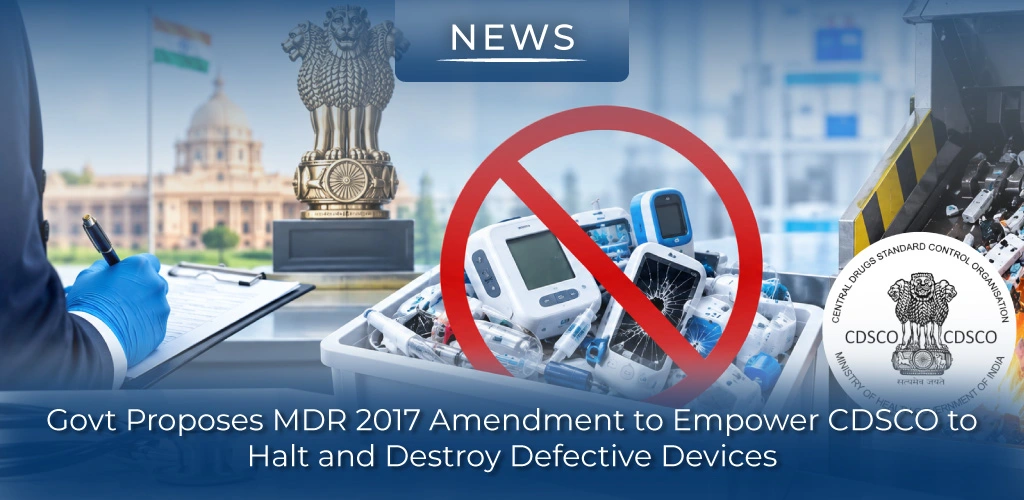
Govt Proposes MDR 2017 Amendment to Empower CDSCO to Halt and Destroy Defective Devices
In a decisive move to strengthen market enforcement and safeguard patient safety, the Union Government is considering major changes to the Medical Devices Rules (MDR), 2017. The proposed amendment specifically targets Rule 30(1), aiming to grant explicit statutory authority to central and state regulators to immediately halt the manufacturing, sale, and distribution of unsafe or defective products and order their supervised destruction.
The proposal has been placed before the Drugs Consultative Committee (DCC) for review and recommendations before final notification.
Contact Us for CDSCO Compliance
Bridging the Regulatory Enforcement Gap
Under the current legal framework governed by the Drugs and Cosmetics Act, 1940, and the MDR, 2017, licensing authorities have the power to suspend or cancel manufacturing or import licenses when non-compliance is detected. However, regulators often face procedural hurdles when attempting to execute immediate, product-specific interventions.
Key Limitations of the Existing Framework:
License-Centric Actions: Existing enforcement primarily focuses on suspending or revoking site licenses rather than targeted batch-level containment.
Lack of Explicit Destruction Mandates: Current provisions lack an unambiguous mandate empowering inspectors to immediately seize and destroy hazardous or spurious stocks lingering in distribution channels.
Risk of Recirculation: Without formal supervised disposal protocols, compromised inventory or discarded hospital stock risks being relabeled or diverted to secondary grey markets.
The proposed Medical Devices Rules 2017 Amendment seeks to resolve these legal ambiguities by providing precise, product-level enforcement mechanisms.
Major Highlights of the Proposed Rule 30(1) Revision
If approved, the updated Rule 30(1) will equip both the Central Drugs Standard Control Organisation (CDSCO) and State Licensing Authorities (SLAs) with expanded administrative tools:
Immediate Cease-and-Desist Directives: Regulators can order manufacturers, importers, and distributors to instantly stop the production, marketing, and hospital distribution of defective, adulterated, or substandard devices.
Mandatory Supervised Destruction: Authorities will gain legal backing to mandate and supervise the destruction of compromised batches using compliant bio-waste methods, creating a verifiable audit trail.
Targeted Batch Containment: Inspectors can isolate specific faulty lots—such as defective surgical sutures, cardiac stents, or diagnostic test kits—without delaying emergency public safety measures or shutting down entire manufacturing facilities unnecessarily.
Enhanced Supply Chain Traceability: Manufacturers and distributors will be required to maintain rigorous batch tracking to execute prompt product recalls when flagged by adverse event reports.
This regulatory shift aligns with India’s broader initiatives—including the Materiovigilance Programme of India (MvPI)—to build a transparent, world-class healthcare technology framework.
How Operon Strategist Can Help
With the government tightening regulatory oversight under the proposed MDR 2017 amendments, medical device manufacturers and importers must maintain total product compliance and complete supply chain traceability to prevent costly enforcement actions, product recalls, or batch destruction orders. Operon Strategist offers comprehensive regulatory consulting to help organizations navigate these evolving compliance standards seamlessly.
Our point-wise services include:
CDSCO Medical Device Registration & Licensing: End-to-end guidance in securing CDSCO manufacturing licenses, import permits, and product approvals while ensuring full adherence to updated MDR 2017 provisions.
ISO 13485 Quality Management System (QMS) Implementation: Designing, auditing, and implementing robust Quality Management Systems to eliminate manufacturing non-conformities, batch failures, and substandard product risks.
Post-Market Surveillance & Materiovigilance Setup: Establishing structured Post-Market Surveillance (PMS) protocols, adverse event reporting systems, and audit-ready product recall mechanisms compliant with CDSCO requirements.
Regulatory Compliance Audits & Gap Analysis: Conducting rigorous mock audits and facility inspections to identify quality gaps before official CDSCO or State Licensing Authority reviews.
Technical File & Batch Documentation Verification: Assisting in compiling complete Device Master Files (DMF), Design History Files (DHF), and verifiable batch traceability records to safeguard against regulatory sanctions.
Schedule a Compliance Consultation
Ensure total compliance for your medical devices with expert guidance today.