
Assistant Manager
Sales | 7 Years of Experience Pharmaceutical and medical device
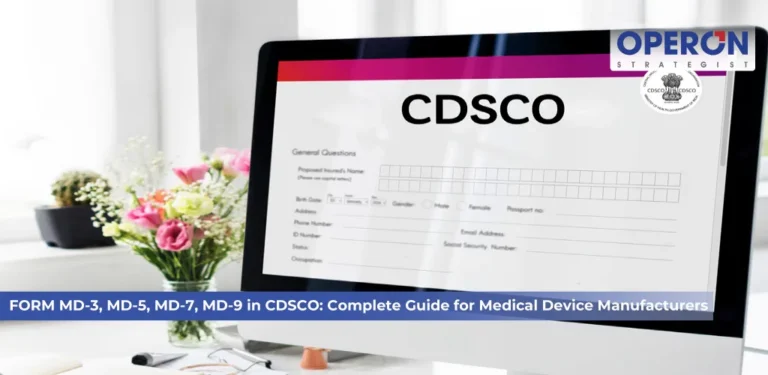
Understanding the correct use of CDSCO forms MD-3, MD-5, MD-7 and MD-9 is important for medical device manufacturers planning to enter or operate in the Indian market. These forms relate to specific stages of the manufacturing licence and compliance process under the Medical Devices Rules, 2017.
Each form serves a different purpose. MD-3 and MD-7 are application forms for manufacturing licences, while MD-5 and MD-9 are associated with the grant of those licences for different medical device risk classes.
Incorrect form selection or incomplete documentation can lead to delays, regulatory queries or rejection of applications. This guide explains the purpose of each form, its applicability and the related compliance requirements. It also covers test licences, post-approval applications and the broader CDSCO registration process.
What Is the Role of CDSCO Forms in Medical Device Regulation?
The Central Drugs Standard Control Organization (CDSCO), also known as the Central Drugs Standard Control Organisation, regulates medical devices in India under the Medical Devices Rules, 2017.
CDSCO forms provide a structured way to manage different regulatory activities. Each form serves as a legally defined checkpoint in the regulatory process. These activities include:
Manufacturing licences
Loan licences
Test licences
Import-related approvals
Post-approval applications
The correct selection of a CDSCO form depends on the type of regulatory activity, the medical device risk class and the purpose of the application.
Key insight: Each form corresponds to a specific regulatory stage and is not interchangeable. Understanding the correct CDSCO forms can help manufacturers avoid application errors and regulatory delays.
For more information about the broader regulatory framework, read also: CDSCO Regulatory Compliance.
FORM MD-3: Manufacturing Licence Application for Class A and B Devices
What Is FORM MD-3 Used For?
FORM MD-3 is used to apply for a manufacturing licence for Class A and Class B medical devices, which fall under the low-risk and low-moderate-risk categories.
It is relevant to domestic manufacturers in India who intend to manufacture these medical devices for sale or distribution.
Who Should Use FORM MD-3?
The form is relevant to:
Domestic medical device manufacturers in India
Companies setting up new manufacturing facilities
Businesses expanding into regulated medical device categories
Key Requirements for the MD-3 Form
Manufacturers should prepare the required documentation and demonstrate that the manufacturing facility meets the applicable requirements.
Important requirements include:
Valid ISO 13485 certificate and compliance
Device Master File (DMF)
Plant Master File (PMF)
Details of the manufacturing site, equipment and personnel
Regulatory Authority
The State Licensing Authority (SLA) is the relevant licensing authority for this application pathway.
Practical Tip
Manufacturing facilities and documentation must be audit-ready. Inspection by the authority is an important part of the approval process. Manufacturers should therefore ensure that their facility, equipment, personnel and quality documentation are prepared before the application progresses.
FORM MD-5: Manufacturing Licence Grant for Class A and B Devices
What Is FORM MD-5?
FORM MD-5 is the manufacturing licence issued upon approval of the MD-3 application for Class A and Class B medical devices.
While MD-3 is the application form, MD-5 represents the licence granted after the application has been approved.
Why Is FORM MD-5 Important?
FORM MD-5 is important because it:
Provides legal authorisation to manufacture medical devices
Is required for commercial production and distribution
Must be maintained for regulatory inspections and applicable compliance activities
Compliance Note
Manufacturers must continue to follow the approved licence conditions after receiving the CDSCO certificate or licence.
Any changes in the manufacturing site, process or device specifications must be reported and approved as required by the applicable regulatory requirements.
FORM MD-7: Application for Manufacturing Licence for Class C and D Devices
What Is FORM MD-7 Used For?
FORM MD-7 is used to apply for a manufacturing licence for Class C and Class D medical devices intended for sale or distribution.
These devices fall under the moderate-high-risk and high-risk categories. Their manufacturing applications follow the Central Licensing Authority (CLA) pathway.
When Should Manufacturers Use FORM MD-7?
Manufacturers should consider this form when:
Manufacturing Class C and Class D medical devices
Setting up a manufacturing facility for higher-risk devices
Applying to CDSCO through the Central Licensing Authority
Key Considerations for the MD-7 Application
The application requires relevant technical and manufacturing documentation. Key considerations include:
Valid ISO 13485 certificate and compliance
Device Master File (DMF)
Plant Master File (PMF)
Details of the manufacturing site, equipment and personnel
Documentation of manufacturing controls
Regulatory Authority
The Central Licensing Authority (CLA) is responsible for this licensing pathway.
Risk Insight
Incomplete documentation or non-compliance may lead to delays, regulatory queries or rejection by CDSCO. Manufacturers should ensure that the application and supporting technical information are complete and consistent.
For related information, read also: Hong Kong MDACS vs India CDSCO: Medical Device Registration.
FORM MD-9: Manufacturing Licence Grant for Class C and D Devices
What Is FORM MD-9 Used For?
FORM MD-9 is issued as the manufacturing licence after approval of FORM MD-7 for Class C and Class D medical devices.
It is the licence associated with the manufacturing approval pathway for these higher-risk device categories.
Who Needs FORM MD-9?
This form is relevant to:
Manufacturers of Class C and Class D medical devices
Companies intending to commercially manufacture and sell these devices
Key Limitations
Manufacturers must follow the conditions specified in the approved licence.
Manufacturing must comply with the approved conditions.
Any changes requiring regulatory approval must be handled through the applicable process.
Strategic Use
FORM MD-9 enables the legal manufacturing and commercialisation of Class C and Class D medical devices, subject to the approved licence conditions and applicable regulatory requirements.
Accelerate Market Access with End-to-End Regulatory Guidance
FORM MD-12: Application for Test Licence
What Is FORM MD-12 Used For?
FORM MD-12 is used to apply for a test licence to manufacture medical devices for testing, evaluation, demonstration or training purposes.
This application is relevant during product development and pre-market activities where devices need to be manufactured for specific non-commercial purposes.
When Should Manufacturers Use It?
FORM MD-12 may be relevant for:
Product testing and validation
Clinical evaluation or performance assessment
Device demonstration or training
Research and development (R&D) and pre-market stages
Key Considerations
Manufacturers should consider the following requirements:
Devices must not be used for commercial sale.
The quantity should be limited to testing requirements.
A test protocol or justification should be submitted.
Details of the testing site and purpose should be provided.
Risk Insight
Misuse of a test licence, such as commercial sale or distribution of devices, may lead to regulatory action, rejection of future applications or penalties.
FORM MD-13: Test Licence
What Is FORM MD-13 Used For?
FORM MD-13 is issued for testing, evaluation, demonstration or training purposes.
It is associated with the test licence process and supports activities that take place during product development and pre-market validation.
Who Needs FORM MD-13?
This form is relevant to:
Manufacturers conducting product validation
Research and development organisations
Key Limitations
The use of devices under this licence is restricted.
Devices cannot be sold commercially.
Usage is restricted to the approved purposes only.
Strategic Use
FORM MD-13 is important during product development and pre-market validation. It allows the relevant testing and evaluation activities to take place within the approved scope.
FORM MD-16: Application for Test or Clinical Investigation Import Licence
What Is FORM MD-16 Used For?
FORM MD-16 is used to apply for a licence to import medical devices for clinical investigation, testing, evaluation, demonstration or training.
It applies to applicants who need to bring medical devices into India for specific non-commercial activities.
When Should Applicants Use It?
FORM MD-16 may be used:
For importing devices for clinical investigations
For testing and evaluation purposes
For demonstration or training activities
During pre-market validation stages
Key Considerations
Applicants should consider the following:
Devices must not be used for commercial sale.
A clinical investigation plan should be submitted where applicable.
The proposed import quantity should be justified.
Details of the testing or investigation site should be provided.
Ethics Committee approval is required for clinical investigations, as applicable.
Risk Insight
Improper use of imported devices or a deviation from the approved purpose may lead to regulatory action, suspension of permissions or rejection of future applications.
Post-Approval Applications for Medical Devices
What Are Post-Approval Applications Used For?
Post-approval applications are used to notify the licensing authority or obtain prior approval for changes made after the grant of a manufacturing or import licence.
A medical device licence does not remove the need to manage later changes. Manufacturers and importers must assess changes and follow the applicable regulatory process.
When Should Manufacturers and Importers Use Them?
Post-approval applications may be required for changes such as:
Change in manufacturing site or facility layout
Addition of new models under the same product in an existing licence
Changes in device design, specifications or intended use
Change in manufacturing process or equipment
Labelling or packaging updates
Key Considerations
Applicants should prepare relevant supporting information, which may include:
Updated DMF and/or PMF
Justification and supporting documentation for the change
Risk assessment and impact analysis
Prior approval for major changes, where required
Evidence of compliance with the conditions of the existing licence
Risk Insight
Failure to notify the authority or obtain approval for changes, where required, may result in regulatory action. This can include suspension or cancellation of a licence, product recall or rejection of future applications.
Manufacturers should therefore maintain change-control procedures and assess the regulatory impact of proposed changes before implementation.
For support with regulatory documentation and quality systems, explore Operon Strategist’s QMS services.
How Do These CDSCO Forms Fit into the Approval Workflow?
The different CDSCO forms are connected to specific stages of the medical device regulatory process. Understanding their sequence helps manufacturers identify the relevant application and licence forms.
Simplified CDSCO Approval Pathway
| Regulatory stage | Applicable form or activity |
|---|---|
| Manufacturing licence application for Class A and B | FORM MD-3 |
| Manufacturing licence application for Class C and D | FORM MD-7 |
| Review and inspection | Application assessment and facility inspection |
| Licence grant for Class A and B | FORM MD-5 |
| Licence grant for Class C and D | FORM MD-9 |
| Test licence application | FORM MD-12 / FORM MD-16 |
| Testing phase | FORM MD-13 / FORM MD-17 |
| Post-approval changes | Applicable amendment applications |
Key takeaway: Understanding CDSCO forms helps manufacturers navigate each regulatory stage. Every form represents a specific step and is not interchangeable with another form.
The CDSCO SUGAM portal is also relevant to understanding the online application environment and related regulatory submissions.
Common Mistakes Manufacturers Should Avoid
Incorrect form selection and incomplete documentation can affect the CDSCO registration process. Manufacturers should pay attention to the following common mistakes:
Using MD-3 instead of MD-7: Selecting the wrong manufacturing licence application for the device risk class can create regulatory issues.
Submitting incomplete DMF or PMF: Missing or inconsistent technical and facility information can lead to queries.
Ignoring ISO 13485 requirements: Quality management system requirements must be considered as part of manufacturing compliance.
Misusing a test licence: Devices approved for testing or evaluation must not be used for commercial purposes.
Not applying for post-approval changes: Changes to manufacturing or device information may require notification or prior approval.
Poor control over manufacturing processes: Weak manufacturing controls can affect compliance with approved conditions.
Lack of coordination with licensed manufacturing partners: Responsibilities and documentation should be clearly managed when working with manufacturing partners.
Proper knowledge of CDSCO forms can help manufacturers reduce these common compliance errors and prepare more complete applications.
Regulatory Trends in CDSCO
Medical device regulation continues to evolve. Manufacturers need to follow regulatory requirements and remain aware of changes that may affect their applications and ongoing compliance.
Some important areas include:
Increased scrutiny on documentation accuracy: Complete and consistent application information remains important.
Digitalisation through the online CDSCO portal: Online processes support regulatory applications and related submissions.
Stronger enforcement of post-market surveillance: Manufacturers need to consider compliance beyond the initial licence grant.
Alignment with global standards: International frameworks and standards, including ISO and IMDRF, remain relevant to medical device quality and regulatory practices.
As regulatory expectations evolve, staying updated with CDSCO forms and their latest requirements is essential for manufacturers.
For the official regulatory framework, refer to the Medical Devices Rules, 2017, published by CDSCO.
How Operon Strategist Can Support Your CDSCO Licensing Process
Operon Strategist provides regulatory and manufacturing support for medical device companies working towards CDSCO compliance.
Support areas include:
CDSCO registration strategy and form selection: Support in identifying the relevant regulatory pathway and application forms.
MD-3 and MD-7 application preparation: Assistance with application documentation and submission preparation.
ISO 13485 QMS implementation: Support in developing and implementing a quality management system.
Technical file preparation: Assistance with Device Master File (DMF) and Plant Master File (PMF) documentation.
Regulatory approvals: Support for regulatory requirements in India, US FDA and CE marking.
Manufacturing setup: Support for manufacturing facility setup, cleanroom design and validation.
Post-approval compliance: Assistance with ongoing regulatory requirements and audit support.
Through its regulatory and compliance services under ElevatePlus, Operon Strategist supports medical device manufacturers with regulatory approvals, quality systems and manufacturing compliance.
Get Your Medical Device Market-Ready with Expert Regulatory Support
FAQ's
What is the difference between MD-3 and MD-7?
MD-3 is used for manufacturing licence applications for Class A and B devices, while MD-7 is used for Class C and D devices.
Is MD-5 a licence or an application form?
MD-5 is the manufacturing licence issued after approval of the MD-3 application.
Can MD-9 be used for testing?
No. MD-9 is a manufacturing licence. Testing activities are addressed through the applicable test licence process, including MD-13 as described in this guide.
Do Class C and D devices use MD-7 and MD-9?
Yes. MD-7 is the manufacturing licence application form, and MD-9 is the licence grant form for Class C and D devices.
Is ISO 13485 important for CDSCO manufacturing approval?
Yes. ISO 13485 compliance is an important quality management consideration for medical device manufacturing licences.