
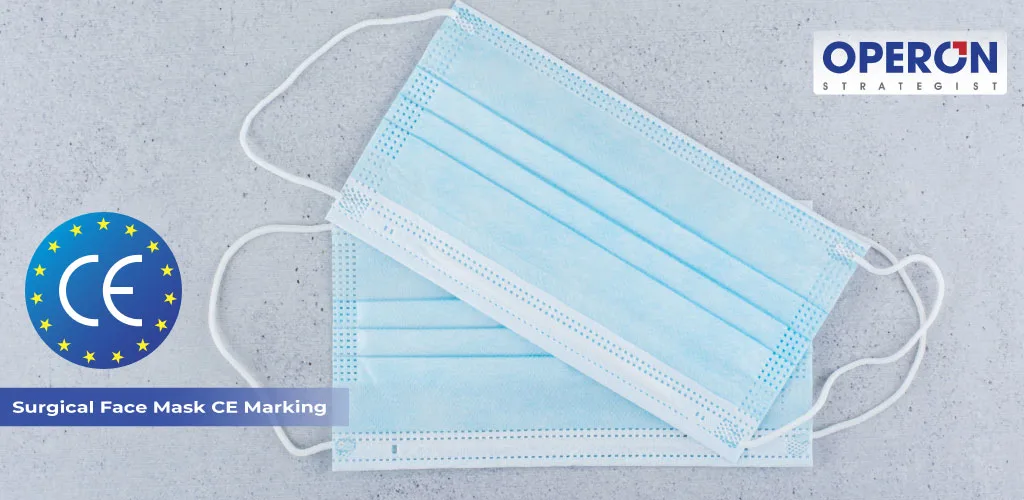
Surgical Face Mask CE Marking
Overview: Surgical Face Mask CE Marking Requirements
Under the European Medical Device Regulation (EU MDR 2017/745), non-sterile surgical face masks intended for source control (protecting patients from wearer emissions) are classified as Class I Medical Devices. Obtaining a Surgical Face Mask CE Marking requires demonstrating full compliance with harmonized standard EN 14683, which evaluates Bacterial Filtration Efficiency (BFE), breathability splash resistance (for Type IIR), and bioburden cleanliness. Non-sterile Class I masks follow a self-declaration route requiring a technical file, ISO 13485 QMS alignment, and an Authorized Representative (EC REP) for non-EU manufacturers, while sterile masks (Class Is) require Notified Body involvement.
Contact us
Regulatory Framework: EU MDR 2017/745 vs. PPE Regulation
Placing surgical face masks on the European Economic Area (EEA) market requires precise regulatory classification. Under current European law, masks are divided into two distinct categories depending on their intended purpose:
| Regulatory Parameter | Medical Device Pathway | Personal Protective Equipment (PPE) Pathway |
| Intended Purpose | Protect Patient / Environment (Source Control) | Protect Wearer from Airborne Aerosols |
| Device / Equipment Category | Medical Device (Class I) | Personal Protective Equipment (PPE) |
| Governing Regulation | EU MDR 2017/745 Annex VIII | PPE Regulation (EU) 2016/425 |
| Harmonized Standard | EN 14683 | EN 149 |
| Product Classifications / Tiers | Type I, Type II, Type IIR | FFP1, FFP2, FFP3 |
Medical Devices (EU MDR 2017/745): Surgical masks designed to act as a barrier limiting the transmission of infectious agents from staff to patients during surgical procedures and clinical settings fall under the Medical Device Regulation. To understand risk boundaries across mask types, review our guide on medical face mask classification.
Personal Protective Equipment (EU 2016/425): Filtering half-masks (such as FFP2 or FFP3 respirators) designed specifically to protect the wearer against airborne particulates and droplets are regulated under PPE rules and tested against EN 149.
Understanding these distinctions ensures that your technical documentation matches the appropriate regulatory pathway. Learn more about broader European compliance via our specialized CE Marking (EU MDR / IVDR) service page.
Must Read: Medical Face Mask Classification
Technical Performance Standards: EN 14683 Test Parameters
To affix the CE mark on surgical face masks, manufacturers must complete laboratory testing according to EN 14683 (Medical face masks — Requirements and test methods).
The standard divides medical face masks into three performance tiers based on specific physical and biological test criteria:
Type I: Primarily used by patients and the general public to reduce the risk of spreading infections in epidemic situations.
Type II: Intended for healthcare professionals in clinical environments without fluid splash exposure.
Type IIR: Includes fluid-resistant layers to shield the wearer from potential blood or fluid splashes in operating rooms.
For manufacturers setting up production facilities for these layered non-woven barriers, explore our operational insights on disposable masks manufacturing.
Related Reads: N-95 Masks and Gowns FDA Registration
Key Differences: EN 14683 (Surgical Masks) vs. EN 149 (Respiratory Equipment)
A common mistake among manufacturers is confusing surgical face mask requirements with respiratory protective equipment.
| Aspect | Surgical Face Masks (EN 14683) | Respirator Half Masks (EN 149) |
| Governance | EU MDR 2017/745 (Medical Device) | Regulation (EU) 2016/425 (PPE) |
| Primary Function | Source control (protecting patients) | Wearer protection (filtering inhaled air) |
| Fit Requirement | Loose-fitting barrier | Tight-sealing facial fit |
| Classification Tiers | Type I, Type II, Type IIR | FFP1, FFP2, FFP3 |
| Conformity Assessment | Class I Self-Declaration (if non-sterile) | Module B + C2/D Notified Body Audit |
If your product portfolio extends into dual-purpose products or global distribution beyond Europe, read our article on N-95 masks and gowns FDA registration.
5-Step Compliance Roadmap for Surgical Face Mask CE Marking
Non-sterile surgical face masks follow the Class I self-declaration pathway under EU MDR 2017/745. Manufacturers can place the CE mark under their own responsibility by completing these steps:
Verify Intended Purpose & Classification: Confirm Class I (Rule 1) status and determine the target mask type (Type I, II, or IIR).
Execute EN 14683 Laboratory Testing: Perform testing for bacterial filtration efficiency, differential pressure, splash resistance, bioburden, and ISO 10993 biocompatibility at accredited test facilities.
Compile Technical Documentation: Build a technical file complying with Annex II and III of EU MDR. Secure your core design and risk history by structuring a compliant Design History File (DHF).
Implement an ISO 13485 QMS: Establish quality procedures covering manufacturing consistency, change control, and post-market surveillance. Learn more about building an audit-ready .Quality Management System (QMS)
Appoint an EC REP & Submit Declaration of Conformity: Non-EU manufacturers must appoint an Authorized Representative (EC REP), complete EUDAMED registration, sign the EU Declaration of Conformity (DoC), and affix the CE mark to product labeling.
For localized regulatory consultation across major manufacturing hubs, consult our teams for CE Marking Consultant in Pune or CE Marking Consultant in Delhi.
Planning European market entry for surgical or protective masks
Schedule a technical file and EN 14683 review with Operon Strategist today.
How Operon Strategist Accelerates Surgical Mask CE Mark Certification
Navigating EU MDR technical requirements demands precise regulatory expertise. Operon Strategist provides end-to-end consulting services to guide surgical mask manufacturers from initial testing through to European commercial distribution:
Technical File & Annex II/III Compilation: Structuring comprehensive technical files, clinical evaluations, risk management files (ISO 14971), and labeling compliance.
Testing Strategy & Gap Analysis: Managing test protocols for EN 14683 (BFE, breathability, splash resistance) and ISO 10993 biocompatibility with accredited testing partners.
ISO 13485 Quality Management System: Customizing QMS processes specifically tailored to non-woven medical mask manufacturing facilities.
EC REP & EUDAMED Actor Registration: Assisting non-EU businesses with European Authorized Representative agreements and Single Registration Number (SRN) generation.
Global Compliance Alignment: Harmonizing EU MDR files to facilitate US FDA (510(k), QMSR, & Registration) and CDSCO (India) market clearances via thorough Regulatory Due Diligence for Medical Devices and initial Product Feasibility.
Need an Authorized Representative (EC REP)
Partner with Operon Strategist for fast-track Global Product Registration.
FAQ's
Is a Notified Body required for non-sterile surgical face mask CE marking?
No. Non-sterile surgical face masks are Class I medical devices, allowing manufacturers to self-declare conformity under EU MDR 2017/745 without Notified Body audit involvement.
What standard must medical face masks meet for CE marking in Europe?
Medical face masks must comply with harmonized standard EN 14683, which specifies requirements and test methods for Type I, Type II, and Type IIR masks.
What labeling information must appear on surgical face mask packaging under EU MDR?
Packaging must display the CE mark logo, manufacturer details, EC REP name/address (for non-EU makers), EN 14683 mask type , lot number, expiration date, single-use symbol, and storage conditions.
Can an EN 149 FFP2 mask be CE marked as a surgical medical device?
No. FFP2 masks are regulated as Personal Protective Equipment (PPE) under Regulation (EU) 2016/425. Masks intended for patient protection must be certified under EU MDR 2017/745 and EN 14683.
Do non-EU mask manufacturers need an European Authorized Representative (EC REP)?
Yes. Non-EU manufacturers must formally appoint an EC REP located in the European Union to handle regulatory communication, EUDAMED registration, and vigilance oversight.