
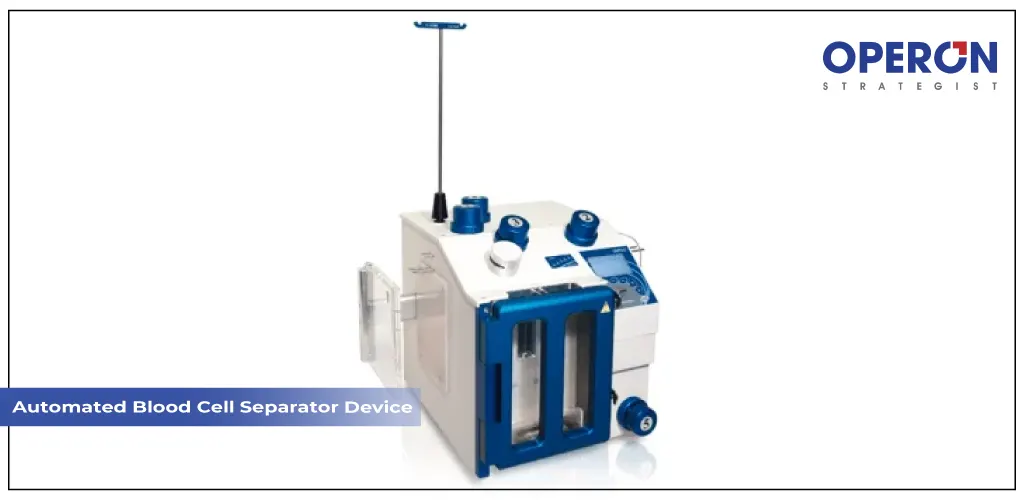
Automated Blood Cell Separator Device
Overview
An Automated Blood Cell Separator is a device that utilizes a centrifugal or filtration separation rule to consequently pull out entire blood from a donor, separate the entire blood into blood components, collect at least one of the blood components, and get back to the donor the rest of the entire blood and blood components. The automated blood cell separator device is planned for routine assortment of blood and blood segments for transfusion or further manufacturing use.
We know about what Blood is and how significant that is for people just as animals. However, what you probably won’t know is the thing that it is made out of. It comprises Formed Elements, which structure 45% of its consistency, and Plasma, which is the streaming fluid that makes it stream framing the remainder of the piece.
Contact Us
- As CE Marking Consultant for medical devices we’ll help you for the process of making a defined technical file with all the product details.
- We will help you in meeting European submission standards that state the product offered is in compliance with the exact requirements of European safety.
In all cases, an Automated Blood Cell Separator calculates the number of cells in these areas to see if it is between the ideal ranges to ensure everything is perfectly fine. An Automated Blood Cell Separator has been created by the National Cancer Institute and International Business Machines Corporation. Improvement of the separator, which can measure up to 100 ml of blood each moment, was declared at the fifteenth yearly Research Equipment Exhibit and Instrument Symposium in Washington, DC.
Also Read: EU MDR Common Pitfalls in Medical Device Compliance
Looking Forward To CE Marking Process For Medical Devices?
We help you in the process of making a defined and comprehensive technical file with all product details required for CE marking.
The Automated Blood Cell Separator can be used for bulk processing of bank blood; or, with incorporation of certain monitoring devices, for the immediate processing of blood from donors. The machine extracts the blood, separates it into fractions and returns the plasma. FDA, are issuing a guidance document related to a Federal Register last standard renaming from class III to class II the Automated Blood Cell Separator device working on a radial partition rule proposed for the normal assortment of blood and blood segments.
The device consequently pulls out entire blood from a donor, separates 3 the entire blood into blood components, gathers at least one of the blood segments, and gets back to the donor the rest of the entire blood and blood segments (apheresis donation). The blood components gathered are bonded or utilized for further manufacture. This guidance applies to Automated Blood Cell Separator devices that work by either outward or filtration division standards or where the proposed use is for the normal assortment of blood and blood segments. FDA has classified these automated blood cell separator devices as class II (special controls).
Automated Blood Cell Separator Approval
The automated blood cell separator device working on a filtration separation principle planned for the normal assortment of blood and blood parts was renamed as class II on February 28, 2003 (68 FR 9530). Unique controls, when joined with general controls, normally address the dangers related with utilization of the device. An automated blood cell separator device operating by centrifugal or filtration separation principle intended for the routine collection of blood and blood components will need to address the issues covered in this special controls guidance.
FDA believes that special controls, when combined with general controls, will be sufficient to provide reasonable assurance of the safety and effectiveness of the automated blood cell separator device operating on a centrifugal or filtration separation principle and intended for the routine collection of blood and blood components. A manufacturer that intends to market a device of this generic type should,
- conform to the general controls of the Federal Food, Drug, and Cosmetic Act (the Act), including the 2 premarket notification requirements described in Title 21 Code of Federal Regulations (CFR), Part 807,
- address the specific risks to health associated with the automated blood cell separator device identified in this guidance, and
- obtain a substantial equivalence determination from FDA prior to marketing the device (see also 21 CFR 807.85).
21 CFR 864.9245 for Automated Blood Cell Separator Approval
Title 21 CFR 864.9245 provides the classification for automated blood cell separators. The automated blood cell separator is a device that operates on a centrifugal or a filtration separation principle intended for the routine collection of blood and blood components.
Classification. Class II (special controls). The special control for this device is guidance for industry and FDA staff entitled “Class II Special Controls Guidance Document: Automated Blood Cell Separator Device Operating by Centrifugal or Filtration Separation Principle.”
For currently marketed products not approved under the premarket approval (PMA) process, the manufacturer should file with FDA for three consecutive years an annual report on the anniversary date of the device reclassification from class III to class II, or, on the anniversary date of 510(k) clearance. Also, a manufacturer of a device determined to be substantially equivalent to the automated blood cell separator device operating by centrifugal or filtration separation principle intended for the routine 4 collection of blood and blood components, should comply with the same general and special controls.
Planning to bring an apheresis or blood-processing system to market
Connect with our regulatory experts to establish your medical device compliance strategy
How Operon Strategist Accelerates Blood Cell Separator Clearances
Bringing an automated blood cell separator device to market demands precise regulatory positioning, technical documentation, and quality controls. Operon Strategist provides end-to-end consulting support tailored to blood collection and separation technology:
Premarket Notification & 510(k) Strategy: Authoring and submitting 510(k) dossiers under 21 CFR 864.9245, identifying appropriate predicate devices, and demonstrating substantial equivalence through US FDA (510(k), QMSR, & Registration) services.
Special Controls & Risk Management: Conducting hazard analyses, software validation, and physical integrity test planning aligned with FDA Special Controls and Design History File (DHF) requirements.
Technical File Compilation for CE Marking: Preparing defined European technical files, Clinical Evaluation Reports (CER), and safety data to meet European submission standards for CE Marking (EU MDR / IVDR).
Annual Reporting & Post-Market Support: Assisting cleared manufacturers with post-market reporting obligations, annual adverse event summaries, change controls, and ongoing Quality Management System (QMS) maintenance.
Turnkey Facility & Plant Layout Engineering: Guidance on cleanroom setup, production workflow design, and facility layout under Plant Layout Detail Engineering and Product Process Engineering for Manufacturing.
Also Read: DHF Requirement for Class I Medical Device
Need a comprehensive technical file for global submissions
Speak with our compliance team to review your test data
FAQ's
What is an automated blood cell separator device?
An automated blood cell separator is a medical device that uses centrifugal or filtration mechanisms to draw whole blood from a donor, isolate specific components (like plasma or platelets), and return the remaining blood to the donor.
What FDA classification applies to automated blood cell separators?
Automated blood cell separators operating on centrifugal or filtration principles are classified as Class II (Special Controls) medical devices under 21 CFR 864.9245.
Is a 510(k) submission required for marketing an apheresis device in the US?
Yes. Manufacturers must submit a 510(k) premarket notification and obtain a substantial equivalence determination from the FDA prior to commercial distribution.
What are the key regulatory requirements for CE marking an automated blood separator?
CE marking under EU MDR requires a complete technical file, software validation, biocompatibility verification, clinical evaluation, and QMS audit by a Notified Body.
What annual reporting is required post-reclassification or clearance?
Manufacturers must submit annual reports to the FDA for three consecutive years following clearance, summarizing adverse events and minor device modifications.