
Co Packaged Combination Product: Regulatory Consulting Guide
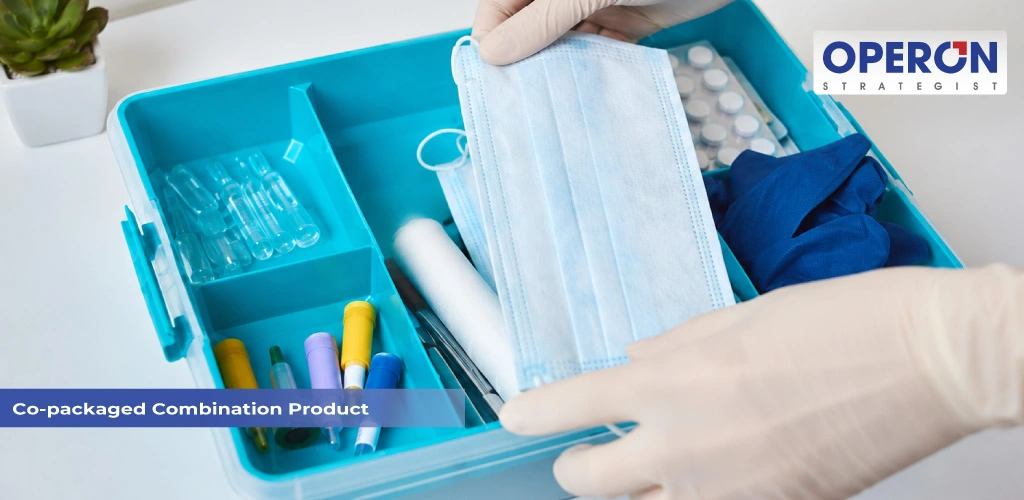
A co packaged combination product consists of two or more components — such as a drug and a device — packaged together as separate items rather than physically or chemically combined. Common examples include first-aid kits, surgical kits, and a drug vial packaged with an empty syringe. In the U.S., co-packaged products are regulated under 21 CFR 3.2(e) and 21 CFR Part 4, with jurisdiction assigned by the FDA’s Office of Combination Products based on Primary Mode of Action (PMOA). In India, classification and licensing depend on whether CDSCO determines the product is drug-led or device-led under the Medical Device Rules, 2017.
Bringing a co-packaged combination product to market means satisfying two regulatory systems at once — drug and device — often under a single submission. Misclassification, incomplete CGMP documentation, or unclear labeling responsibility are the most common reasons these products stall in review. This guide breaks down classification, compliance requirements, and how Operon Strategist helps manufacturers get it right the first time.
Talk to a Combination Product Regulatory Expert
What Is a Co-Packaged Combination Product?
A co-packaged combination product contains two or more individual components — most often a drug and a device — packaged together in a single unit without being chemically or physically combined. Because the components remain physically separate, classification hinges on how they’re intended to be used together, not just what’s in the box.
Common examples:
- An inhaler packaged with a filled drug cartridge
- A drug delivered via a separate delivery mechanism — nebulizer, dropper, or syringe
- Convenience kits, such as first-aid kits or surgical kits
Regulatory expectations have expanded well beyond simply citing an existing device registration (like a 510(k)). Reviewers now expect manufacturers to demonstrate that the drug and device function together as a system — covering functionality, compatibility, and human factors testing to confirm the combination achieves its intended clinical result.
Read Related Blog: Disposable Syringe Manufacturing Guide
Co-Packaged vs. Single-Entity vs. Cross-Labeled: What's the Difference?
FDA defines combination products under 21 CFR 3.2(e) in three configurations, and confusing them is one of the most common classification mistakes manufacturers make:
| Configuration | Definition | Example |
|---|---|---|
| Single-Entity | Components are physically or chemically combined into one product | Drug-eluting stent, prefilled syringe |
| Co-Packaged | Components are packaged together but remain separate items | Surgical kit with device + antiseptic drug |
| Cross-Labeled | Components are packaged separately but labeled for joint use | Light-activated drug labeled for use with a specific light-source device |
The 9 Types of Combination Products
| Type | Description | Common Examples |
|---|---|---|
| 1 | Convenience Kit or Co-Package | First-aid kits, surgical kits |
| 2 | Prefilled Drug Delivery Device/System | Prefilled syringes, auto-injectors, metered-dose inhalers, nasal sprays |
| 3 | Prefilled Biologic Delivery Device/System | Vaccine in a prefilled syringe or auto-injector |
| 4 | Device Coated/Impregnated/Combined with Drug | Drug-eluting stents, antimicrobial-coated catheters, spermicidal condoms, fluoride dental floss |
| 5 | Device Coated or Combined with Biologic | Cell-seeded device scaffolds, extracorporeal columns with bound protein |
| 6 | Drug/Biologic Combination | Antibody-drug conjugates |
| 7 | Separate Products Requiring Cross-Labeling | Light-activated drugs labeled for a specific light source |
| 8 | Possible Combination Based on Cross-Labeling | Drug/biologic in development where device pairing isn’t finalized |
| 9 | Other Part 3 Combination Product | Products combining all three constituent types, or overlapping combination types |
Manufacturers of co-packaged combination products with a device constituent part must establish and maintain CAPA procedures in accordance with 21 CFR 820.100.
How Are Co-Packaged Combination Products Classified? (FDA vs. CDSCO)
United States (21 CFR Part 3 & the FD&C Act)
- Regulated by the FDA’s Office of Combination Products (OCP), established to coordinate jurisdiction across CDER (drugs), CDRH (devices), and CBER (biologics).
- Classification is based on Primary Mode of Action (PMOA) — whichever component provides the primary therapeutic effect determines the lead review center.
- If PMOA is unclear, manufacturers can file a Request for Designation (RFD) — FDA is generally required to respond within 60 days of filing — or seek informal guidance through a Pre-RFD.
- Manufacturers must demonstrate compliance with 21 CFR Part 4, which clarifies how drug CGMPs (21 CFR 210/211) and device QSR/QMSR (21 CFR 820) apply to co-packaged and single-entity combination products, typically using a “streamlined” approach built around one primary system supplemented by specific requirements from the other.
India (CDSCO)
- Governed by the Medical Device Rules, 2017 and the New Drugs and Clinical Trial Rules, 2019.
- CDSCO requires manufacturers to establish whether a product is drug-led or device-led, which determines licensing authority and pathway.
- Proper classification upfront avoids submission delays caused by filing under the wrong regulatory pathway.
Schedule a Compliance Consultation
Ensure FDA QSR Compliance for German Manufacturers with Expert Guidance
Testing & Documentation Requirements
Regulators expect testing that reflects how the product will actually be manufactured and administered — using all intended components and containment materials (vials, stoppers, syringes, etc.), and referencing recognized standards (ISO, USP, ASTM) wherever one exists. Where no standard directly applies, testing should still be designed to evaluate every essential characteristic of the drug’s production and delivery process, referencing the closest applicable standard as a benchmark.
Because a co-packaged product must be evaluated as a system, not as isolated parts, manufacturers need documentation that ties together:
- Device Design History File (DHF) and device QSR/QMSR compliance
- Drug CGMP documentation under 21 CFR 210/211
- Human factors and usability testing showing the drug and device work together as intended
- Combined or cross-referenced labeling and Instructions for Use (IFU)
Common Challenges in Co-Packaged Product Compliance
- Determining Primary Mode of Action (PMOA) — the single most common source of classification delay.
- Harmonizing drug and device documentation standards, since each constituent part typically has its own existing quality framework.
- Usability engineering and human factors testing for the combination as a whole, not just the individual components.
- Managing dual QMS compliance — GMP (drugs) and ISO 13485 (devices) — under a single streamlined system.
- Developing compliant labeling and IFUs that clearly address combined-use instructions.
- Navigating submission timelines without delays caused by incomplete or misaligned documentation between the drug and device sides.
Why Choose Operon Strategist for Combination Product Compliance
✅ Global Regulatory Expertise — experience across FDA, CDSCO, EU MDR, and other major markets
✅ Turnkey Solutions — from PMOA/classification strategy through post-market support
✅ Multidisciplinary Team — dedicated regulatory and quality affairs experts for both drug and device requirements
✅ Client-Centric Approach — customized regulatory pathways for startups and established manufacturers alike
✅ Trusted Partner — 950+ successful projects across 32+ countries
We don’t just consult — we partner with you to get your co-packaged combination product compliant, approved, and to market.
Schedule a Compliance Consultation
Ensure FDA QSR Compliance for German Manufacturers with Expert Guidance
FAQ
What is a co-packaged combination product?
A co-packaged combination product contains two or more components — typically a drug and a device — packaged together as separate items, rather than physically or chemically combined. A surgical kit containing a device and an antiseptic drug is a common example.
What's the difference between co-packaged and single-entity combination products?
Single-entity products are physically or chemically combined into one item (such as a drug-eluting stent), while co-packaged products remain separate items packaged together (such as a drug vial packaged with an empty syringe).
Is a first-aid kit considered a combination product?
Yes. A first-aid kit combining a device (such as bandages) with a drug component (such as an antiseptic) is a common example of a co-packaged combination product.
How does the FDA classify combination products?
FDA classification is based on Primary Mode of Action (PMOA) — whichever constituent part provides the primary therapeutic effect determines which FDA center (CDER, CDRH, or CBER) has lead jurisdiction. Manufacturers can request formal clarification through a Request for Designation (RFD).