
Assistant Manager
Regulatory Affairs | 5.7+ Years of Experience
A medical device label is information that identifies a medical device and provides information on its intended purpose and how to use it safely. If the manufacturer is marketing in the European Union, the labelling is governed by Regulation EU MDR 2017/745.
Most requirements are in Annex 1, Chapter III- 23. They concern the content, format, legibility, symbols, instructions for use (IFU), and information supplied with the device on the label. A compliant label must also consider the device’s intended users and the countries in which it is marketed.
These EU MDR labeling requirements form an important part of medical device labeling regulations in Europe. Manufacturers should ensure that every MDR label provides clear, accurate and appropriate information for the intended user.
Medical Device Label Requirements Under EU MDR
EU MDR requires manufacturers to provide the information needed to identify the device and its manufacturer, along with relevant safety and performance information. The Regulation allows information to be on the device, packaging, or IFU as appropriate.
Consult Annex I, Chapter III Section 23 (23.1, 23.2 and 23.3) for the applicable requirements before designing the label. Some information will differ depending on the device and its intended use.
Mandatory Information on a Medical Device Label
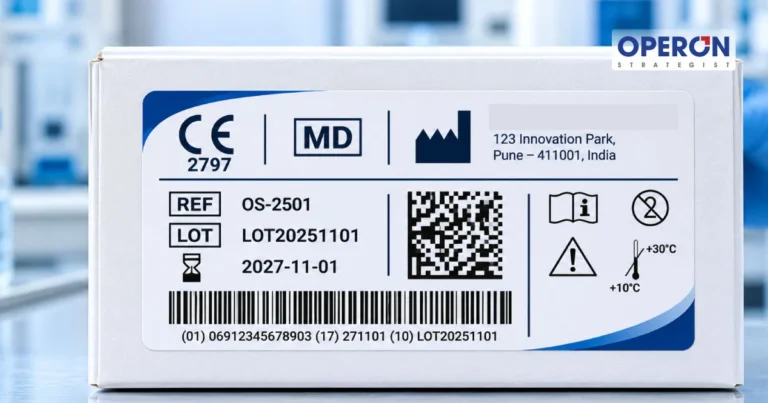
As applicable to the device, the label should include:
- Device name or trade name and information identifying the device and package contents.
- Manufacturer’s registered name and business address.
- Authorised representative’s name and address when the manufacturer is established outside the EU.
- Lot or serial number and the UDI carrier.
- Expiry date, where relevant, or manufacturing date when no safe-use time limit applies.
- Special storage or handling conditions.
- Sterile status and sterilisation method, where applicable.
- Warnings and precautions that require the user’s immediate attention.
- Single-use indication, where applicable.
- The words “custom-made device” or “exclusively for clinical investigation”, where applicable.
- An indication that the product is a medical device.
Certain devices also require specific information about incorporated substances or their composition. For sterile packaging, other information should be included, for example, the sterilisation method, the date of manufacture, period of certification of safe use, and advice in the case of damaged packaging. Refer to the relevant MDR provisions before finalising the artwork.
ISO 15223-1: International Standard Symbols for Use
Symbols can help reduce text on a label and assist in communicating information in various markets with the above information. ISO 15223-1:2021 Medical devices Symbols to be used with medical device labels and instructions for use. Amendment 2025 also updates the definition of authorised representative and the EC REP symbol to EU REP symbol.
Use symbols relevant to the device consistently. If a symbol is not included in a harmonised standard or in the common specifications, explain its meaning in the documentation.
Manufacturers should refer to ISO 15223-1 for medical devices and the applicable EN ISO 15223-1 requirements when they select the symbols for device labels. These medical device labelling standards help maintain consistency in the information supplied with a device.
Verify UDI labelling requirements
The Unique Device Identification (UDI) system supports device identification and traceability. The UDI carrier generally appears on the device label and higher packaging levels, subject to specific exceptions.
The UDI includes a Device Identifier (UDI-DI) and Production Identifier (UDI-PI). The PI can include relevant production information (e.g. expiry date, lot number or serial number, etc). Check the device classification, packaging level and relevant Annex VI rules when deciding where the UDI carrier must appear.
Manufacturers should check UDI labeling requirements for each applicable device and packaging level. The UDI label must carry the required identification information in the format specified by the applicable MDR provisions.
Read next: Medical Device Labeling: Debunking 4 Major Misconceptions
Confirm EU Language Requirements
Language requirements may differ among EU member states and between professional users versus patients/lay users. Manufacturers should verify the country requirements for each intended market before translating the label and IFU.
Refer, MDR – Language requirements for manufacturers – Rev. 3 (August 2025) for languages. This is nevertheless overridden by national law and competent authority requirements. Do not assume an English language or symbol-only label will be adequate for all markets.
Accelerate Market Access with End-to-End Regulatory Guidance
Plan Label Design and Packaging Levels
The label’s size, format, placement, contrast and legibility should suit the device and its intended users. Required information must remain readable throughout storage, handling and use. If space is limited, assess whether information can legally be placed on the unit packaging, outer packaging or IFU. Do not remove mandatory information simply to make the design smaller.
Consider the different packaging levels:
- Primary packaging: Packaging in direct contact with the device.
- Secondary packaging: Outer packaging that groups or protects one or more primary packs.
- Tertiary packaging: Packaging used for bulk handling, storage and transportation.
Verify UDI labeling and data requirements at each relevant level of packaging. The use of an electronic IFU or QR code is possible only when the relevant EU regulations allow it. The use of a QR code does not necessarily replace label information or paper IFU.
When considering e-labeling for medical devices, manufacturers should first confirm whether electronic information is permitted for the specific device and intended users under the applicable EU rules.
Also Read: Medical Device Labeling: Standards, Regulatory Symbols & Compliance
Review Legal Manufacturer and Own-Brand Details
The label must identify the legal manufacturer responsible for the device under the MDR.In case the manufacturer is not within the EU, the label must also contain the information about the authorized representative.
Article 16 deals with situations where an importer, distributor, or other party has taken up responsibilities of the manufacturer, such as putting the device in the market with their own brand. There could be an exception to this rule where the original manufacturer is listed on the label and continues to be liable based on an agreement.
Need help reviewing your EU MDR label? Speak with Operon Strategist’s regulatory team.
EU MDR Label Compliance: Final Review Before Printing
Before releasing a label for production, manufacturers should:
- Map each applicable Annex I requirement to the label, packaging or IFU.
- Verify symbols against the applicable version of ISO 15223-1.
- Confirm UDI-DI and UDI-PI data and carrier placement.
- Check manufacturer and authorised representative details.
- Verify translations for each intended EU market.
- Review legibility, warnings, dates, lot or serial numbers and sterile information.
- Obtain documented review and approval before production.
- Control label revisions so obsolete artwork is not used.
A mistake in labeling can cause problems with traceability and safe use. This can result in non-conformities or actions to be taken. Make sure that labeling is included in your quality management system.
How Operon Strategist Supports EU MDR Medical Device Labelling
Operon Strategist’s ElevatePlus team supports medical device manufacturers with regulatory and compliance activities, including:
- EU MDR regulatory guidance: Support with applicable regulatory requirements and CE marking pathways.
- Label and IFU review: Assessment of label content, symbols, warnings and information supplied with the device.
- UDI and documentation support: Guidance on UDI-related requirements and consistency with technical documentation.
- QMS support: Assistance with quality management system implementation and documentation control.
- Market-specific compliance: Guidance on regulatory requirements for the EU and other target markets.
Explore our CE Marking for Medical Devices service or ELEVATEPlus regulatory consulting.
Preparing a medical device for the European market? Contact Operon Strategist to discuss your regulatory requirements.
Get Your Medical Device Market-Ready with Expert Regulatory Support
FAQ's
What is required on a medical device label under EU MDR?
It must include device identification, manufacturer details, UDI carrier and other applicable information such as lot number, expiry date, warnings and sterile status.
Which standard covers medical device labelling symbols?
ISO 15223-1:2021 specifies symbols used for information supplied by medical device manufacturers. Amendment 1:2025 should also be considered.
Is UDI required on medical device labels?
UDI carrier placement is required under the MDR for applicable devices and packaging levels, subject to specified exceptions.
Can a QR code replace a printed IFU?
Only where electronic IFUs are permitted under applicable EU rules. A QR code does not automatically replace mandatory label information.
Must medical device labels be translated into EU languages?
Language requirements depend on the Member State and intended user. Manufacturers must check the applicable national requirements for each market.