
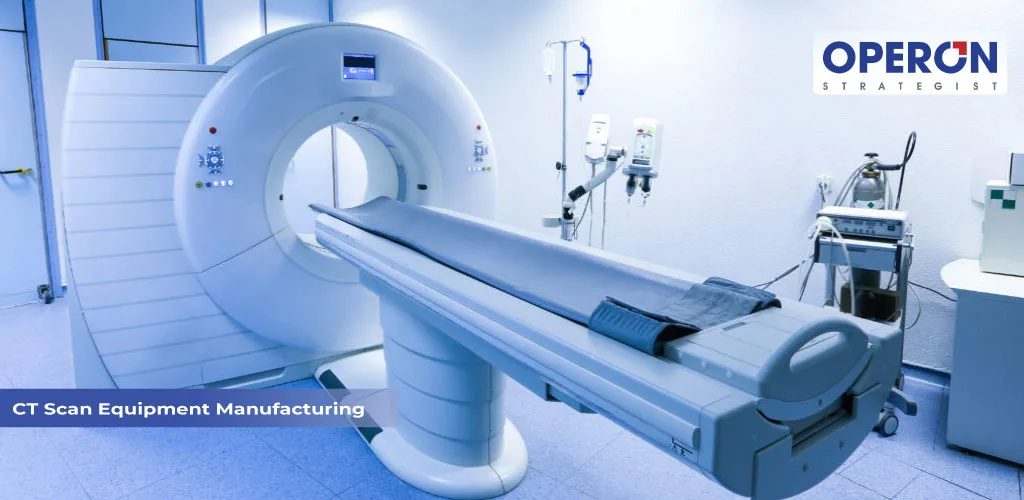
CT Scan Equipment Manufacturing: Regulatory & Technical Guide
Computed Tomography (CT) scan equipment has transformed diagnostic radiology by offering high-resolution cross-sectional and 3D imaging of human anatomy. Unlike traditional 2D radiography, CT scanners capture multiple X-ray attenuation profiles from varied angles, allowing clinicians to detect complex pathologies with sub-millimeter precision.
For medical device manufacturers, CT scan equipment manufacturing presents a high-growth opportunity coupled with complex engineering and strict global regulatory requirements. Establishing a compliant manufacturing line requires seamless integration of precision mechanics, radiation safety systems, and international quality management standards.
Have a project in mind? Get in touch
Understanding CT Scan Equipment Manufacturing
CT scan equipment manufacturing involves integrating complex electrical, mechanical, and software subsystems into a single diagnostic imaging assembly.
During operation, the patient rests on a motorized couch that moves through a rotating gantry. The X-ray source and solid-state detectors spin continuously around the patient, acquiring attenuation data. Advanced computer algorithms process these signals via filtered back-projection or iterative reconstruction to generate accurate anatomical slices.
| CT Scan Generation / Type | Core Technical Characteristics | Primary Medical Application |
| Multi-Detector CT (MDCT) | Multi-row detector arrays capturing up to 640 slices per rotation | Whole-body, emergency, and routine clinical imaging |
| Dual-Source CT (DSCT) | Two X-ray tubes and detectors positioned at 90 degrees | High-speed cardiac imaging and vascular diagnostics |
| Cone Beam CT (CBCT) | Pyramid-shaped X-ray beam with flat-panel detector | Dental, maxillofacial, and ENT imaging |
| PET-CT Hybrid Systems | Combined anatomical CT and metabolic PET detection | Advanced oncology staging and radiation therapy |
Key Components in CT Scan Equipment Manufacturing
Manufacturing high-performance CT scanners requires sourcing and assembling high-precision hardware and software components:
High-Heat Capacity X-Ray Tubes: Generate controlled X-ray photons capable of penetrating dense anatomical structures without thermal degradation.
Solid-State Detector Arrays: Convert attenuated X-ray photons into high-fidelity digital signals with minimal electronic noise.
Rotating Gantry & Slip-Ring Assembly: Houses the X-ray tube, generator, and detectors, rotating continuously at high speed while transferring power and data.
Motorized Patient Table (Couch): Provides ultra-precise longitudinal movement with low radiation attenuation.
High-Performance Image Reconstruction Unit: Processes massive real-time data streams into high-resolution 2D and 3D visual outputs.
Operator Control Console & Acquisition Software: Interface allowing radiographers to calibrate dose protocols, control scans, and review diagnostic images.
Regulatory Compliance for CT Scan Equipment Manufacturing
Because CT scanners emit ionizing radiation, manufacturers must satisfy stringent safety, performance, and quality standards across target jurisdictions before commercial distribution.
1. India (CDSCO Compliance)
Classification: CT scanners are classified under high-risk medical device categories under India’s Medical Device Rules (MDR 2017).
Licensing Requirements: Manufacturers must obtain a Manufacturing License (Form MD-9) from the Central Licensing Authority (CDSCO).
Radiation Safety: Approval from the Atomic Energy Regulatory Board (AERB) is mandatory for layout approval, radiation safety, and type clearance.
2. United States (US FDA)
Classification: Classified primarily as Class II medical devices (21 CFR 892.1750).
Clearance Path: Requires a premarket notification FDA 510(k) demonstrating substantial equivalence to a predicate device.
Radiation Control: Compliance with the Radiation Control for Health and Safety Act (RCHSA) performance standards for ionizing radiation emitting products.
3. European Union (EU MDR 2017/745)
CE Marking: CT scanners fall under Class IIb active diagnostic devices emitting ionizing radiation.
Technical Documentation: Requires a comprehensive Technical Documentation file, Clinical Evaluation Report (CER), and conformity assessment by a Notified Body.
4. Other Global Markets
Saudi Arabia (SFDA): Medical Device Interim Regulation submission and Medical Device Marketing Authorization (MDMA).
United Kingdom (MHRA): UKCA marking compliance and registration under UK Medical Devices Regulations.
Need expert regulatory guidance for your manufacturing setup?
Consult with Operon Strategist’s medical device experts today.
Key Challenges in CT Scan Equipment Manufacturing
Capital-Intensive Infrastructure: Setting up specialized assembly lines, cleanrooms, and radiation-shielded testing bays requires significant initial capital.
Complex OEM Supply Chain Sourcing: Sourcing high-end components such as heavy-duty anode X-ray tubes, slip rings, and scintillation detectors requires robust supplier quality auditing.
Radiation Shielding & Calibrations: Ensuring precise beam collimation and zero leakage radiation demands advanced calibration phantom testing.
Multi-Jurisdictional Regulatory Approvals: Navigating overlapping local radiation safety guidelines (e.g., AERB) and medical device regulations (e.g., CDSCO, FDA).
Clinical Applications in Modern Healthcare
Oncology: Identifying tumor location, tracking metastatic spread, and planning stereotactic radiation treatment.
Cardiology: Performing non-invasive coronary angiography and assessing calcium scoring.
Neurology: Rapidly diagnosing acute ischemic strokes, intracranial hemorrhages, and brain trauma.
Orthopedics: Evaluating complex fractures, joint degeneration, and post-surgical implant alignment.
Optimizing Production for Manufacturing Efficiency
Implement Lean Assembly Lines: Organize work cells specifically for high-voltage testing, mechanical gantry balancing, and final imaging calibration.
Automate Quality Control (QC): Use automated phantom testing software to verify spatial resolution, CT number accuracy, and slice thickness.
Build an ISO 13485 Compliant QMS: Establish robust process controls, design controls, and risk management (ISO 14971) right from the R&D stage.
Partner with Regulatory Specialists: Work alongside specialized medical device consultants to streamline plant design, auditing, and license applications.
How Operon Strategist Can Help
Operon Strategist provides end-to-end consulting for CT scan equipment manufacturers to help them navigate technical hurdles and secure global approvals efficiently:
Turnkey Facility Setup: Design compliant cleanroom layouts, radiation-shielded testing bays, and production workflows tailored for diagnostic equipment.
CDSCO Licensing: Complete guidance for MD-9 manufacturing licenses, factory audits, and AERB radiation type clearance in India.
Global Market Access (FDA & EU MDR): Hands-on support for FDA 510(k) submissions, EU MDR Class IIb technical files, and CE marking.
ISO 13485 QMS Implementation: Assistance in establishing a robust Quality Management System covering design controls, supplier verification, and post-market surveillance.
Audit Preparation & Compliance: Comprehensive mock audits and gap analyses to ensure zero-deficiency outcomes during regulatory inspections.
Planning to launch or scale your CT scanner production line?
Speak with our regulatory specialists to fast-track your approvals.
FAQ's
What regulatory class is a CT scanner?
CT scanners are generally classified as Class II under US FDA rules, Class IIb under EU MDR, and Class C or D under India CDSCO MDR 2017.
Do CT scan manufacturers need AERB approval in India?
Yes. Manufacturers in India must obtain Atomic Energy Regulatory Board (AERB) layout and type approvals for radiation safety alongside CDSCO licenses.
What quality standard is required for CT scanner manufacturing?
An ISO 13485:2016 certified Quality Management System (QMS) is mandatory for design, manufacturing, and regulatory approvals globally.
What is the most critical mechanical component of a CT scanner?
The gantry assembly, which houses the rotating X-ray tube, slip rings, and detector array, is the primary mechanical component.
Can Operon Strategist assist with turnkey plant layout design?
Yes. Operon Strategist offers end-to-end turnkey solutions, including cleanroom design, workflow optimization, and regulatory audit readiness.