
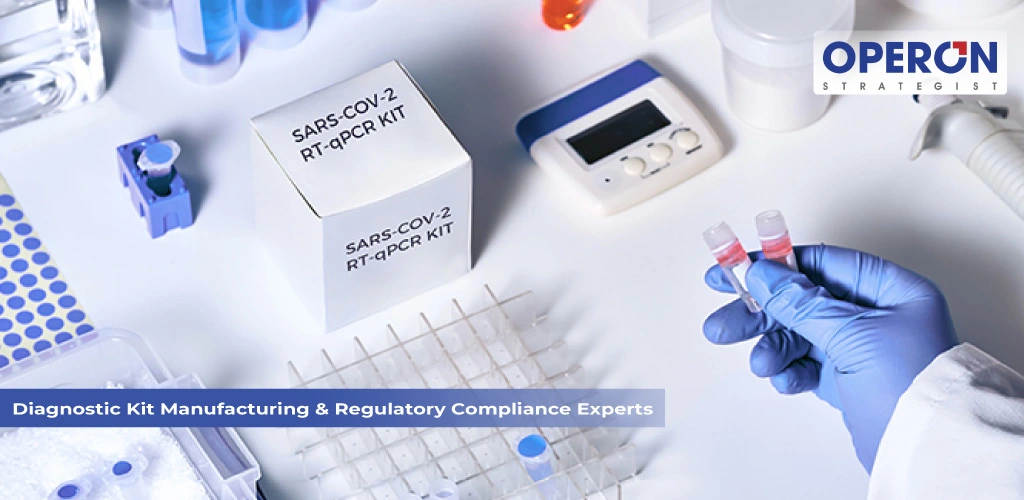
Diagnostic Kit Manufacturing & Regulatory Compliance Experts
Diagnostic kit manufacturing involves much more than producing an assay or test device. Manufacturers must manage research and development, assay design, analytical and clinical performance, manufacturing processes, quality control, regulatory documentation, and post-market surveillance.
Diagnostic kits such as rapid diagnostic tests (RDTs), PCR-based tests, immunoassays, and ELISA kits play an important role in disease detection and clinical decision-making. Because inaccurate results can directly affect patient care, manufacturers must establish robust processes for product performance, manufacturing consistency, and regulatory compliance.
This guide explains the diagnostic kit manufacturing process, key quality requirements, regulatory considerations, and the major steps involved in taking a diagnostic product from development to market.
Looking for Medical Device Regulatory Consultant?
What Is Diagnostic Kit Manufacturing?
Diagnostic kit manufacturing is the process of converting a validated diagnostic assay or test concept into a consistent, controlled, and commercially producible product.
Depending on the type of diagnostic kit, manufacturing may involve:
- Reagent preparation
- Antibody or antigen production
- Primer and probe preparation
- Buffer formulation
- Component assembly
- Device or strip manufacturing
- Filling and packaging
- Labeling
- Quality control testing
- Stability testing
- Final product release
The manufacturing process must be designed to maintain the diagnostic kit’s intended accuracy, reliability, stability, and performance throughout its specified shelf life.
What Are the Main Steps in Diagnostic Kit Manufacturing?
1. Research and Development
The process begins with identifying the clinical need and determining the biological target.
Key activities may include:
- Biomarker identification
- Target selection
- Assay design
- Reagent selection
- Prototype development
- Optimization of test conditions
The objective is to develop an assay that can reliably detect or measure the intended analyte.
For example, molecular diagnostic kits may use specific nucleic-acid targets, while immunoassays may detect particular antigens or antibodies.
2. Assay Development and Optimization
Once the target has been identified, manufacturers develop and optimize the assay.
Important performance characteristics may include:
- Sensitivity
- Specificity
- Accuracy
- Precision
- Limit of detection
- Reproducibility
- Interference
- Cross-reactivity
- Cut-off determination
The appropriate characteristics depend on the intended use and type of diagnostic product.
3. Verification and Validation
Verification and validation provide evidence that the diagnostic kit meets its predefined requirements and is suitable for its intended use.
Analytical Performance
Analytical studies may evaluate:
- Accuracy
- Precision
- Repeatability
- Reproducibility
- Analytical sensitivity
- Analytical specificity
- Measuring range
- Interference
- Cross-reactivity
- Stability
Clinical Performance
Clinical performance studies may be required to demonstrate that the diagnostic kit produces reliable results when used with the intended population, specimen types, and clinical conditions.
The extent of clinical evidence depends on the product, intended purpose, classification, and applicable regulatory framework.
4. Process Development and Scale-Up
A successful laboratory prototype cannot simply be transferred directly into mass production.
Manufacturers must develop controlled and reproducible production processes.
This can include:
- Raw material specifications
- Supplier qualification
- Equipment selection
- Manufacturing procedures
- In-process controls
- Environmental controls
- Batch-size determination
- Process validation
- Packaging development
- Storage conditions
5. Quality Control in Diagnostic Kit Manufacturing
Quality control is essential for maintaining consistency between production batches.
Typical QC activities may include:
- Raw material testing
- In-process testing
- Finished-product testing
- Reagent performance testing
- Stability testing
- Environmental monitoring where applicable
- Packaging inspection
- Label verification
- Batch-release testing
Quality Management System for Diagnostic Kit Manufacturing
A robust Quality Management System (QMS) is a fundamental part of diagnostic kit manufacturing.
Manufacturers commonly establish processes covering:
- Document control
- Design and development
- Supplier management
- Purchasing controls
- Production controls
- Risk management
- Quality control
- CAPA
- Complaint handling
- Change control
- Internal audits
- Training
- Post-market surveillance
ISO 13485 is an important quality management standard for medical devices and is widely relevant to manufacturers operating in the IVD and medical device sectors, subject to applicable regulatory requirements.
Also, read about IVD manufacturing guide.
Diagnostic Kit Manufacturing Plant Requirements
Manufacturers planning a diagnostic kit manufacturing facility should consider the facility requirements early in product development.
Important considerations include:
Facility Layout
The facility should provide logical movement of:
Raw materials → Production → QC → Packaging → Finished goods
Environmental Controls
Depending on the product and process, manufacturers may need controls for:
- Temperature
- Humidity
- Airborne contamination
- Microbial contamination
- Pressure
- Cleanroom conditions
Equipment
Production and testing equipment should be appropriately selected, qualified, calibrated, and maintained.
Material and Personnel Flow
Separate or controlled movement of personnel and materials can help minimize contamination and mix-up risks.
Operon Strategist can support manufacturers with manufacturing facility planning, plant layout, cleanroom requirements, and turnkey manufacturing solutions.
Schedule a Compliance Consultation
Accelerate Market Access with End-to-End Regulatory Guidance
Regulatory Documentation for Diagnostic Kits
Regulatory submissions typically require comprehensive technical and quality documentation.
Depending on the market and product, documentation may include:
- Device description
- Intended purpose
- Classification rationale
- Risk management documentation
- Design and development records
- Analytical performance data
- Clinical performance evidence
- Stability data
- Manufacturing information
- Quality system information
- Labeling
- Instructions for use
- Packaging information
- Post-market surveillance documentation
The exact requirements should be determined according to the target market and applicable regulatory pathway.
How Operon Strategist Supports Diagnostic Kit Manufacturing
Operon Strategist provides regulatory and manufacturing consulting support across the diagnostic product lifecycle.
Our services can include:
- Diagnostic product feasibility assessment
- Regulatory pathway identification
- IVD regulatory consulting
- QMS implementation
- ISO 13485 consulting
- Technical documentation
- Risk management
- Analytical and clinical performance strategy
- Manufacturing facility planning
- Cleanroom and plant-layout guidance
- Process validation strategy
- Regulatory submission support
- Post-market surveillance planning
Our multidisciplinary approach helps manufacturers connect product development, manufacturing, quality, and regulatory requirements into a coordinated market-entry strategy.
Also Read: ENT Medical Devices Manufacturing License in India
Ensure Seamless Regulatory Compliance for Your Device
Get Your Medical Device Market-Ready with Expert Regulatory Support
FAQ's
What are the main steps in diagnostic kit manufacturing?
The main stages include R&D, assay development, verification and validation, process development, scale-up, manufacturing, quality control, regulatory submission, market launch, and post-market surveillance.
What quality standard is used for diagnostic kit manufacturing?
ISO 13485 is a key quality management standard relevant to medical device and IVD manufacturers, subject to the applicable regulatory requirements in the target market.
What testing is required for diagnostic kits?
Testing depends on the product and intended use but may include analytical sensitivity, specificity, accuracy, precision, reproducibility, interference, cross-reactivity, stability, and clinical performance evaluation.
Are diagnostic kits regulated as medical devices?
Many diagnostic kits are regulated as in vitro diagnostic medical devices (IVDs). However, the applicable regulatory classification and requirements depend on the product and jurisdiction.
Why is post-market surveillance important for diagnostic kits?
PMS allows manufacturers to monitor product performance after commercialization, identify emerging issues, evaluate complaints and incidents, and implement corrective or preventive actions when necessary.