
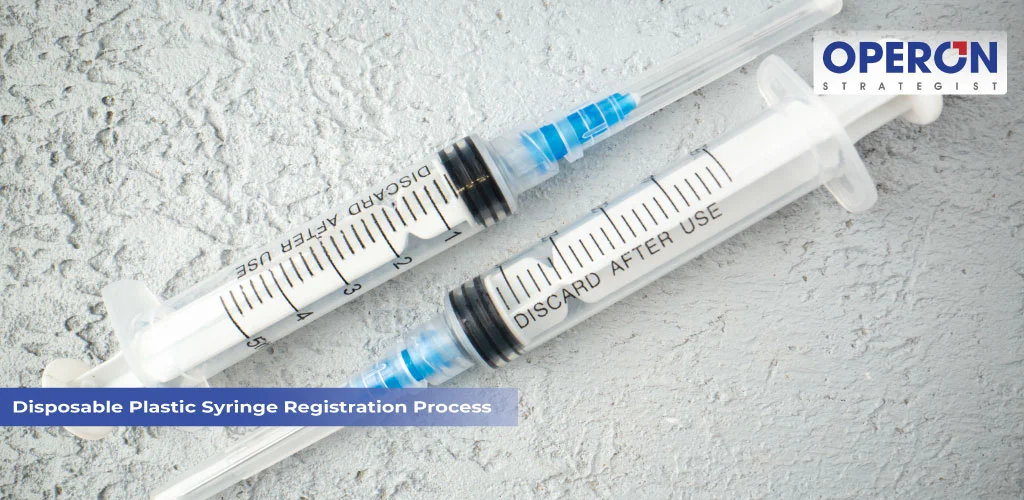
Disposable Plastic Syringe Registration Process (USFDA, European CE, SFDA and Other Regulatory Countries)
Disposable plastic syringes are widely used for administering medications, vaccines, and other injectable products. Because they come into direct contact with patients and may be supplied as sterile, single-use devices, manufacturers must meet strict regulatory, quality, safety, and performance requirements before placing them on the market.
The disposable plastic syringe registration process varies by country. A syringe manufacturer planning to enter the United States, European Union, India, Saudi Arabia, or other regulated markets must first determine the product classification and applicable regulatory pathway.
This guide explains the key requirements for disposable plastic syringe registration in the USFDA, European Union, India through CDSCO, and Saudi Arabia through SFDA, along with the common technical and quality requirements manufacturers should prepare.
Talk to our experts
What Is the Disposable Plastic Syringe Registration Process?
The disposable plastic syringe registration process is the regulatory procedure used to demonstrate that a syringe complies with the applicable safety, performance, quality, labeling, and manufacturing requirements of the target market.
Depending on the country, registration may involve:
- Product classification
- Regulatory pathway determination
- Technical documentation
- Risk management
- Biocompatibility testing
- Sterilization validation
- Performance testing
- Packaging validation
- Clinical or clinical evaluation requirements, where applicable
- Quality management system compliance
- Regulatory submission
- Post-market surveillance
The exact requirements depend on factors such as syringe type, intended use, sterility, capacity, needle configuration, whether the syringe is supplied with a needle, and the claims made for the product.
Disposable Plastic Syringe Registration Process by Country
The regulatory pathway is not identical across countries. The following sections provide an overview of the major markets.
1. United States: USFDA Registration for Disposable Syringes
In the United States, disposable syringes are regulated by the U.S. Food and Drug Administration (FDA) as medical devices.
For many conventional disposable syringes, the applicable pathway is a Class II medical device pathway involving 510(k) premarket notification. However, the exact classification and submission requirements should be confirmed against the specific device, intended use, and applicable FDA product classification.
Key requirements may include:
- FDA device classification
- Identification of an appropriate predicate device
- 510(k) submission, where applicable
- Substantial equivalence assessment
- Device description
- Performance testing
- Biocompatibility information
- Sterilization information, where applicable
- Packaging and shelf-life information
- Labeling and Instructions for Use
- Risk management documentation
- Quality system compliance
A manufacturer may also need to complete FDA establishment registration and device listing after obtaining the applicable market authorization.
How to improve the FDA approval process
A well-prepared 510(k) strategy can help avoid unnecessary review questions. Manufacturers should identify the appropriate product code and predicate device early and ensure that performance, biocompatibility, sterilization, and labeling documentation supports the intended use.
Important: FDA registration is not the same as FDA clearance. For devices requiring 510(k), the manufacturer must obtain the applicable clearance before commercial distribution.
2. European Union: CE Marking Under EU MDR
In the European Union, disposable plastic syringes are regulated under Regulation (EU) 2017/745 on medical devices (EU MDR).
The classification depends on the device’s intended purpose, design, invasiveness, duration of use, sterility, and other applicable classification rules. A conventional syringe may fall under a particular MDR class, but manufacturers should not assume a fixed classification without evaluating the specific product.
For applicable devices, the manufacturer must establish conformity with the MDR before placing the device on the EU market.
Key steps include:
- Determine the device classification.
- Establish the applicable conformity assessment procedure.
- Implement an appropriate quality management system.
- Prepare technical documentation.
- Conduct risk management.
- Complete required testing and evaluation.
- Prepare clinical evaluation documentation.
- Prepare labeling and IFU.
- Complete notified body assessment where required.
- Prepare the EU Declaration of Conformity.
- Affix the CE marking.
- Complete applicable registration and post-market obligations.
For sterile disposable syringes, sterilization and sterile barrier validation are particularly important.
Manufacturers outside the European Union also need to address requirements concerning the EU Authorized Representative, importer, and economic operator responsibilities where applicable.
3. India: CDSCO Registration for Disposable Plastic Syringes
In India, medical devices are regulated by the Central Drugs Standard Control Organization (CDSCO) under the Medical Devices Rules, 2017.
The first step in the disposable plastic syringe registration process in India is determining the device classification based on its intended purpose and applicable classification rules.
Depending on the product and regulatory pathway, manufacturers and importers may need to prepare documentation such as:
- Device Master File
- Plant Master File
- ISO 13485 certificate
- Device specifications
- Risk management documentation
- Performance and safety test reports
- Biocompatibility data
- Sterilization validation
- Packaging validation
- Labeling and IFU
- Clinical evaluation or clinical investigation information, where applicable
- Manufacturer details
- Authorized Indian Agent information for foreign manufacturers
Foreign manufacturers intending to market disposable syringes in India generally need an authorized Indian representative and must follow the applicable CDSCO import licensing pathway.
Why product classification matters in India
CDSCO requirements can vary according to device classification. Therefore, manufacturers should determine the correct classification before preparing the application instead of using a generic registration strategy.
4. Saudi Arabia: SFDA Registration
In Saudi Arabia, medical devices are regulated by the Saudi Food and Drug Authority (SFDA).
Manufacturers planning to market disposable plastic syringes in Saudi Arabia must follow the applicable SFDA medical device regulatory requirements and obtain the required market authorization.
The process generally involves:
- Product classification
- Manufacturer and economic operator information
- Technical documentation
- Product specifications
- Risk management documentation
- Clinical evidence or evaluation, where applicable
- Biocompatibility information
- Sterilization documentation
- Labeling and IFU
- Quality management system documentation
- SFDA submission and review
Foreign manufacturers may also need to work through the applicable Saudi regulatory representative and economic operator structure.
The exact SFDA pathway depends on the product and its classification, so a regulatory assessment should be completed before submission.
Key Technical Requirements for Disposable Plastic Syringes
A successful disposable plastic syringe registration process depends heavily on technical documentation and product testing.
1. Barrel
The barrel is generally manufactured from medical-grade plastic materials such as polypropylene. It must provide adequate transparency, dimensional accuracy, strength, and compatibility with the intended application.
2. Plunger
The plunger must move smoothly through the barrel while maintaining the required seal and preventing leakage.
3. Gasket or Piston
Depending on the syringe design, a gasket or piston may be used to create an effective seal between the plunger and barrel. Material selection and biocompatibility should be appropriately evaluated.
4. Needle
Where the syringe is supplied with a needle, the needle may require separate evaluation for characteristics such as dimensions, sharpness, penetration performance, corrosion resistance, and material safety.
5. Lubricant
Medical-grade silicone oil or another appropriate lubricant may be used to support smooth plunger movement. The manufacturer should assess its compatibility and safety for the intended use.
6. Packaging
Sterile syringes require packaging capable of maintaining sterility throughout the claimed shelf life and under the specified storage and transportation conditions.
Testing Requirements for Disposable Plastic Syringes
Testing requirements vary according to the product design and target market. Depending on the syringe configuration, manufacturers may need to evaluate:
- Dimensional characteristics
- Leakage
- Plunger force
- Breakaway force
- Dead space
- Graduated scale accuracy
- Fluid path integrity
- Material compatibility
- Biocompatibility
- Sterility
- Bacterial endotoxin, where applicable
- Packaging integrity
- Shelf life
- Transportation stability
- Performance after sterilization
Relevant international or national standards should be identified based on the exact product configuration and regulatory market.
Schedule a Compliance Consultation
Accelerate Market Access with End-to-End Regulatory Guidance
Sterilization and Packaging Validation
Sterility is a critical consideration for disposable syringes supplied as sterile medical devices.
Common sterilization technologies include:
- Ethylene oxide (EO)
- Gamma irradiation
- Steam sterilization, where suitable for the product
The manufacturer must validate the selected sterilization process and demonstrate that the process consistently achieves the required sterility assurance level without adversely affecting device performance.
Packaging validation should also demonstrate that the sterile barrier remains intact throughout the claimed shelf life and expected distribution conditions.
Quality Management System Requirements
A compliant quality management system is an important part of the disposable plastic syringe registration process.
ISO 13485 is widely used as the quality management standard for medical device manufacturers and may be required or strongly expected depending on the target market and regulatory pathway.
The quality system should cover areas such as:
- Design and development
- Supplier controls
- Incoming material inspection
- Manufacturing controls
- Process validation
- Sterilization
- Packaging
- Traceability
- Nonconforming products
- Corrective and preventive actions
- Complaint handling
- Post-market surveillance
For manufacturers producing disposable syringes at scale, maintaining consistent manufacturing and inspection controls is essential for both regulatory compliance and product quality.
Common Documents Required for Syringe Registration
Although requirements vary by country, manufacturers should generally be prepared with:
- Company and manufacturer information
- Device description
- Intended use
- Product specifications
- Manufacturing process information
- Bill of materials
- Risk management file
- Biological evaluation
- Performance test reports
- Sterilization validation
- Packaging validation
- Shelf-life data
- Clinical evaluation, where applicable
- Labeling
- Instructions for Use
- Quality management system certificates
- Declaration of Conformity or equivalent documents
- Existing regulatory approvals, where applicable
A country-specific document checklist should be prepared before starting the registration process.
How Operon Strategist Can Help With Disposable Plastic Syringe Registration
The disposable plastic syringe registration process can involve multiple technical, quality, and regulatory requirements, particularly when a manufacturer plans to enter several international markets.
Operon Strategist provides medical device regulatory consulting and market-entry support for manufacturers, importers, startups, and international medical device companies.
Our support can include:
- Regulatory classification
- USFDA 510(k) consulting
- EU MDR and CE Marking support
- CDSCO registration and import licensing
- SFDA medical device registration
- ISO 13485 implementation and certification support
- Technical documentation
- Risk management documentation
- Device Master File and Plant Master File preparation
- Biocompatibility and performance testing guidance
- Sterilization and packaging validation support
- Regulatory submission support
- Regulatory query response
- Post-market compliance guidance
Operon Strategist can also support broader medical device projects, including QMS implementation, validation documentation, manufacturing facility planning, medical device feasibility studies, regulatory strategy, and turnkey medical device projects.
By assessing the product, target markets, classification, testing requirements, and documentation needs at the beginning, manufacturers can build a more efficient regulatory pathway and reduce avoidable submission issues.
Read Next: Point-of-Care Testing Devices Manufacturing: Compliance Guide.
Ensure Seamless Regulatory Compliance for Your Device
Get Your Medical Device Market-Ready with Expert Regulatory Support
FAQ
What is the plastic syringe registration process?
The plastic syringe registration process involves obtaining regulatory approval from authorities like USFDA, EU MDR, CDSCO, or SFDA to ensure the product meets safety, quality, and performance standards before market entry.
Is a 510(k) required for disposable plastic syringes in the US?
Yes, most disposable plastic syringes are classified as Class II medical devices and require a 510(k) premarket notification to demonstrate substantial equivalence with an already approved device.
What is the classification of disposable syringes in Europe?
Under EU MDR 2017/745, disposable syringes are generally classified as Class IIa medical devices and require CE marking through a notified body assessment.
Is ISO 13485 mandatory for syringe registration?
Yes, ISO 13485 certification is mandatory or highly recommended in most countries as it ensures a compliant quality management system for medical device manufacturing.