
Classification of Drug-Device Combination Products: Complete Guide
The classification of drug-device combination products depends on the product’s Primary Mode of Action (PMOA), intended purpose, and how the drug and device components are integrated. Regulatory authorities such as the FDA and the European Union (EU) use classification to determine which regulations apply, the appropriate approval pathway, and the documentation required for market authorization.
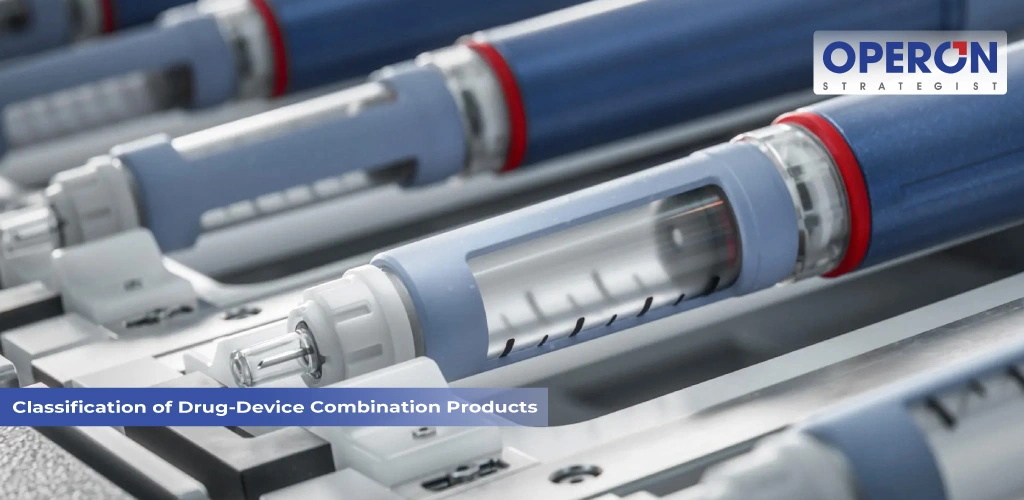
Drug-device combination products are transforming modern healthcare by combining pharmaceuticals and medical devices into integrated therapeutic solutions. Products such as prefilled syringes, insulin pens, drug-eluting stents, transdermal patches, and improve treatment accuracy, enhance patient convenience, and support better clinical outcomes.
However, before these products can be marketed, manufacturers must determine how they are classified. This is one of the most critical decisions in the product development lifecycle because classification determines the applicable regulatory framework, conformity assessment process, documentation requirements, and regulatory authority responsible for the review.
In this guide, you’ll learn how drug-device combination products are classified, the role of Primary Mode of Action (PMOA), the different categories of combination products, and how classification differs between the FDA and the European Union.
Talk to our experts
Regulatory Classification Overview
Aspect | Details |
Focus | Classification of Drug-Device Combination Products |
Key Determinant | Primary Mode of Action (PMOA) |
Main Regulatory Authorities | FDA, EMA, Competent Authorities, Notified Bodies |
Applicable Regulations | FDA Combination Product Regulations, EU MDR (EU) 2017/745 |
Classification Outcome | Drug-led, Device-led, or Biologic-led |
What Is the Classification of Drug-Device Combination Products?
The classification of drug-device combination products is the regulatory process of determining which component of the product—drug, medical device, or biologic—provides the principal therapeutic effect. This decision establishes the product’s regulatory pathway and identifies the authority responsible for reviewing the submission.
Unlike standalone medical devices or pharmaceuticals, combination products integrate two or more regulated components into a single therapeutic solution. As a result, regulators evaluate not only the individual components but also how they interact to achieve the intended clinical outcome.
Classification influences several aspects of product development, including:
- Applicable regulatory framework
- Product development strategy
- Technical documentation requirements
- Clinical evidence expectations
- Conformity assessment procedures
- Market authorization pathway
- Post-market surveillance obligations
Manufacturers should complete the classification assessment early in product development to avoid regulatory uncertainty later in the process.
Why Is Classification Important?
Product classification is more than a regulatory formality—it forms the foundation of an effective regulatory strategy.
A correct classification helps manufacturers:
- Identify the applicable regulations
- Determine the appropriate approval pathway
- Prepare the required technical documentation
- Plan clinical and performance studies
- Understand quality management requirements
- Reduce regulatory risks and approval delays
On the other hand, an incorrect classification can result in duplicate testing, additional regulatory submissions, increased costs, and significant delays in bringing the product to market.
For innovative combination products, early classification discussions with regulatory experts can help establish a clear development roadmap and minimize compliance risks.
Understanding Primary Mode of Action (PMOA)
The Primary Mode of Action (PMOA) is the key factor used to classify a drug-device combination product. It refers to the component—drug, device, or biologic—that provides the primary therapeutic effect and determines the applicable regulatory pathway.
Drug-Led Combination Products
The drug provides the primary therapeutic effect, while the device delivers or administers it.
Examples:
- Prefilled syringes
- Auto-injectors
- Metered-dose inhalers
- Transdermal patches
Device-Led Combination Products
The device provides the primary therapeutic effect, with the drug serving a supporting role.
Examples:
- Drug-eluting stents
- Drug-coated balloons
- Antimicrobial catheters
Biologic-Led Combination Products
The biologic provides the primary therapeutic effect, while the device or drug supports its delivery.
Examples:
- Cell therapy delivery systems
- Tissue-engineered products
Schedule a Compliance Consultation
Accelerate Market Access with End-to-End Regulatory Guidance
Types of Drug-Device Combination Products
Combination products are classified based on how the drug and device components are integrated. The main categories are:
Single-Entity Combination Products
The drug and device are physically combined into one product.
Examples:
- Prefilled syringes
- Insulin pens
- Drug-eluting stents
Co-Packaged Combination Products
Separate drug and device components are packaged together for use as one therapeutic system.
Examples:
- Surgical kits
- Infusion systems with drugs
Cross-Labeled Combination Products
The drug and device are marketed separately but intended to be used together.
Examples:
- Drugs for specific infusion pumps
- Diagnostic agents with designated devices
Convenience Kits
Multiple regulated products are packaged together for convenience, while each component generally retains its own regulatory status.
Examples:
- Procedure packs
- Surgical kits
FDA vs EU Classification of Drug-Device Combination Products
Although the FDA and the European Union share the common goal of ensuring the safety and effectiveness of drug-device combination products, their approaches to classification differ.
The FDA determines the regulatory pathway based on the product’s Primary Mode of Action (PMOA) through the Office of Combination Products (OCP). The OCP assigns the product to the appropriate lead center—Center for Drug Evaluation and Research (CDER), Center for Devices and Radiological Health (CDRH), or Center for Biologics Evaluation and Research (CBER).
In contrast, the European Union evaluates combination products under EU MDR (EU) 2017/745, medicinal product legislation, and related guidance. Depending on the product, regulatory assessment may involve Competent Authorities, the European Medicines Agency (EMA), and Notified Bodies, particularly where Article 117 applies.
FDA vs EU Classification Comparison
Classification Aspect | United States (FDA) | European Union (EU) |
Lead Authority | Office of Combination Products (OCP) | Competent Authorities / EMA / Notified Bodies |
Key Classification Factor | Primary Mode of Action (PMOA) | PMOA, intended purpose, product integration |
Applicable Regulations | FDA Combination Product Regulations | EU MDR (EU) 2017/745 + Medicinal Product Legislation |
Device Assessment | ||
Additional Requirement | Depends on product type | Article 117 (where applicable) |
Although both systems rely heavily on PMOA, manufacturers should avoid assuming that a product classified under one regulatory framework will automatically follow the same pathway in another jurisdiction. Early regulatory planning for each target market is essential.
Best Practices for Combination Product Classification
A well-defined classification strategy supports efficient product development and smoother regulatory approval. Consider these best practices:
Evaluate PMOA Early
Determine which component provides the primary therapeutic effect during the initial stages of product development.
Assess the Entire Product
Review the design, intended purpose, mechanism of action, and interaction between all regulated components rather than focusing on a single element.
Understand Market Requirements
Classification should be assessed separately for each target market to ensure compliance with regional regulations.
Develop Regulatory and Technical Documentation Together
Maintaining complete documentation throughout development supports classification decisions and future regulatory submissions.
Seek Regulatory Expertise
Complex or innovative products often benefit from early consultation with regulatory specialists who can help identify the most appropriate pathway and avoid costly compliance issues.
For innovative drug-device combination products, classification is not simply an administrative step—it shapes the entire regulatory strategy. Decisions made during classification influence clinical evidence, quality management, technical documentation, conformity assessment, and ultimately the product’s timeline to market. Investing time in a thorough classification assessment early in development can prevent significant delays later in the regulatory process.
How Operon Strategist Supports Combination Product Classification
Determining the correct classification for a drug-device combination product requires a clear understanding of regulatory expectations across multiple jurisdictions. Operon Strategist helps manufacturers develop robust classification strategies that align with product design, intended use, and commercialization goals.
Our expertise includes:
- Product classification and regulatory pathway assessment
- Primary Mode of Action (PMOA) evaluation
- FDA and EU regulatory strategy
- Technical documentation planning
- Article 117 and EU MDR compliance
- CE Marking strategy
- Risk management documentation
- Global regulatory consulting for combination products
Whether you are developing a novel combination product or expanding into international markets, our team supports every stage of the regulatory journey.
Ensure Seamless Regulatory Compliance for Your Device
Get Your Medical Device Market-Ready with Expert Regulatory Support
FAQ's
What is the classification of a drug-device combination product?
Classification is the regulatory process used to determine whether a combination product is primarily regulated as a drug, medical device, or biologic based on its Primary Mode of Action (PMOA), intended purpose, and product design.
What is the Primary Mode of Action (PMOA)?
The Primary Mode of Action is the single mode of action that provides the product’s principal therapeutic effect. It is the primary factor used by regulators to determine the applicable regulatory pathway.
What are the different types of drug-device combination products?
The main categories include single-entity combination products, co-packaged combination products, cross-labeled combination products, and convenience kits, depending on how the drug and device components are integrated or supplied.
Who determines the classification of a combination product?
In the United States, the FDA’s Office of Combination Products determines the lead regulatory pathway. In the European Union, classification is assessed under EU MDR, medicinal product legislation, and guidance from Competent Authorities, the EMA, and Notified Bodies where applicable.
Can the same product be classified differently in different countries?
Yes. Regulatory requirements vary between jurisdictions, and manufacturers should evaluate classification separately for each target market.