
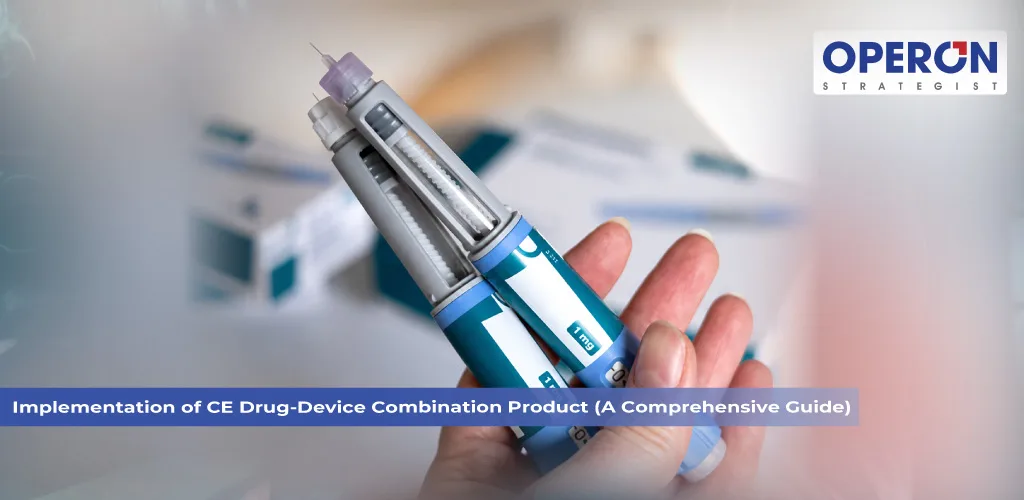
CE Marking for Drug-Device Combination Products: EU MDR Compliance Guide
CE Marking for drug-device combination products depends on how the product is classified under the EU regulatory framework.
While standalone medical devices require CE Marking before being placed on the European market, certain integral drug-device combination products are assessed under medicinal product legislation and may instead require compliance with Article 117 of EU MDR, including a Notified Body Opinion for the device component where applicable.
Need Support with EU MDR Compliance?
Introduction
Bringing a drug-device combination product to the European market involves more than developing an innovative therapy. Manufacturers must demonstrate that the product meets applicable regulatory requirements for safety, quality, and performance before commercialization.
One of the most common areas of confusion is CE Marking. Many manufacturers assume that every combination product must obtain a CE certificate, while others believe medicinal products are entirely exempt from medical device regulations. In reality, the applicable pathway depends on the product’s classification, intended purpose, and the role of the medical device component.
Understanding when CE Marking is required, how Article 117 applies, and when a Notified Body must be involved is essential for avoiding regulatory delays and ensuring a successful market entry strategy. This guide explains the CE Marking process for drug-device combination products under EU MDR (EU) 2017/745, helping manufacturers understand the key regulatory requirements and compliance steps.
Regulatory Snapshot
Requirement | Details |
Regulation | EU MDR (EU) 2017/745 |
Applicable Products | Drug-Device Combination Products |
Key Requirement | CE Marking or Article 117 Compliance |
Notified Body | Required in specific cases |
Main Objective | Demonstrate safety, performance and conformity |
What Is CE Marking for Drug-Device Combination Products?
The CE Marking indicates that a medical device complies with the applicable requirements of EU MDR (EU) 2017/745 and can be legally placed on the European market. For drug-device combination products, however, the regulatory pathway is more complex because the product combines medicinal and medical device components.
The applicable conformity assessment depends on several factors, including:
- Product classification
- Primary Mode of Action (PMOA)
- Degree of integration
- Intended purpose
- Risk classification
- Whether the device component is marketed separately or forms an integral part of the medicinal product
As a result, some combination products require a traditional CE Marking process, while others follow the medicinal product pathway supported by Article 117.
Which Combination Products Require CE Marking?
Not every combination product follows the same conformity assessment process. The applicable requirements depend on the product design and regulatory classification. Generally, CE Marking is required when the medical device component is regulated independently under the EU MDR or when the applicable conformity assessment requires certification before market placement.
Examples include:
- Drug-eluting stents
- Drug-coated balloons
- Certain reusable administration devices
- Co-packaged medical device combination products
- Standalone medical devices supplied with medicinal products
Manufacturers should determine the regulatory pathway during product development to avoid delays caused by incorrect classification or incomplete documentation.
Expert Insight
A common misconception is that CE Marking and Article 117 are interchangeable. In practice, Article 117 does not replace CE Marking. Instead, it introduces additional evidence requirements for specific integral drug-device combination products regulated under the medicinal product framework. Identifying the correct pathway early helps manufacturers avoid unnecessary testing, documentation gaps, and regulatory delays.
Navigate CE Marking for Drug-Device Combination Products with Confidence
Connect with our regulatory experts to discuss your product and CE marking requirements.
Understanding Article 117 and Its Impact on CE Marking
One of the most significant changes introduced by EU MDR (EU) 2017/745 for drug-device combination products is Article 117. It strengthens the regulatory assessment of the medical device component when it forms an integral part of a medicinal product. Under Article 117, manufacturers must demonstrate that the integrated device complies with the relevant General Safety and Performance Requirements (GSPRs) of the EU MDR. If the device component is not already CE marked for its intended purpose and requires the involvement of a Notified Body, the Marketing Authorization Application (MAA) must include a Notified Body Opinion confirming its conformity.
It is important to understand that Article 117 does not replace CE Marking. Instead, it provides an additional conformity assessment pathway for specific integral combination products regulated primarily as medicinal products.
Learn more – Navigating the European NB Opinion Process for Drug-Device Combination Products.
Role of Notified Bodies in CE Marking
Notified Bodies are independent organizations designated by European authorities to assess whether medical devices comply with the requirements of the EU MDR. For drug-device combination products, their involvement depends on the product classification and applicable conformity assessment route.
A Notified Body may be responsible for:
- Reviewing the medical device component against applicable GSPRs
- Assessing technical documentation
- Evaluating risk management evidence
- Reviewing design and manufacturing controls
- Issuing a CE Certificate for applicable devices
- Providing a Notified Body Opinion under Article 117 where required
Expert Insight
Manufacturers often focus on obtaining a CE Certificate without first confirming whether the product actually requires one. Understanding the distinction between traditional CE Marking and the Article 117 pathway is one of the most effective ways to prevent unnecessary costs and regulatory delays.
How Operon Strategist Supports CE Marking for Drug-Device Combination Products
Achieving CE Marking for a drug-device combination product requires expertise in both medical device regulations and medicinal product requirements. Operon Strategist supports manufacturers through every stage of the compliance process, helping them build an efficient and well-documented regulatory strategy.
Our services include:
- Regulatory pathway assessment
- Product classification and PMOA evaluation
- Article 117 compliance support
- Technical documentation preparation and review
- GSPR gap assessments
- CE Marking strategy
- Quality Management System implementation
- Risk management documentation
- Global regulatory consulting for combination products
Also Read: Key Regulatory Challenges for Drug-Device Combination Products
Planning CE Marking for Your Drug-Device Combination Product?
Connect with our regulatory experts to simplify your CE Marking journey.
FAQ's
Do all drug-device combination products require CE Marking?
No. The requirement for CE Marking depends on the product’s classification, intended purpose, and regulatory pathway. Certain integral combination products are regulated primarily as medicinal products and may instead require compliance with Article 117.
What is the difference between CE Marking and Article 117?
CE Marking demonstrates that a medical device complies with EU MDR requirements. Article 117 applies to specific integral drug-device combination products and requires evidence that the integrated device component meets applicable GSPRs, often supported by a Notified Body Opinion.
What is a CE Certificate?
A CE Certificate is issued by a Notified Body after successful conformity assessment of applicable medical devices under the EU MDR. It confirms that the device meets the required regulatory standards for placement on the European market.
When is a Notified Body required?
A Notified Body is required when the applicable conformity assessment procedure involves independent evaluation under the EU MDR or when a Notified Body Opinion is needed under Article 117.
What documentation is required for CE Marking?
Manufacturers should prepare technical documentation that includes product specifications, GSPR compliance, risk management, verification and validation evidence, clinical evaluation where applicable, labeling, and quality management records.
Can CE Marking accelerate market access?
Yes. A well-planned CE Marking strategy helps reduce regulatory delays, improve submission quality, and support timely access to the European market.