
Senior Executive – Regulatory Affairs
Regulatory affairs professional with an M.Pharm in Regulatory Affairs
Introduction to Nephrology and Renal Care Device Category
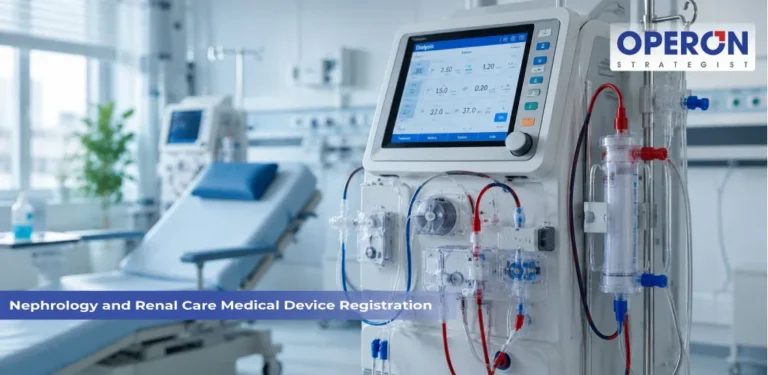
Nephrology is the medical field dedicated to kidney-related issues, encompassing conditions like kidney disease, infections, and hypertension. Renal care devices comprise various tools aiding diagnosis and treatment, including dialysis machines for blood filtration, peritoneal dialysis equipment for at-home treatment, biopsy needles for tissue sampling, and electrolyte management tools. These devices play a pivotal role in enhancing patient care and outcomes by supporting kidney function assessment, treatment, and monitoring.
Operon Strategist will assist you in Nephrology and Renal Care Medical Device Registration Process. Contact us today!
Information About an Update on Compulsory Registration for Class C and D Medical Devices
The Central Drugs Standard Control Organization (CDSCO) has issued a circular announcing a shift in the regulatory framework for Class C and Class D (non-notified) medical devices. These devices, previously subject to mandatory registration, will now fall under a licensing system as per GSR 102(E) dated 11.02.2020. This transition will become effective from October 1, 2023.
Manufacturers and importers seeking manufacturing or import licenses for Class C and Class D medical devices must follow the Medical Devices Rules (MDR) 2017. They are advised to apply through CDSCO’s online portal, providing necessary documents and fees.
Please refer to the official circular here.
List of Class C and D Nephrology and Renal Care Medical Devices -
Take a look at a couple of products categorized under Class C and Class D Nephrology and Renal Medical Devices –
Sr. No. | Device Name | Risk Class |
1. | Dialysis apheresis unit, Therapeutic | C |
2. | Kidney donor-organ preservation/transport system | C |
3. | Kidney stone filter | C |
4. | Haemodialysis system central monitor | C |
5. | Absorbable peritoneum catheter cuff | D |
Please review the complete assortment of Class C and D Dental Medical Devices provided here.
Documents Required for CDSCO Manufacturing License of Class C and Class D Nephrology and Renal Medical Devices
Obtaining a CDSCO manufacturing license involves a comprehensive dedication to adherence, encompassing precise facility requirements, systematic procedures, and thorough record-keeping. This steadfast strategy ensures the development of medical devices that consistently meet stringent standards for both quality and safety.
Documents Required for CDSCO Import License of Class C and Class D Nephrology and Renal Medical Devices
Acquiring a CDSCO import license requires obtaining Approval and Free Sale Certificates from well-known international regulatory authorities such as the USA, EU, Japan, Australia, and Canada. These certificates validate adherence to global quality standards and unrestricted market acceptance, underscoring their crucial role in ensuring safety and import excellence.
Elevate your venture into the realm of Nephrology and Renal Care Medical Device Registration with Operon Strategist. As your unwavering partner, we specialize in the intricacies of regulatory compliance, ensuring a seamless and triumphant journey toward manufacturing and import licenses. Our tailored solutions cater to both industry veterans and newcomers, making complex processes accessible. With Operon Strategist, you gain a proven track record, expert insights, and a dedicated ally to simplify your pursuit of licensing excellence in the nephrology and renal sector. If you’re looking for help in this area, get in touch with us today!
Also Read: Regulatory Requirements for Dialysis Machines.
Get Your Medical Device Market-Ready with Expert Regulatory Support
FAQ's
What is the difference between renal and nephrology?
“Renal” is an adjective that refers specifically to matters related to the kidneys. It’s used to describe anything pertaining to the kidneys themselves or their function. For example, renal function refers to how well the kidneys are working to filter waste and regulate various bodily processes.
“Nephrology” is a medical specialty that focuses on the diagnosis, treatment, and management of kidney-related conditions and diseases. Nephrologists are medical doctors who specialize in this field. They are trained to diagnose and treat a wide range of kidney disorders, including kidney infections, kidney stones, chronic kidney disease, and more.
What is a renal care?
Renal care involves medical attention and treatments aimed at maintaining kidney health and treating kidney-related issues.
What medical device classification is a dialysis machine?
A dialysis machine is typically classified as a Class II medical device in the United States by the U.S. Food and Drug Administration (FDA). Class II devices are considered to have a moderate to high risk level and require specific controls to ensure their safety and effectiveness.
Senior Executive – Regulatory Affairs
Regulatory affairs professional with an M.Pharm in Regulatory Affairs, specializing in medical device registration, regulatory documentation, and regulatory requirements. Her expertise includes regulatory submission support and medical device compliance with applicable international standards.